Steam Wishlist Deletions: Normal Rates, Spikes and What to Do
What counts as a Steam wishlist deletion, normal delete rates (median 7.75%), why deletes spike in sales, and how to read your Steamworks report.
Short answer: A Steam wishlist deletion is a player removing your game from their wishlist without buying it, and every game gets them. Valve's wishlist reporting page tracks "additions, purchases, and deletions" as separate lines, so a sale that converts wishlists also lowers your outstanding balance without a single delete. Across 58 developers surveyed by How To Market A Game, the median game lost 7.75% of its wishlists to deletes and the average was 9.8%. Deletions spike when Steam sales start, because players clean their lists while hunting deals, and the biggest spike for almost every game graphed lined up with the Summer Sale. If your rate sits near those numbers, nothing is broken. Keep adding wishlists faster than you lose them.
What counts as a deletion in your Steamworks wishlist report
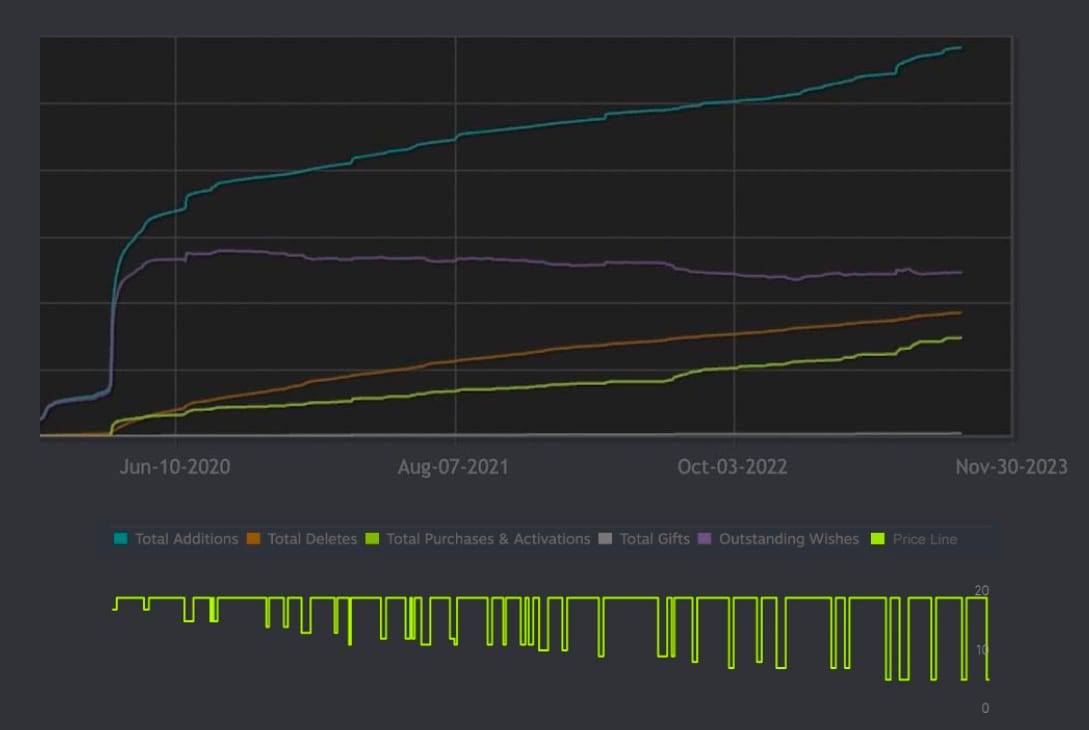
Open your app in the Sales & Activation Reports portal and find the "Wishlists" section. Valve's wishlist documentation says this section "tracks additions, purchases, and deletions by users that have your game on their wishlist." The full report page plots several running totals. In a real Steamworks chart shared by GameDiscoverCo, the legend reads Total Additions, Total Deletes, Total Purchases & Activations, Total Gifts and Outstanding Wishes.
| Report line | What it means | Is it bad? |
|---|---|---|
| Additions | A player added your game to their wishlist | Good |
| Deletes | A player removed your game without buying it on Steam | Normal in small amounts |
| Purchases & Activations | A wishlister got the game, so it left their wishlist as a conversion | Good |
| Gifts | Wishlist activity tied to gifting | Usually tiny |
| Outstanding Wishes | Your current balance: additions minus everything that left | Depends on why it moved |
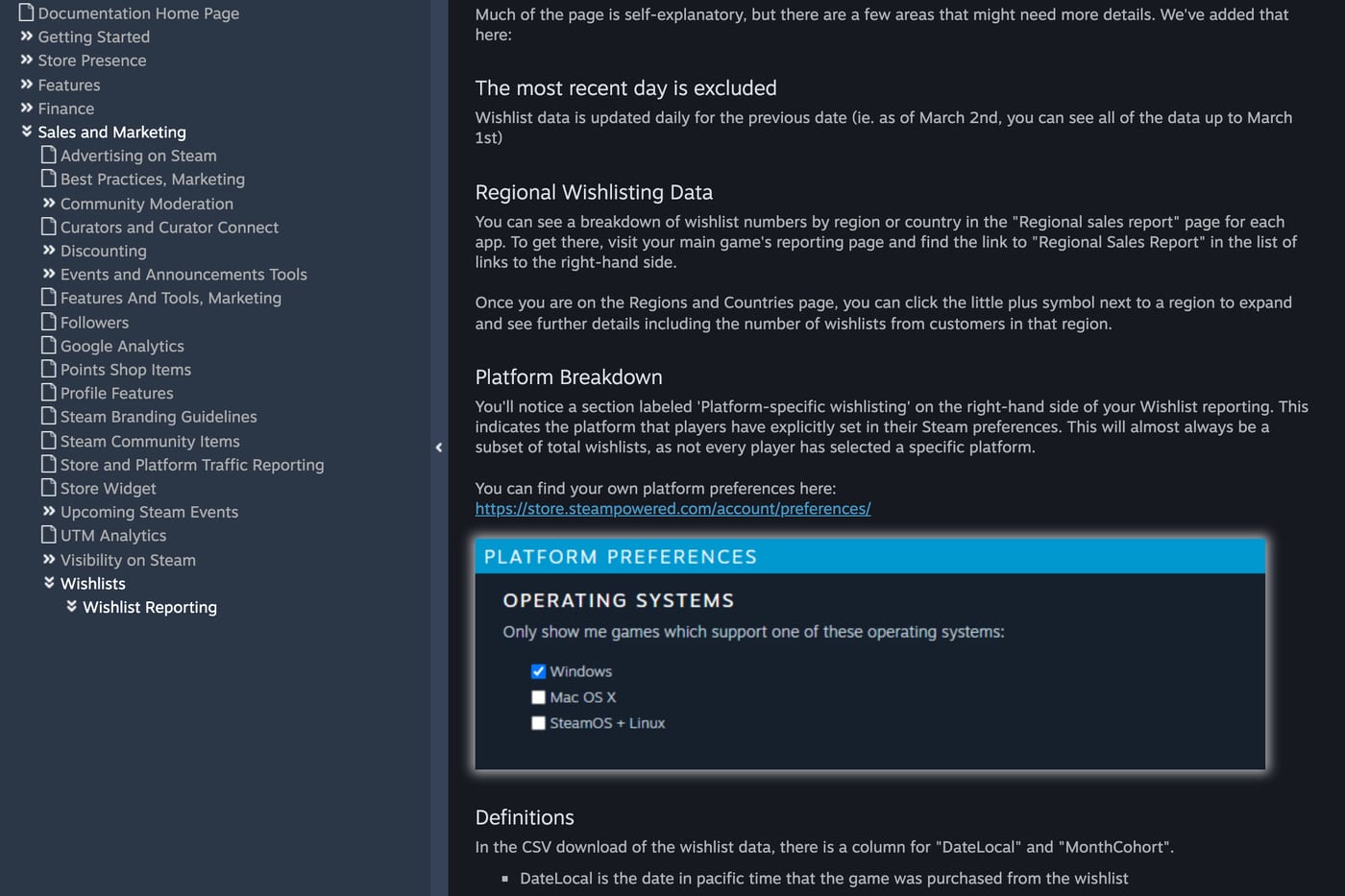
A few details from Valve's reporting page matter when you read a drop:
- The latest day is missing. Data "is updated daily for the previous date," so on March 2nd you see everything up to March 1st. A number that looks flat today may just be yesterday's data.
- The CSV has cohorts. The download includes "DateLocal" (the Pacific time date the game was purchased from the wishlist) and "MonthCohort" (the month the player first wishlisted). That lets you check whether old or new wishlisters are the ones leaving or buying.
- Regional splits live elsewhere. Wishlists by country sit in the "Regional sales report" page, not the main wishlist page.
If you want daily deletes in a readable chart, the Steam Wishlist Chart tool on How To Market A Game takes the "Wishlist Action Summary, all history" CSV. Its expected header row is DateLocal, Game, Adds, Deletes, PurchasesAndActivations, Gifts, which confirms that deletes and purchases are separate columns in the export. For the basics of finding these screens, see our guide on how to see your Steam wishlists.
Why your wishlists go down even when nobody deletes
The most common reason a developer searches "why are my Steam wishlists going down" is a launch or a discount. When a wishlister buys your game, the entry leaves their list and lands in Purchases & Activations, not Deletes. Your Outstanding Wishes line drops, and that drop is revenue.
GameDiscoverCo's chart of an anonymous premium game shows this over 3.5 years and roughly 40 discounts. Total deletes and total purchases both climb steadily, additions climb faster, and the outstanding balance drifts down only slightly after its post-launch peak. Simon Carless notes the balance was still at 87% of its peak after all those discounts. Each sale brought in new wishlists, and those roughly replaced the ones that converted or got deleted.
So before you worry, split the drop in two. A fall made mostly of purchases means your wishlists are doing their job. A fall made mostly of deletes is the part worth reading closely.
What is a normal Steam wishlist deletion rate
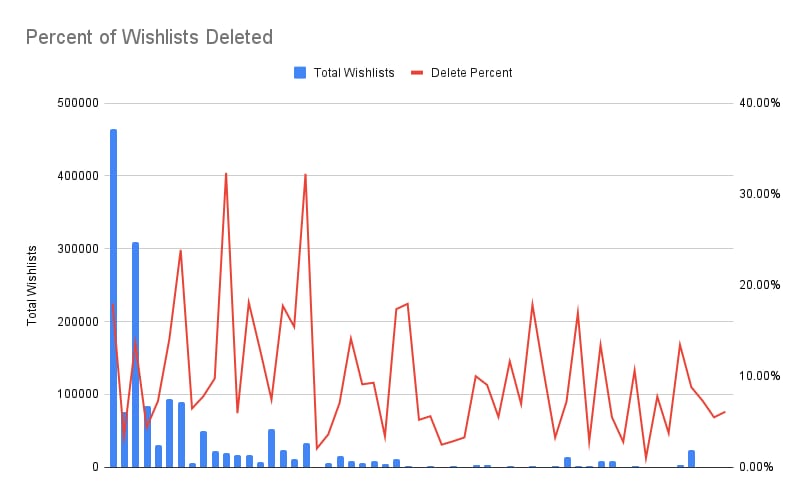
The best public benchmark is still Chris Zukowski's survey of wishlist data he collected from 58 developers in 2021, published in 2022. The rate there is the share of a game's wishlists that were deleted.
| Benchmark | Delete rate | Source |
|---|---|---|
| Median across 58 games | 7.75% | How To Market A Game, 2022 |
| Average across 58 games | 9.80% | How To Market A Game, 2022 |
| Song of Iron at launch (one developer's data) | 8.9% | How To Market A Game, 2025 |
| Worst outliers in the survey | above 30% | How To Market A Game, 2022 |
Zukowski drew a few patterns from that survey:
- Size barely matters. He found no clear link between total wishlists and delete rate, except that very small games tended to have lower rates. He suspected that huge counts built through festivals and streamers include more people who wishlist as a bookmark and remove it later.
- Time on Steam adds a little. Sorted by age, older games had slightly higher delete rates, but the difference was small. Being on Steam longer still earns you more wishlists than it costs you.
- Joke games churn. The only two games above 30% were gag games a YouTuber made for his channel. A meme audience is more fickle than a typical Steam shopper.
A concrete example: solo developer Joe Winter's action game Song of Iron reached 89,082 wishlists by its August 2021 launch and had logged 7,928 deletes along the way. That left 81,154 outstanding on launch day, an 8.9% delete ratio, right around the survey average.

Treat these figures as a rough baseline, not a target. The data was collected in 2021. Since then, wishlisting has become easier and more casual (more on that below), and nobody has published a newer delete survey that we could find. If your lifetime rate is in single digits or low teens, you are in normal territory.
Why Steam wishlist deletions spike
Steam seasonal sales
Big sales are the main trigger. On day one, players get an email full of discounts, then open their wishlist to compare deals. While they scroll, they ask whether they will ever buy each game, and they prune. Zukowski found that for just about every game he graphed, the largest delete spike matched the Summer Sale. Games that are not on sale get cut too, including unreleased ones.
The Riftbreaker is his example: it lost 290 wishlists in a single day when the Steam sale started, even though it was not yet available to buy.
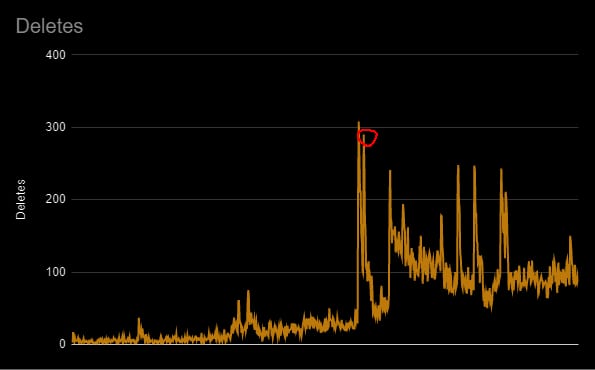

CCCP Games saw the same thing with Dead in Vinland during the 2019 Summer Sale. Bruno Laverny told GameDaily the game usually lost 20 to 30 wishlists a day and had lost 270 since that sale began. That gives you a useful habit: know your normal daily delete count, so you can tell a sale spike from a real problem. Plan around the calendar with our Steam sale dates for 2027.
Confusing store events
The worst recorded spike came from Valve itself. The 2019 Summer Sale ran a Grand Prix event where some players could win games from their wishlist, and many read it as a reason to delete cheaper indie games so that a pricey game would be the one they won. According to Game World Observer and GamingOnLinux:
- David Stark, developer of Airships: Conquer the Skies, reported roughly three deletes for every copy sold on the first day.
- J. Kyle Pittman of Minor Key Games said deletions beat purchases and additions by a wide margin for the first time, after a previous holiday sale that was about 50/50.
- Raymond Doerr of Rise to Ruins said he had not seen deletes outnumber adds and purchases during a seasonal sale in five years.
Valve apologized for the confusion, clarified the rules and posted that players did not need to remove anything. The lesson for today: if your deletes jump on a day when many other developers report the same thing, it is probably a store-wide event, not your game.

Launches and other big notification days
Wishlist emails go out when your game launches and when you run a discount of 20% or more that affects the lowest priced package and lasts longer than 8 hours, per Valve's wishlist docs. Every email puts your game in front of people who may have forgotten why they added it. Most ignore it. A few buy, and a few delete. Expect a small delete bump on launch day and on each discount, alongside the purchases.
Wishlists that were bookmarks to begin with
Wishlisting is cheaper than it used to be. In October 2026 Zukowski argued that wishlist inflation is real: stars on hover tooltips let players wishlist a game without opening its store page, and festival features hand out wishlists to far more games than before. In his survey of 160 games, a 2023 to 2025 release sold roughly half as many first-month units per wishlist as a 2020 to 2022 release. Easy, low-intent wishlists are also the easiest to delete later.
The Axis Unseen shows how far intent can vary. GameDiscoverCo estimated it at over 150,000 wishlists before its October 2024 launch, yet week one conversion was an estimated 0.02x to 0.03x and concurrent players peaked at 86. Those wishlists did not need to be deleted to be worth less than they looked.
Cheaper elsewhere, delays and dead silence
Two more causes come up often, though we found no hard data on either:
- Deals on other stores. GamingOnLinux suggested competing sales on Epic, GOG and Humble as a possible factor in the 2019 spike. A player who buys your game somewhere else creates no Steam purchase, so if they then tidy their wishlist, Steam counts a delete.
- Release date delays and long silences. We found no published dataset tying deletes to delay announcements. Valve's own best practices do tell you to "stay engaged over time," and a page with no news for a year gives a sale-day pruner nothing to hold on to.
Do old wishlists rot?
A common fear is that wishlists collected two years before launch are dead weight that will all be deleted. The data says otherwise. Zukowski used Song of Iron's MonthCohort data in Do wishlists get old? and found the cohorts converted at an average of 8.02%, with a flat trend once the tiny friends and family month was removed. His conclusion: there is no evidence that wishlists get old. The same post shows Cosmoteer's cohorts converting at a 19.31% average regardless of age.
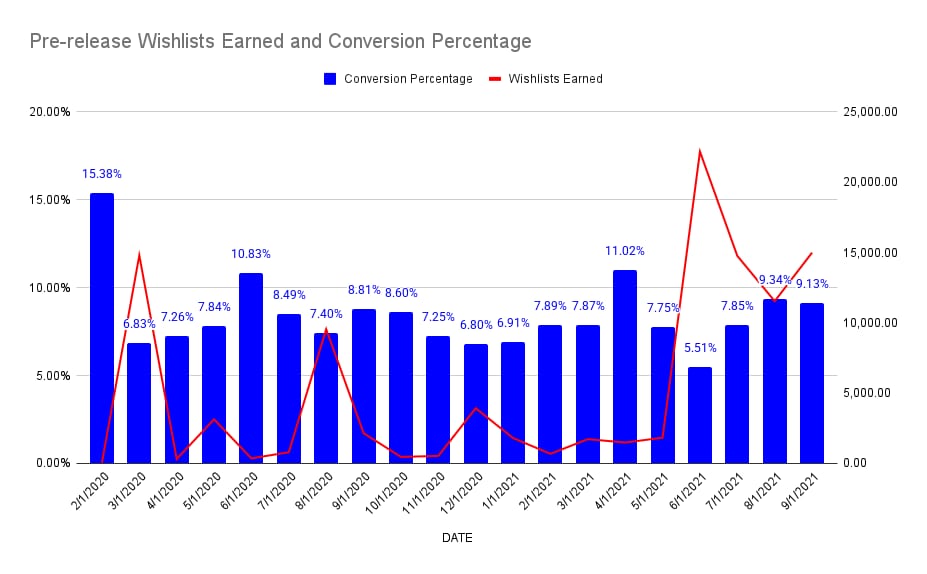
What drives conversion is fit: how well your game matches what the wishlister expected. That is also what drives deletes. For more on what good conversion looks like, read our Steam wishlist conversion rate guide.
How to diagnose a wishlist drop
Run through this whenever the balance falls and you are not sure why.
- Wait one day. The report excludes the current date, so confirm the drop on the next update.
- Split the drop. Compare Deletes with Purchases & Activations for the same days. If purchases explain most of it, you are fine.
- Compare with your normal delete rate. Export the CSV and compute your average daily deletes over a calm month. A day at 3x to 10x that baseline needs a reason.
- Check the calendar. Was it the first day of a seasonal sale, your launch, a discount or a Next Fest? Those days produce spikes for everyone.
- Check the lifetime rate. Total deletes divided by total additions. Under about 10% matches the 2021 survey median and average.
- Look at cohorts and regions. Use MonthCohort to see if one acquisition burst (a festival, a viral post) is churning harder than the rest, and use the regional report to spot a single country driving deletes.
- Ask other developers. If many studios saw the same spike on the same day, it was the store, not you.
What to do about wishlist deletions
You cannot stop deletes, and chasing them is rarely worth your time. A few things do help:
- Make the store page honest. A page that sets accurate expectations attracts wishlisters who stay. A trailer that shows real gameplay in the first seconds and an accurate tag set filter out people who would delete later. Our Steam store page checklist covers the details.
- Give wishlisters a reason to keep you. Post updates and events so a sale-day pruner sees an active game. Zukowski's untested idea from 2021 was to refresh the capsule with an "updated" banner ahead of the Summer Sale. Valve's own advice is that players often wait for a reason to buy, such as an Early Access exit, a content update or a discount. See our guide to Steam events and announcements.
- Time your discounts. A discount of 20% or more sends wishlist emails, and those emails convert some wishlisters and push others to delete. Both outcomes clear the list of people who were never going to pay full price.
- Grow additions, not just the balance. The GameDiscoverCo example held 87% of its peak through 40 discounts because new additions kept coming in. Steady adds from outside Steam, such as creator videos, matter more than any one delete spike. We break down how views turn into wishlists in creator views to Steam wishlists.
- Watch acquisition quality. If one source (a giveaway or a festival feature) brings a burst of wishlists that churn fast, weight it lower in your forecasts.
One recent change may help players hold on to games. In July 2026 Valve added wishlist categories and let players limit notifications to certain categories, so someone with a long list can sort it instead of cutting it. It is too early to say whether that lowers delete rates.
FAQ
What is a wishlist deletion on Steam?
It is a player removing your game from their wishlist without buying it on Steam. Valve tracks deletions separately from purchases in the Wishlists section of the Sales & Activation Reports portal.
Does buying the game count as a wishlist deletion?
No. A wishlister who buys the game leaves the list as a conversion, shown under Purchases & Activations. Your outstanding balance goes down, but the Deletes line does not.
What is a normal Steam wishlist deletion rate?
In How To Market A Game's survey of 58 developers, the median was 7.75% of wishlists deleted and the average was 9.8%. Rates above 30% showed up only for two joke games.
Why did I lose so many wishlists during the Steam sale?
Sales push players to review their wishlists, and many prune games they will not buy. The largest delete spike for almost every game in Zukowski's charts matched the Summer Sale, so this is expected.
Do wishlist deletions hurt my Steam visibility?
Valve does not say. Its docs say wishlists "can be an important factor in determining where your game appears on Steam," but also that there is no minimum wishlist count before Steam starts showing your game.
Why don't I see today's wishlist numbers?
Steamworks updates wishlist data once a day for the previous date. On March 2nd you can see data up to March 1st.
Are old wishlists more likely to be deleted?
Older games show slightly higher lifetime delete rates, but Song of Iron's cohort data showed old wishlists converting about as well as new ones. Age matters less than whether the game matches what wishlisters expected.
Sources: Steamworks Documentation (Wishlists; Wishlist Reporting); Steam announcement on wishlist categories (July 2026); How To Market A Game (2021 mass deletes post, 2022 delete benchmark, 2025 Do wishlists get old?, 2026 wishlist inflation, Steam Wishlist Chart tool); GameDiscoverCo (November 2023, November 2024); GameDaily, Game World Observer and GamingOnLinux coverage of the 2019 Grand Prix sale; checked November 2026.
Get a wishlist forecast for your game
Send us your Steam page. We estimate views, creators and cost per wishlist before you spend anything.
Keep reading
Twitter for Game Developers: Is X Still Worth It in 2026?
Is X still worth it for indie devs? Link penalty facts, Bluesky…

How to Market a Strategy Game: 4X, RTS and City Builders
How to market a strategy game on Steam: who buys it, demos…
Instagram Reels for Game Developers: Ranking, Formats, Steam Links
How Instagram ranks Reels, which game formats work, how to send viewers…