Indie Game Marketing Budget: What Studios Actually Spend
How much indie studios really spend on marketing, with published budgets from Lost Ember, Furnish Master and others, plus sample $0 to $100k plans.
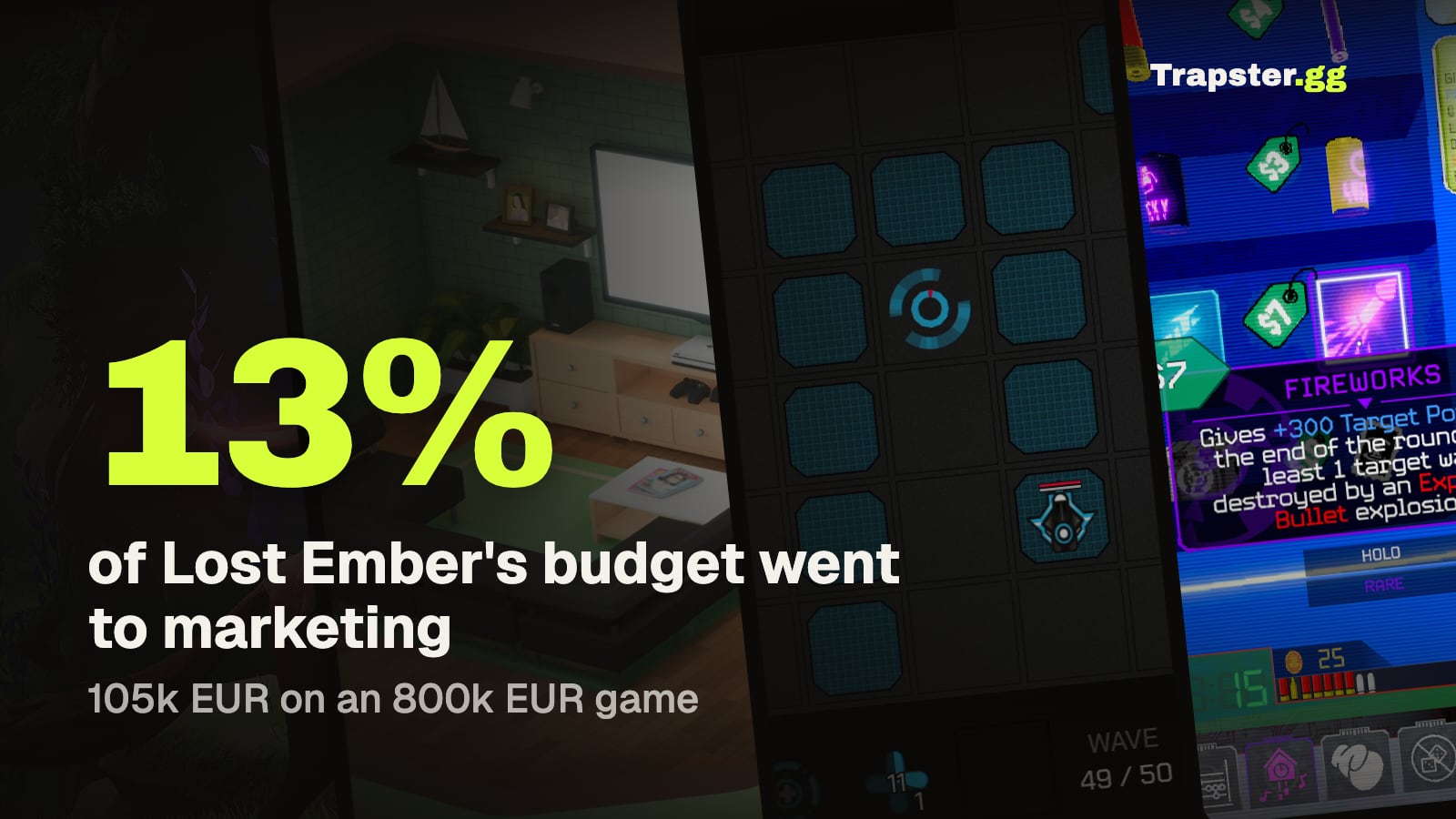
Short answer: Most indie studios spend somewhere between $0 and about 20% of their development budget on marketing. Lost Ember's team spent about 105,000 EUR of an 800,000 EUR budget, roughly 13% (Mooneye Studios). A 2014 GDC survey of 300+ developers found 47.5% set aside 10% or less (Game Developer). Agencies tend to recommend 20% to 30% (The Game Marketer via Game Developer). In dollars, a small solo game can launch well on $0 to $5,000 if the money goes to capsule art first, and paid ads only make sense once you know your cost per wishlist.
Why there is no standard number
Studios rarely publish marketing spend. Failbetter Games put it bluntly in a 2017 post: the games industry "isn't great at sharing how much they spend on marketing" (Failbetter Games). Most "marketing budget" articles you will find are written by agencies or tool vendors, and their percentages are rules of thumb, not measurements.
So this guide does two things. It lists the real, published budgets we could verify, with links. Then it turns them into sample plans you can adapt. Every number below is from a named source. Where a number is one developer's report, we say so.
What real studios published
| Game (studio) | Total marketing spend | Share of budget | Public outcome |
|---|---|---|---|
| Lost Ember (Mooneye Studios) | about 105,000 EUR | about 13% of 800,000 EUR | 250,000 copies by the time of the postmortem, per the studio |
| Furnish Master (Alex Blintsov, built in his spare time) | $11,550 pre-release costs (incl. nearly $8,000 ads, $1,600 assets) plus $4,000 after launch | budget about $85,000 including the dev's own time | 96,000 wishlists at launch, over $787,000 gross in 12 months, per WN Hub |
| This Grand Life 2 (Poking Water Games) | $4,365 on ads | not published | about 4,000 wishlists at $1.10 average (developer's figures), per WN Hub |
| Danchi Days (Melos Han-Tani) | $7,000 on Reddit ads over 108 days | not published | about 3,000 UTM-tracked wishlists; $1.79 to $1.94 each counting his estimate of untracked ones, per the developer |
| Lucky Shot (Deliver Games) | about $11,000 | not published | recouped dev and marketing costs, per a write-up of the dev's Reddit post |
| Core Defense (solo dev Mario Kaiser) | about $300 cash on ads and sponsored videos | not published | $20,186 gross in week one, per GameDiscoverCo |
| Dark Queen of Samobor (Downtown Game Studio) | $0 | 0% | about 5,700 wishlists by February 2025, still pre-launch, per the team |
Two patterns stand out. First, the games that spent five figures put most of it into ads. Lost Ember's ad lines (Facebook, YouTube, Instagram, banners, Twitter) add up to about 65,000 EUR, close to two thirds of its marketing. Second, the cheap campaigns worked because the game, the capsule and the store page were already doing the selling. Money amplified something that was converting. It did not create interest from nothing.
What the money buys, and what it costs
Below are the line items you will actually face, with published prices where they exist.
| Line item | Published cost | Source |
|---|---|---|
| Steam Direct fee | $100 per app, recouped after $1,000 in Adjusted Gross Revenue | Steamworks |
| Capsule art | "$250 minimum all the way up to multiple thousands" | How To Market A Game |
| Online festival fees | about $3,000 a year if you entered every festival Zukowski tracks; most are free | How To Market A Game |
| PR campaign (press and influencers) | "around $5000 for a decent campaign" | How To Market A Game |
| Physical booth (PAX East 10x10, travel included) | $5,834.67 for Heart Shaped Games in 2019 | Game Developer |
| Paid social ads | Zukowski's anecdotal rule of thumb is 1 wishlist per $1; published campaigns averaged $1.10 to about $1.94 | How To Market A Game, WN Hub, Melodic Ambient |
| Localization | 0.10 to 0.14 EUR per word for German, French, Spanish and Japanese; 0.09 to 0.12 EUR for Simplified Chinese at one games vendor | Allcorrect pricing |
A few notes on each.
Capsule art. If you only pay for one thing, pay for this. Zukowski's advice is to pay for a professional capsule "even if you don't have marketing money set aside" (How To Market A Game). Every other dollar you spend sends people to a page where the capsule is the first thing they judge. Our capsule art guide covers sizes and briefs.
Trailer. We could not find trailer editor rates published by the editors themselves, so we will not quote a range. Ask two or three editors for a quote once your art style is final. Zukowski suggests hiring one once you can show three distinct environments. If you cut it yourself, our trailer guide walks through structure.
Festivals and showcases. Steam Next Fest has no listed participation fee, and each game can only enter once (Steamworks). Paid third-party showcases are a gamble. Example: Fooya Games paid $600 for a slot in The Mix + Kinda Funny Spring Game Showcase and got about 65 wishlists in 24 hours (TheGamer). That is roughly $9 per wishlist. Zukowski's rule is to pay only when the organizer guarantees Steam featuring.
Physical booths. These eat budgets. Heart Shaped Games spent $5,834.67 on its first PAX East booth for We Are The Caretakers and said the connections were worth it, but did not publish wishlist numbers from the show (Game Developer). Lost Ember spent 30,000 EUR on conventions. Zukowski's verdict for small budgets: "Don't splurge on a booth. Save your money."
Paid ads. Steam itself sells no ads. Valve's Next Fest FAQ answers "Are there any paid advertising opportunities for Next Fest or on Steam in general?" with "No" (Steamworks). So paid traffic means Reddit, Meta, X or YouTube. More on channels in our paid ads guide.
Localization. Translating a whole text-heavy game is expensive. Translating just the store page is cheap and can matter a lot. The Dark Queen of Samobor team localized its Steam page into 12 languages and reported daily wishlists rising from about 1 to 10 to 30 or more (one team's figures) (itch.io). When Squeaky Wheel added eight languages to Academia: School Simulator, Thai revenue rose 331% over six months while several other new languages fell, against a total baseline of minus 17% (GameDiscoverCo). Pick languages with data, not by habit.
How much paid ads really cost per wishlist
Ads are where most of the money in published budgets goes, so it is worth looking closely at the results.
Example: Patrick Tang ran ads, mostly on Reddit with some X and Facebook, for This Grand Life 2 in 2024, spent $4,365 and got about 4,000 wishlists at $1.10 average, ranging $0.80 to $2.50 by ad group. Click-through rates in relevant subreddits averaged 1.5% to 2% (WN Hub). One caveat: his goal was reaching Popular Upcoming, and Valve changed that section in the June 2026 home page refresh to show the most anticipated releases of the coming month. The same spend would not buy the same placement today.
Example: Melos Han-Tani spent $7,000 on Reddit ads for Danchi Days from December 2025 to April 2026 and tracked about 3,000 wishlists through UTM links. Adding his estimate of untracked Reddit wishlists, he put the cost at $1.79 to $1.94 each. In a later edit, after launch, he wrote that the Reddit wishlists converted much lower than expected, and that Reddit ads are likely not worth it unless the game is AAA or has a very obvious focused niche (Melodic Ambient). His view is that a game combining many genres is hard to communicate through a single screenshot or headline.
Example: Klukva Games founder Pavel Belchenko reported that X ads for Dead Weight ran at $50 to $60 a day for about 70 to 80 tracked wishlists a day, and that the game passed 73,000 total wishlists (WN Hub). After a slump, the team credited the later recovery to a new capsule, shorter ad copy and more careful targeting.
Example: Furnish Master spent nearly $8,000 on Twitter, Reddit and Meta ads before Early Access (WN Hub). The game sold well, but the ads were one input among several.
The math to run before you spend: if a wishlist costs you $1.10 to $2 and only a fraction of wishlists ever buy, you need a price, conversion rate and post-launch tail that cover it. Start at $10 to $20 a day, as Zukowski suggests, and scale only what has proven itself.
Sample budgets for $0, $5k, $25k and $100k
These are planning templates built from the prices above, not published budgets. Adjust them for your genre and how far along you are.
$0 (time only)
- Steam Direct fee of $100 is a store cost, recouped after $1,000 in revenue.
- Make your own trailer. Use the free Steam events: Next Fest, themed sales that include upcoming games, and free festivals.
- Translate the store page with volunteer or community help if you can.
- Email creators yourself with keys.
Example: Dark Queen of Samobor's team reported about 5,700 wishlists by February 2025 with no paid marketing. A "Games from Croatia" Steam sale brought about 2,000 wishlists in two days and a "Myths & Legends" sale about 650 (itch.io).
About $5,000
| Item | Amount |
|---|---|
| Capsule art from a professional artist | $500 to $1,500 |
| Trailer edit (or a consult on your own cut) | $1,000 to $2,000 |
| Selected paid festival entries with guaranteed Steam featuring | $500 |
| Ad test at $10 to $20 a day to learn your cost per wishlist | $500 to $1,000 |
| Store page localization into 3 to 5 languages | remainder |
Example: Mario Kaiser's paid marketing for Core Defense was about $200 on sponsored influencer videos and $100 on a Keymailer ad that brought about 80 key requests, and grossed $20,186 in the first week at $9.99 (GameDiscoverCo). That was 2020, so treat it as a proof that small budgets can work, not as a current price list.
About $25,000
At this level you can add a real PR campaign, a launch trailer and a creator push, and still keep ads as an experiment.
| Item | Amount |
|---|---|
| Capsule plus key art | $1,500 to $3,000 |
| Announce and launch trailers | $3,000 to $6,000 |
| PR campaign (press and creators) | about $5,000 |
| Paid ads, only after a test proves the cost per wishlist | $5,000 to $8,000 |
| Creator sponsorships or campaigns around launch | $3,000 to $5,000 |
| Localization of store page and key UI | remainder |
Example: Lucky Shot's developer reported spending about $11,000 across four items: $1,600 on a Keymailer boost that brought no press, $2,000 on paid X posts that led to coverage by a large Japanese outlet, $2,000 to $3,000 on sponsored YouTube segments that were profitable, and $5,000 on a short-form creator campaign after launch that roughly tripled daily sales within five days and recovered its cost (Mad Octopus summary of the dev's Reddit post). The two creator lines were the only ones that clearly paid back. If you go this route, our guide on turning creator views into wishlists shows how to measure it.
About $100,000
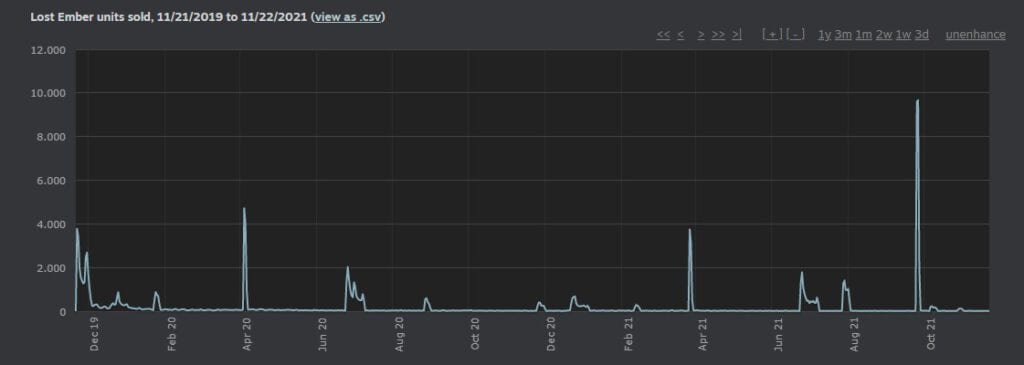
This is publisher or funded studio territory. Lost Ember is the clearest published template:
| Channel | Spend |
|---|---|
| Facebook ads | 40,000 EUR |
| Conventions | 30,000 EUR |
| YouTube ads | 13,000 EUR |
| PR agency (release) | 10,000 EUR |
| Instagram ads | 5,000 EUR |
| Banner ads | 5,000 EUR |
| Twitter ads | 2,000 EUR |
Source: Mooneye Studios. The team sold 23,000 copies across all platforms in launch week and recouped the full budget after about four months. Their main lesson: "Test your marketing strategy in small doses." They posted ads everywhere and moved the rest of the money to whatever performed best.
If you build a budget this size today, you would probably move part of the convention line into creators and short-form video, but that is our opinion, not their data.
How to plan spend by phase
- Before the Steam page (months 18 to 12 out). Spend on capsule art and a rough trailer. Nothing else is worth money until there is a page to send people to.
- Page live, building wishlists (12 to 4 months out). Run small ad tests to learn your cost per wishlist. Enter free festivals. Translate the store page. Hold back most of the budget.
- Next Fest and demo (about 4 to 2 months out). Spend on a polished demo trailer and creator outreach so videos land during the festival week.
- Launch (final 6 weeks). This is where PR and creator spend pay best, because a sale is one click away. Lucky Shot's profitable sponsored segments ran on and around launch day.
- After launch. Keep 20% to 30% of the budget for the first discount, updates and post-launch creator pushes. Furnish Master spent $4,000 after its Early Access launch, and Lucky Shot's best-performing line came after launch, when sales had settled at about 70 a day.
Our game marketing plan has a month-by-month version.
How to pick your number
Start from what the game has to earn, not from a percentage, and answer these before you set a number.
- What is the floor? Capsule art plus a trailer. If you cannot afford those, cut scope before you cut them.
- Do you know your cost per wishlist? If not, spend $500 to $1,000 finding out before you commit a five-figure ad budget. Published campaigns ran from about $0.80 to $2.50 per wishlist.
- What can you afford to lose? Zukowski's warning still applies: "Don't mortgage your house" (How To Market A Game).
Developers themselves seem to think they underspend. In the 2014 GDC Next survey, 47.5% had set aside 10% or less of their budget for marketing, while the largest group, 44.3%, said 11% to 25% was the right share (Game Developer).
FAQ
How much should an indie game spend on marketing?
The clearest published postmortem, Lost Ember, spent about 13% of its dev budget, and agencies recommend 20% to 30%. For a small solo game, $0 to $5,000 spent on capsule art, a trailer and a small ad test is a realistic range.
What percentage of a game's budget goes to marketing?
Lost Ember spent about 13% (105,000 EUR of 800,000 EUR). In a 2014 GDC survey, nearly half of developers spent 10% or less.
Can you market an indie game with no budget?
Yes, if the game and store page convert. Dark Queen of Samobor's team reported about 5,700 wishlists with no paid spend, mostly from Steam theme sales and store page localization.
How much does it cost to get a Steam wishlist from ads?
Published indie campaigns reported $1.10 (This Grand Life 2) and an estimated $1.79 to $1.94 (Danchi Days) per wishlist. Zukowski's anecdotal rule of thumb is about $1 per wishlist.
Can I buy ads on Steam?
No. Valve's Next Fest documentation states there are no paid advertising opportunities on Steam.
Is a convention booth worth it for a small indie?
Usually not as a first spend. A PAX East 10x10 booth cost Heart Shaped Games $5,834.67 in 2019, and Zukowski advises small teams to save the money.
What should I spend on first?
Capsule art. It costs $250 and up and affects every visitor you pay to bring to your page.
Sources: Mooneye Studios Lost Ember postmortem; How To Market A Game; Steamworks Steam Direct fee; Steamworks Next Fest; Game Developer GDC Next survey; GameDiscoverCo Core Defense; GameDiscoverCo localization case study; WN Hub This Grand Life 2; WN Hub Furnish Master; Melodic Ambient Danchi Days; checked November 2026.
Get a wishlist forecast for your game
Send us your Steam page. We estimate views, creators and cost per wishlist before you spend anything.
Keep reading
How Many Copies Do Indie Games Sell? Real Steam Numbers by Tier
Most Steam indie games sell under 1,000 copies. Real numbers by tier…
Game Marketing Hook: How to Find, Test and Show Yours
What a game marketing hook is, how to test one cheaply with…
How to Name Your Game: Searchable, Memorable and Legally Safe
How to name your game: pass the Steam, Google and trademark checks…