How to Name Your Game: Searchable, Memorable and Legally Safe
How to name your game: pass the Steam, Google and trademark checks, follow Steam's rules on titles and see what real renames and trademark fights teach.
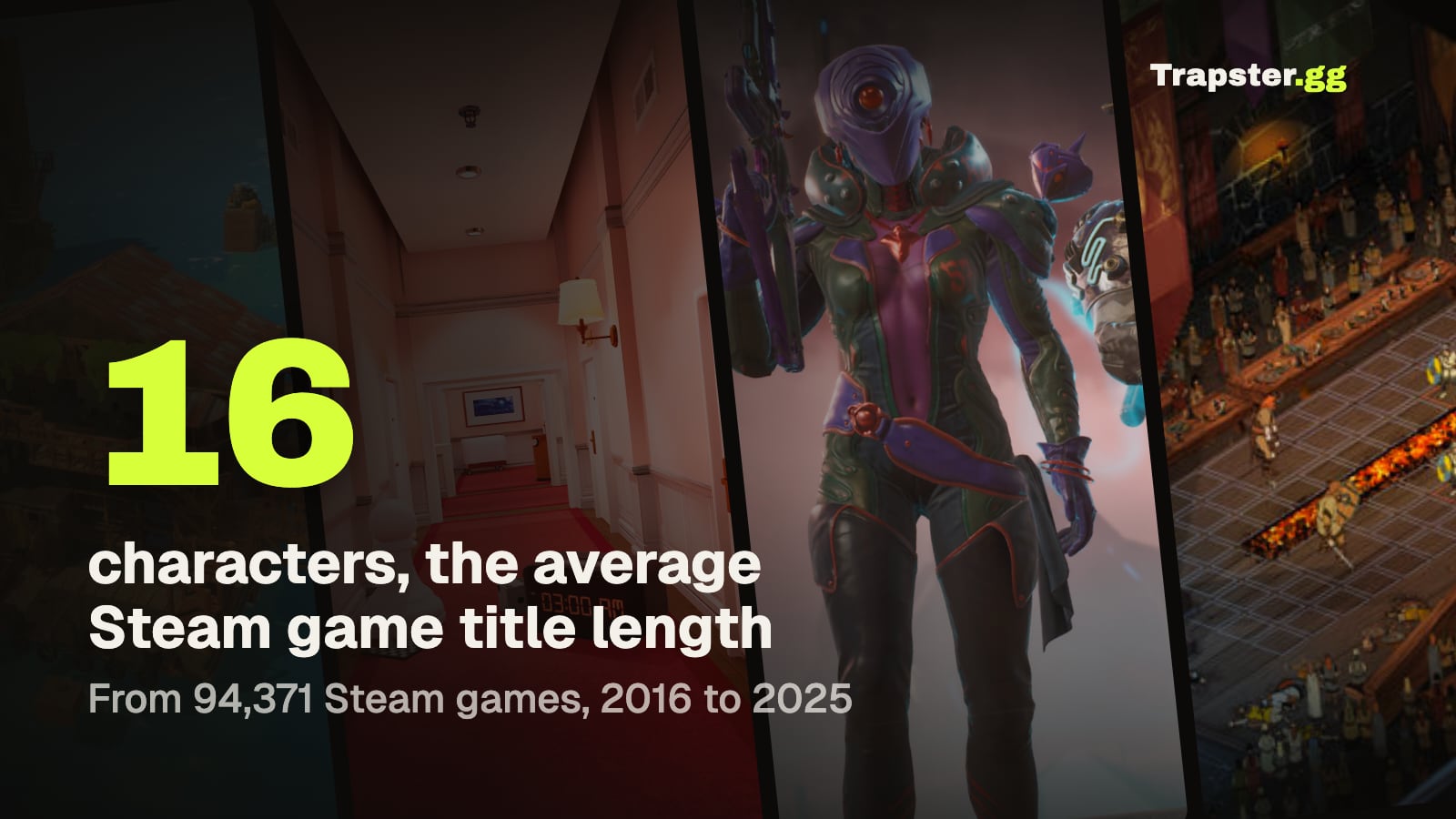
Short answer: Pick a name people can spell after hearing it once and that nobody else already owns for games; a light hint of genre helps. Check it against Steam, Google, the app stores and the official trademark databases (USPTO Trademark Search for the US, TMview for the EU and beyond) before you announce. Lock it in before your Steam page goes through review, because after that Valve only allows a name change through Steamworks support and you have to explain why. Chris Zukowski's analysis of 94,371 Steam games found the average title is about 16 characters and title length does not correlate with sales, so spend your effort on clarity and legal safety, not on length tricks.
What a game name actually has to do
A game name has three jobs, and they are more practical than poetic.
- Survive word of mouth. Most players find your game somewhere else (a video, a friend, a festival) and then type the name into Steam or Google. Zukowski's test: yell the name at someone in a noisy bar and ask them to write down what they heard. If they cannot spell it, people watching a YouTuber on their phone will not find it on their PC later.
- Signal the genre in a list. On Steam your name sits next to a small capsule in rows of other games. Zukowski points out that Valve gives you only a few places to signal genre, so the title, the capsule and the tags have to work together to say "this is a cozy sim" or "this is a horror game" at a glance. Pair the naming work with your capsule art and tags.
- Be ownable. You need to be able to use it on Steam, consoles, social handles and a domain without someone else's trademark getting in the way. This is the part teams skip, and it is the part that causes delays.
Notice what is not on the list: keyword stuffing for Google. Zukowski's view is that SEO matters less for a game title than people assume, because players usually hear about a game somewhere else first and only then search for it. Even the six one character games on Steam came up first or second when he googled "[name] game steam". The exception he flags is emoji: the game "1" was renamed to a double emoji, which made it hard to find through search.
How long should a game name be?
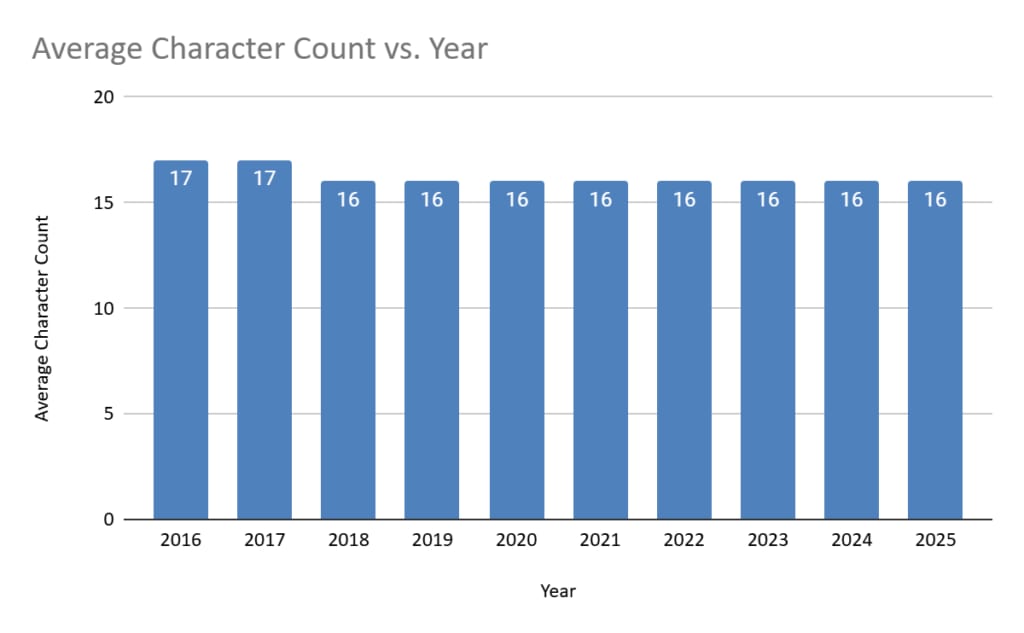
Short enough to say in one breath, long enough to be unique. The data says the market has settled on short names: in Zukowski's dataset the most common titles are 1 to 3 words, and the average sits at roughly 16 characters every year from 2018 to 2025.
Subtitles after a colon are common but not growing: the share has declined in recent years. About 13% of Steam games use a colon on average, with genre differences: over 16% of wholesome and open world survival craft games, only 8.4% of puzzle platformers.
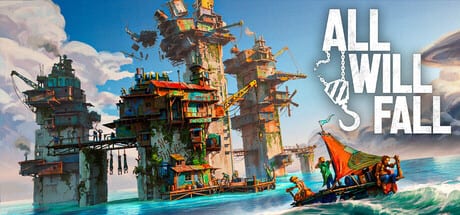
Example: Zukowski notes that GameDiscoverCo's Simon Carless spotted tinyBuild adding genre keywords to titles, with "ALL WILL FALL: Physics-Based Survival City Builder" and "I Am Future: Cozy Apocalypse Survival". As of November 2026, I Am Future still carries the keyword subtitle on Steam, while ALL WILL FALL launched in April 2026 under the plain name. Zukowski's take: keyword subtitles work on mobile, where buyers pick from the top of a list, but Steam's core audience may find them "cringe".
If you are also shipping on mobile, the stores set a hard ceiling. Apple's App Review Guideline 2.3.7 limits app names to 30 characters and forbids packing them with trademarked terms, popular app names or pricing. Google Play's metadata policy also caps titles at 30 characters and bans emoji, ranking claims like "Popular", promotional text like "free for limited time only" and ALL CAPS unless it is part of your brand. If your Steam title is 45 characters, decide now what the 30 character mobile version is.
Name styles and how they play out
| Style | Example | Strength | Risk |
|---|---|---|---|
| Descriptive | Cinema Simulator 2025 | Genre is obvious in a list | Hard to own, hard to trademark, easy to confuse with clones |
| Evocative phrase | Disco Elysium, ALL WILL FALL | Memorable, sets a mood | May not say what the game is |
| Invented word | Superliminal | Unique search results, easy trademark | Needs the capsule to carry the genre |
| Single common word | TUNIC | Short, sayable | Collides with everything else using that word |
| Name plus subtitle | I Am Future: Cozy Apocalypse Survival | Genre spelled out | Long, can read as keyword stuffing |
There is no correct style. Zukowski's point is that you need "just enough" genre signal without sounding like a cliché. His warning example is a word salad such as "Curse of the Legend of the Mystery of the Sages of the Spirits", which nobody can recall in the right order.
Real renames and what they teach
Most famous renames happened before launch, when the original working title did not explain the game.
Superliminal (Pillow Castle). The game was first shown as Museum of Simulation Technology. Lead developer Albert Shih told GamesRadar the working title was well known but "didn't quite explain the game and people could never quite remember the whole title". The dream setting led to "subliminal", which they twisted into Superliminal: one invented word that owns its search results.

TUNIC (Andrew Shouldice, Finji). Publisher Finji's June 2017 announcement notes the game was previously known as Secret Legend. The new name was announced in June 2017, almost five years before its March 2022 Steam release. A generic two word fantasy phrase became one short, sayable word.
Disco Elysium (ZA/UM). The detective RPG was announced as No Truce With the Furies and renamed Disco Elysium in March 2018. PC Gamer's reaction captures the risk of an obscure literary title: the writer said he had no idea what the old name meant. Its Steam page was later renamed again in place to Disco Elysium - The Final Cut, keeping the same store page and its review history.
Rocket League (Psyonix). Its 2008 predecessor was Supersonic Acrobatic Rocket-Powered Battle-Cars. Game Developer's recap of Davis's GDC talk notes it did not sell well, and Psyonix design director Corey Davis called it "the worst game name of all time". The follow-up, Rocket League, shipped in July 2015 with a two word name that a commentator can say mid match.
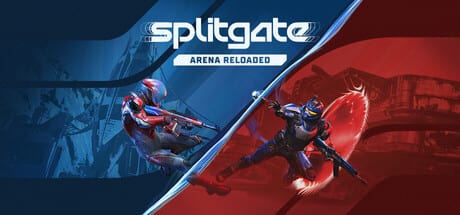
Splitgate: Arena Reloaded (1047 Games). A rare post launch rename. After Splitgate 2's June 2025 launch went poorly, the studio overhauled the game and relaunched it on 17 December 2025 under a new name. The Steam page kept its original app and May 2025 release date, so the rename changed the label, not the store history. This is the scenario Valve's support questions are built for: the product is changing along with the name.
Trademark collisions: the cases that cost time
These are the examples to show your team when someone says "we'll deal with the trademark later".
The Day Before (Fntastic). In January 2023, the game's Steam page was blocked. Fntastic said a private individual had complained about the name, having filed a US trademark application in June 2021, about five months after the game was announced. Release moved from 1 March to 10 November 2023, an eight month delay. Someone else filed for the name after the studio announced it, and the studio paid for it in time.
Gods & Monsters to Immortals Fenyx Rising (Ubisoft). Monster Energy filed an opposition to the "Gods & Monsters" trademark with the USPTO in April 2020, citing its esports sponsorships. Ubisoft renamed the game by June 2020 and said the change was "entirely because of the vision of the game". A lawyer quoted by VGC said Ubisoft would probably have won, but at a real cost in time and money. Even when you are right, an opposition can be cheaper to avoid than to fight.
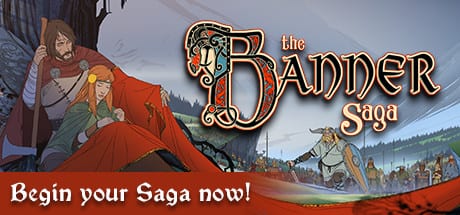
The Banner Saga (Stoic) versus King. Candy Crush maker King opposed Stoic's US trademark for The Banner Saga over the word "Saga". By April 2014 King had dropped its opposition, and Stoic said the agreement lets both sides protect their marks. Stoic kept its name, but a small studio still had to deal with a legal dispute with a much larger company.
How to check a game name before you announce it
Run these checks on your shortlist, not on one favourite. Expect half your list to fail.
- Steam search. Type the name into the Steam store search box and look at the suggestions. If an existing game, DLC or soundtrack shows up for the same or a near identical word, players following a creator's recommendation may land on the wrong page. Do the same with likely misspellings.
- Google. Search "[name] game" and "[name] steam". If page one is a film, a band or a famous app, you will be fighting for every result. Zukowski's data says Steam pages rank well, but you still want your game to be the obvious match.
- App stores and consoles. Search the App Store, Google Play and the console stores even if you are PC only today. Apple asks for a unique app name, and a ported version will need one.
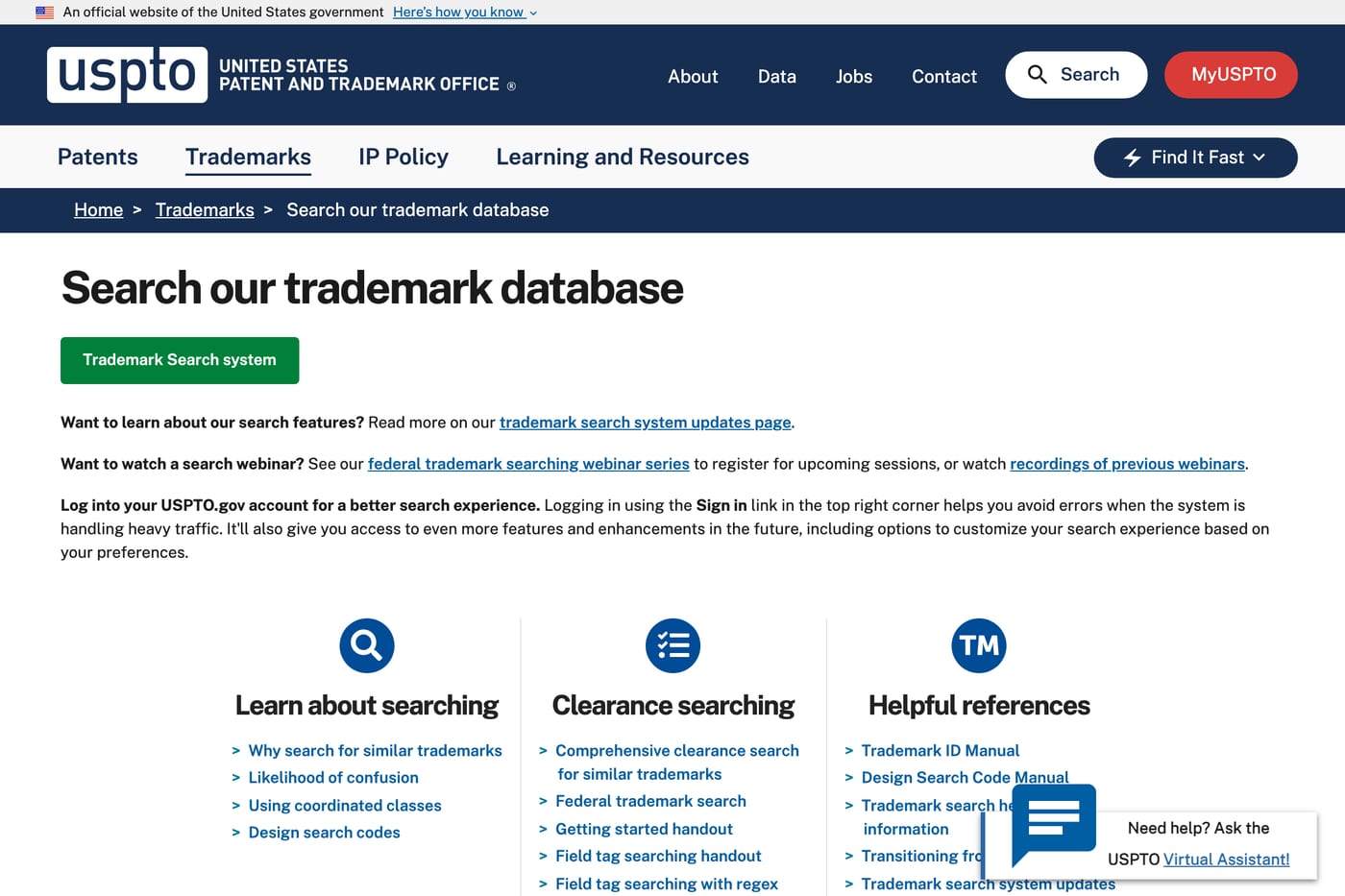
- Trademark databases. For the US, use the USPTO Trademark Search system. For the EU, EUIPO's availability page points to TMview, which covers the trade marks of participating national, EU and international offices in one search. Search for exact matches and similar spellings or sounds, not only your exact string.
- Check the right classes. Trademarks are registered per class of goods and services. The Nice Classification puts "computer game software, downloadable" in class 9, and class 41 covers "game services provided online from a computer network". A shoe brand with your name in class 25 is much less of a problem than a game app in class 9.
- Handles and domain. Check the Steam developer page name, TikTok, YouTube, X, Instagram and a domain. They are not legal protection, but losing all of them to an existing brand is a sign the name is crowded.
- Say it out loud. Read it to five people who have never seen the game. Ask them to spell it and guess the genre.
On cost: the USPTO's fee schedule lists the base electronic application at $350 per class, plus a $200 per class surcharge if you write your own description of goods instead of using the Trademark ID Manual wording. Two classes for a game is $700 in base filing fees, much less than an eight month delay. This is not legal advice: if your search finds close matches, pay a trademark attorney for a clearance opinion before you announce.
Steam's rules on game names
Valve does not publish a long list of naming rules, but the ones it has matter.
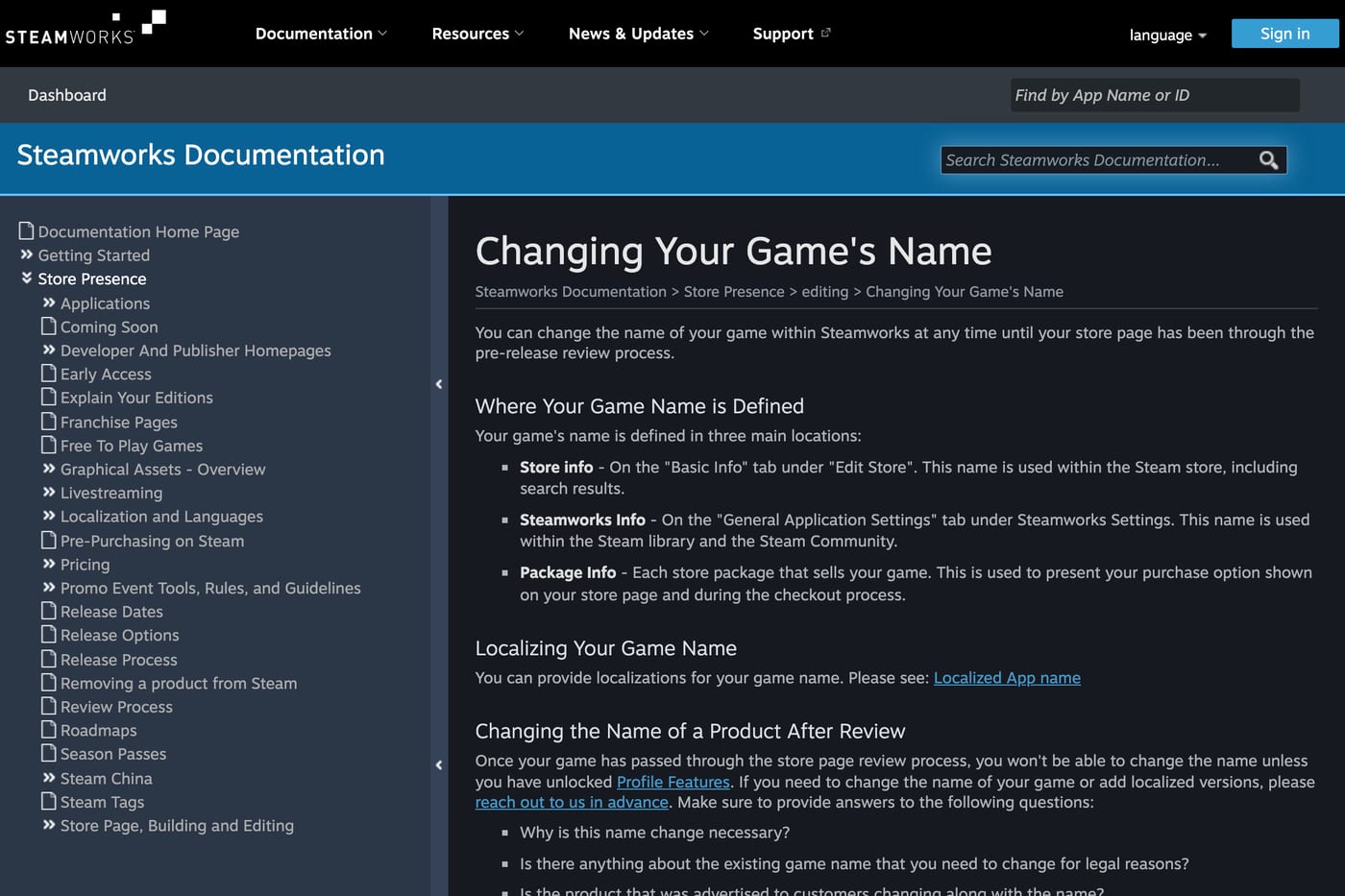
- The name locks at store review. You can change it freely in Steamworks until your store page has been through the pre-release review. After that you cannot change it unless you have unlocked Profile Features, and you must contact Steamworks support in advance. Valve asks why the change is necessary, whether anything must change for legal reasons, and whether the product itself is changing. This is a good reason not to rush the Coming Soon page with a placeholder title.
- The name lives in three places. The store name (Edit Store, Basic Info) is used in the store and search. The Steamworks name (General Application Settings) shows in the library and Community. Each package has its own name shown at checkout. Keep all three consistent.
- Localized names follow the same rules. Steam lets you set a localized name per language, shown to customers running Steam in that language. Valve says the localized name is used for search suggestions in that language, with the base name as a fallback, and that localizing the name has the same limits as changing it. If you plan a Chinese or Japanese title, set it before review. See our localization guide for the rest.
- Capsules must show the name, and nothing else. Under the graphical asset rules, capsule images must contain a readable product logo or name, and base capsules are limited to artwork, the game name and any official subtitle. Your logo has to work at small sizes, so a long title costs you capsule space.
Renaming a game that is already on Steam
If you are past review and the name is hurting you, it is possible, but plan it like a relaunch.
- Write the case for Valve. Answer the three questions from the Steamworks doc in your request. A legal reason (a trademark complaint) or a real product change (as with Splitgate) is a stronger case than "we found a cooler name".
- Expect the store page to persist. In the Splitgate and Disco Elysium cases the same Steam app was renamed, so the store page kept its reviews and history.
- Update everything else on the same day. Logo on all capsules, trailer end cards, press kit, website, social handles, Discord name. Old creator videos will keep the old name in their titles forever, so mention "formerly X" on the store page and in your first Steam announcement about it.
- Keep the old name searchable. Use "formerly known as" in your description for a while so people who search the old name still find you.
When to settle on the name
Settle the name before three things happen: your Steam page review, your first public trailer, and your first outreach to creators. Creators put your name in their video titles and descriptions, and those stay up for years. If you plan to work with creators, make sure the name in their videos is the one players will find on Steam. A working title in a devlog is fine. A working title on a store page that people wishlist is a liability.
FAQ
How do I come up with a name for my indie game?
Write down the core feeling or action of your game and generate 30 to 50 options across styles (descriptive, invented word, phrase). Shortlist ten, run the search and trademark checks, then test the survivors out loud with people who have not seen the game.
Can I change my game's name on Steam?
Yes, freely until the store page passes pre-release review. After that you need Profile Features unlocked and must contact Steamworks support, explaining why the change is needed, whether it is for legal reasons and whether the product is changing.
Do I need to trademark my game name?
Not legally required, but at minimum search the USPTO and EUIPO databases before announcing. The Day Before had its Steam page blocked and its release delayed eight months after a private individual filed a US trademark application for the name.
How much does it cost to trademark a game name in the US?
The USPTO base electronic application fee is $350 per class, with surcharges such as $200 per class for a custom description of goods. Games usually file in class 9 (game software) and often class 41 (online game services).
Does a game name matter for SEO?
Less than people think. Steam pages rank well on Google, and Zukowski found even one character games as the first or second result. Avoid emoji or a name identical to a famous film or app.
Should I add a genre subtitle to my Steam title?
Only if it reads naturally. About 13% of Steam games use a colon, and keyword subtitles can look like stuffing to Steam players.
How long can an app store game name be?
Apple and Google Play both limit app titles to 30 characters, and both forbid keyword stuffing and pricing or promotional text in the name.
Sources: Steamworks: Changing your game's name, Steamworks: Localization, Steamworks: Graphical asset rules, How To Market A Game: Are game names getting longer, USPTO Trademark Search, USPTO fee schedule, TMview, WIPO Nice Classification, Apple App Review Guidelines, Google Play metadata policy, VGC, GamesRadar, Game Developer; checked November 2026.
Get a wishlist forecast for your game
Send us your Steam page. We estimate views, creators and cost per wishlist before you spend anything.
Keep reading
How Many Copies Do Indie Games Sell? Real Steam Numbers by Tier
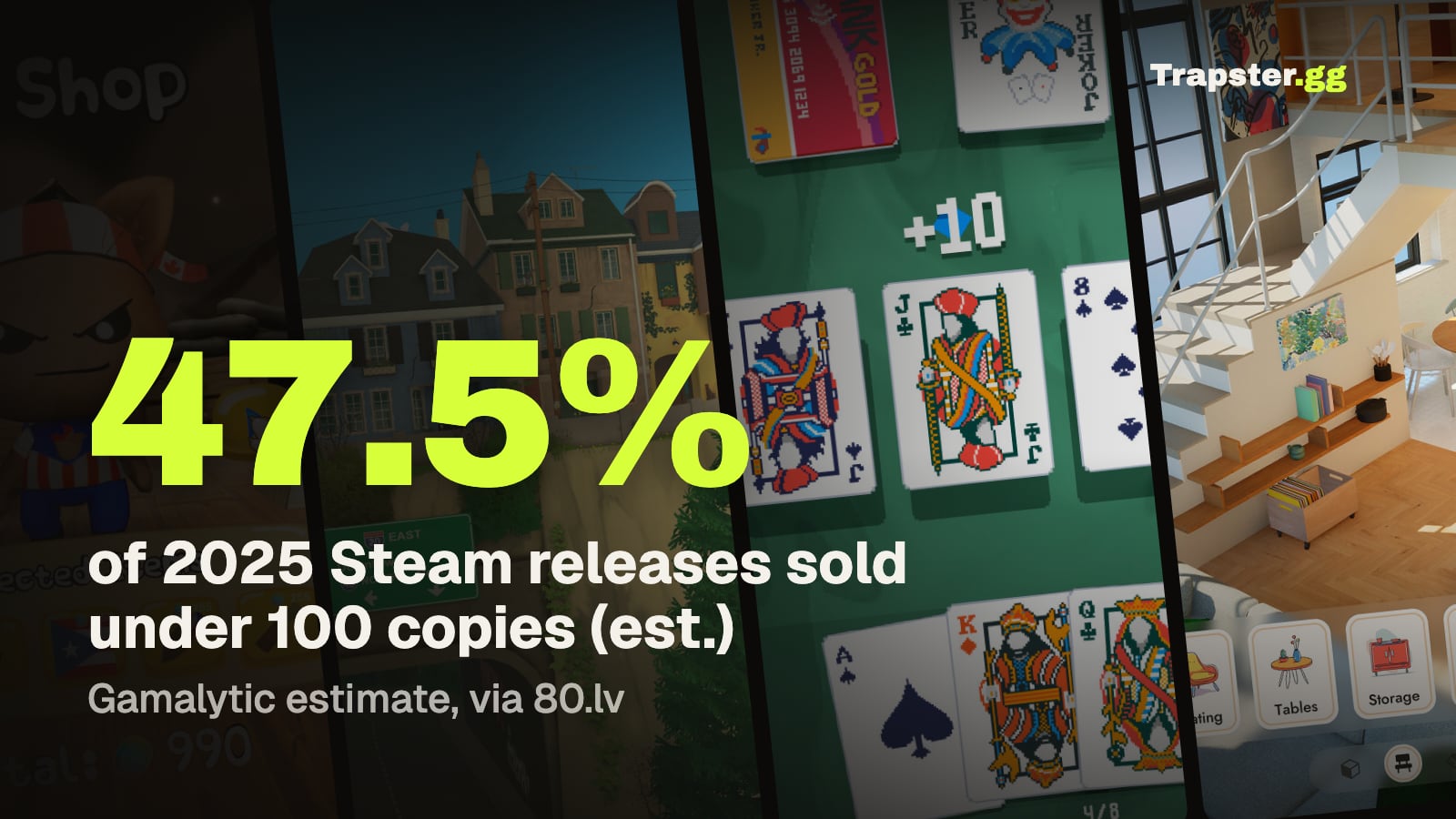
Most Steam indie games sell under 1,000 copies. Real numbers by tier…
Game Marketing Hook: How to Find, Test and Show Yours
What a game marketing hook is, how to test one cheaply with…
How to Get Your Game Into a Showcase (2027 Guide)
How to get your game into Wholesome Direct, Day of the Devs…