How to Publish a Game on the Epic Games Store (2026 Guide)
Epic Games Store for indie developers: the $100 fee, 100% of your first $1M, Epic First Run, free games, exclusives and real Epic vs Steam sales.
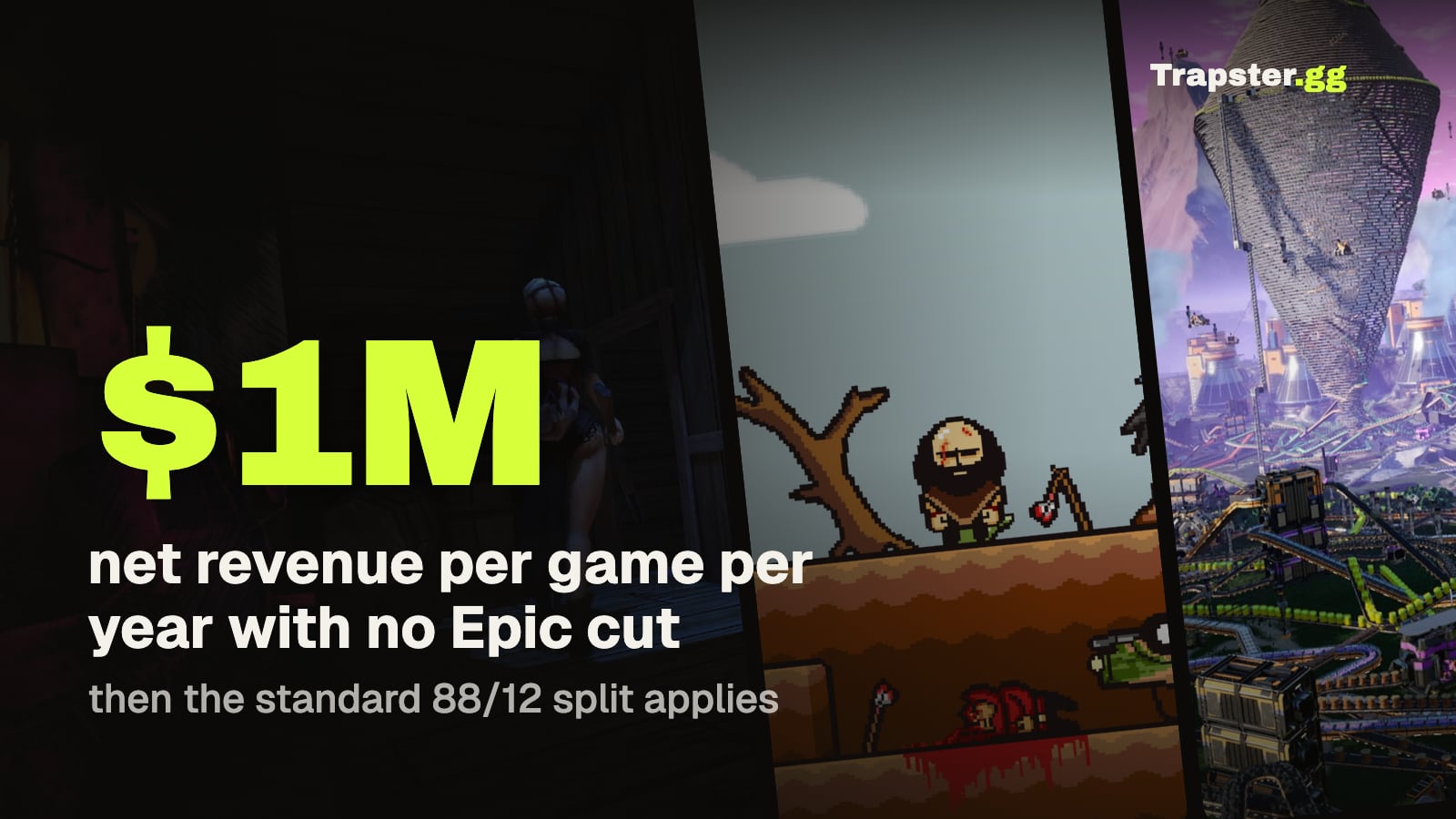
Short answer: To publish a game on the Epic Games Store, you create an organization in the Epic Developer Portal, add your business, tax and payout details, set up the product page and builds with Epic's self-service tools, and pay a recoupable $100 submission fee per game before release (Epic). Since June 1, 2025 you keep 100% of the first $1 million in net revenue per product, per calendar year, and the standard 88/12 split applies after that (Epic announcement). Any engine is accepted, but multiplayer games need crossplay with other PC stores and games with achievements elsewhere need Epic achievements too. The store is open and cheap to enter. The hard part is that most indies sell far less on Epic than on Steam, so treat it as an extra storefront, a free games partner or an exclusivity deal, not a replacement for Steam.
What Epic offers indie developers in 2026
Epic opened self-publishing to everyone on March 9, 2023. Before that, getting on the store meant a curated deal. Game Developer's report on the launch lists the same $100 fee per game that Epic still charges today, along with the core requirements: PC crossplay for multiplayer, age ratings, Epic achievements, and a store page that matches the game.
Here is what the Epic distribution page lists today:
| Item | What Epic says |
|---|---|
| Submission fee | $100 USD per game, recoupable, paid before release |
| Revenue share | 100% of the first $1M net revenue per product, per year. 88/12 after that |
| Engines | Engine agnostic. Unity, Godot and custom engines are fine |
| Unreal royalties | Waived on in-store purchases that use Epic's payment system |
| In-app purchases | You can use your own payment processor. Epic takes nothing on those, but Unreal royalties apply to them |
| Ratings | IARC ratings handled inside the Developer Portal |
| Extras | No-cost localization of store pages, Support-A-Creator affiliate program, regional pricing with suggested discounts |
| Reach claimed | Over 295 million Epic users in 187 countries, 16 languages, 80+ payment methods |
Two notes on that table. "Recoupable" means the $100 comes back out of your earnings, so it is not a pure cost. And the user number is accounts, not buyers. In its 2025 year in review, Epic reported a record 78 million monthly active users in December 2025 but an average of 67 million across the year, per GamesBeat's coverage.
The fees, explained with real numbers
The revenue share is the main reason studios look at Epic. Here is how it works now.
The $1M rule. Epic's announcement says developers "earn 100% of the first $1 million in net revenue per product, per year for any Epic Games Store payments we process." The first window ran June 1 to December 31, 2025. From 2026, the threshold resets every January 1. No application or contract update is needed. It covers PC, Mac, iOS, iPadOS and Android payments that go through Epic's processor.
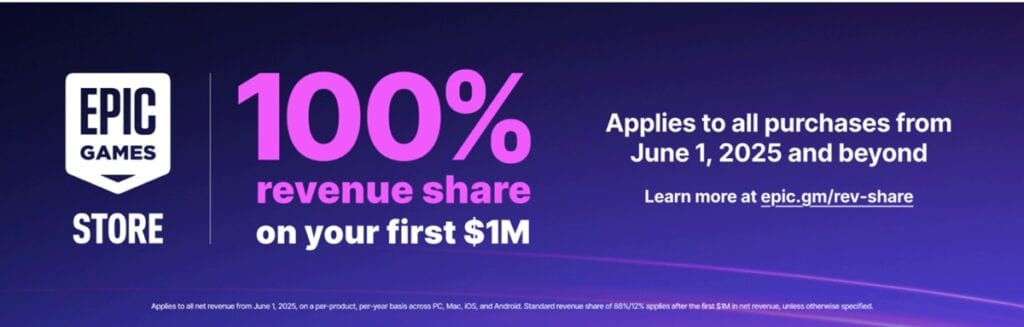
What that means in practice: a $20 indie game that grosses $150,000 net on Epic in 2026 keeps all $150,000. On Steam, the standard split is 70/30 (our Steam fees guide covers the tiers and VAT). Very few indie games will cross $1M per year on Epic, so for most of you the effective Epic fee is zero.
The Unreal Engine royalty. Unreal's standard royalty is 5% of lifetime gross revenue above $1 million. Revenue from Epic Games Store sales processed by Epic does not count toward that and carries no royalty. Since January 1, 2025, the "Launch Everywhere with Epic" program also cuts the royalty on your other stores from 5% to 3.5%, if the game launches on Epic at the same time as or before other Windows, macOS and Android stores, with the same content and updates, and if your marketing treats Epic equivalently (CG Channel). For an Unreal game that expects to pass $1M on Steam, that 1.5 point cut can be worth more than whatever you sell on Epic itself.
Your own payments. Epic lets you sell in-game items through your own processor and pays nothing on those. In 2025, 35% of third-party playtime on the store was in games using their own payment systems, according to GamesBeat. That matters for free-to-play, much less for a premium indie.
How to publish a game on the Epic Games Store, step by step
- Create your organization. Log in at dev.epicgames.com/portal with an Epic account. The sign-up wizard walks you through registering your company and your first product. Have contact, tax and payout details ready (Epic FAQ).
- Accept the agreements. Your organization must accept the Epic Games Store Distribution Agreement before it can sell.
- Pay the $100 submission fee. It is per game, recoupable, and due before release. Paying it is also what makes you eligible for Epic's free store page localization (Game Developer).
- Get your age ratings. Epic uses IARC inside the portal, so you fill one questionnaire instead of applying to each ratings board.
- Build the product page. Description, screenshots, trailer, key art, tags, price and regional prices. The rules say the game must "launch, run, and be consistent with" what the page shows. Reuse your Steam assets where you can.
- Upload builds. You upload and manage builds and updates through the self-service tools.
- Wire up achievements and crossplay if they apply. Games onboarded after March 9, 2023 must enable Epic achievements if they have achievements on other PC stores. Multiplayer games must support crossplay across all PC stores, which you can do yourself, with a third-party SDK, or with Epic Online Services for free.
- Set up a "coming soon" page and collect wishlists. Epic has wishlists. The wishlist number in Dev Portal analytics is a cumulative total, an Epic staffer confirmed on the developer forum in June 2025.
- Release, then decide on programs. Opt into Epic First Run before release if you want exclusivity, or pitch the free games team later in the game's life.
Epic's FAQ rules out pornography, hateful content, IP you don't own, and fake or deceptive products. If your game is adult-only, Epic is likely not an option.
Epic First Run: 100% revenue for six months of exclusivity
Epic First Run launched for games released on or after October 16, 2023. The deal: your game launches on Epic first and stays off other third-party PC stores for six months, and you keep 100% of revenue for those six months with no cap. You can still sell on your own website or launcher, and sell Epic keys through retailers like Humble and Green Man Gaming. Games that were already out on another PC store are not eligible.
What you get on top of the money, per TechCrunch's coverage of the announcement: exclusive badging, home page placements, dedicated collections, and inclusion in store sales and editorial campaigns. First Run games also qualify for the 3.5% Unreal royalty rate (CG Channel). Epic says that once First Run ends, any room left under the $1M yearly threshold still gets the 100% rate (Epic).
The catch is obvious. First Run pays no money up front. Old Epic exclusives came with guarantees. First Run only improves your cut of sales that happen on Epic, while you give up six months of Steam. Now that every game keeps 100% of its first $1M anyway, First Run only adds value if you expect to pass $1M on Epic within six months, or if the featuring is worth more to you than six months of Steam sales.
Example: Saturnalia launched first on the Epic Games Store, Switch and consoles in 2022. It reached Steam in November 2023 with 13,000 wishlists and sold about 2,000 units in its first few months there, which the developer considered unsuccessful (How To Market A Game, GDC 2024 notes). A delayed Steam launch gives up the launch momentum, and Steam players who skipped the Epic version don't come back on their own.
The free games program
Epic gives away games every week. In 2025 that was 100 free games and 662 million claims (GamesBeat). Epic does not publish how titles are picked or what developers are paid for a slot, so treat it as a business development conversation, not a form.
The useful question is what a giveaway does to your game outside Epic. Here is the evidence I could find.
| Game / source | What happened |
|---|---|
| Epic's own 2025 data | Epic reported Steam concurrent players rising about 40% while a title was free on Epic, and over 77% of free titles hit an all-time peak concurrent player record on Epic that week (GamesBeat) |
| Blood West (New Blood) | Free on Epic over the 2025 holidays. CEO Dave Oshry said on X it "sold like 200% more on Steam that day," and console sales rose too (FRVR summary). Single developer report |
| LISA: The Painful | Estimated 40,000 actual players from its Epic giveaway, based on review and achievement data (GameDiscoverCo) |
| Black Book | Estimated around 30,000 actual players from the same method (GameDiscoverCo) |

Read the last two rows next to the claim numbers. In 2023 the median giveaway got about 6.74 million claims, yet only tens of thousands of people actually played these two. GameDiscoverCo's Simon Carless guessed earlier, without hard data, that only 10 to 20% of redemptions lead to play. A giveaway is an awareness spike for a game with a long tail. It works best when you have a sequel, DLC, or a sale on Steam lined up for the same week. If you plan to run a Steam discount at the same time, our discount campaign guide covers how to time outside traffic to it.
Epic exclusives and Epic Games Publishing
There are now three different kinds of "Epic exclusive," and they get mixed up:
- Old paid exclusives (2019 to roughly 2022). Epic paid minimum guarantees for timed PC exclusivity. GameDiscoverCo reported in 2023 that these deals had largely ended. Don't expect a cash offer for a small indie.
- Epic First Run. Self-serve, no cash, six months, 100% revenue. See above.
- Epic Games Publishing. A real publisher. Announced in March 2020 with Remedy, Playdead and genDESIGN, it covers up to 100% of development costs including marketing, splits profits at least 50/50 after recoupment, and leaves the IP with the developer (Gematsu). GameDiscoverCo noted that its titles stay Epic exclusive on PC for longer than the old timed deals (GameDiscoverCo).
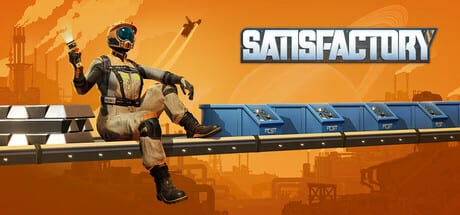
Example: Satisfactory (Coffee Stain) launched as an Epic exclusive, then came to Steam. By July 2020 it had sold 958,917 units after 15 months on Epic and 367,601 in its first month on Steam (GameDiscoverCo). Carless called the Epic number high-end for the platform: it was the second best selling Epic title of 2019. The Steam month shows how much demand was waiting.
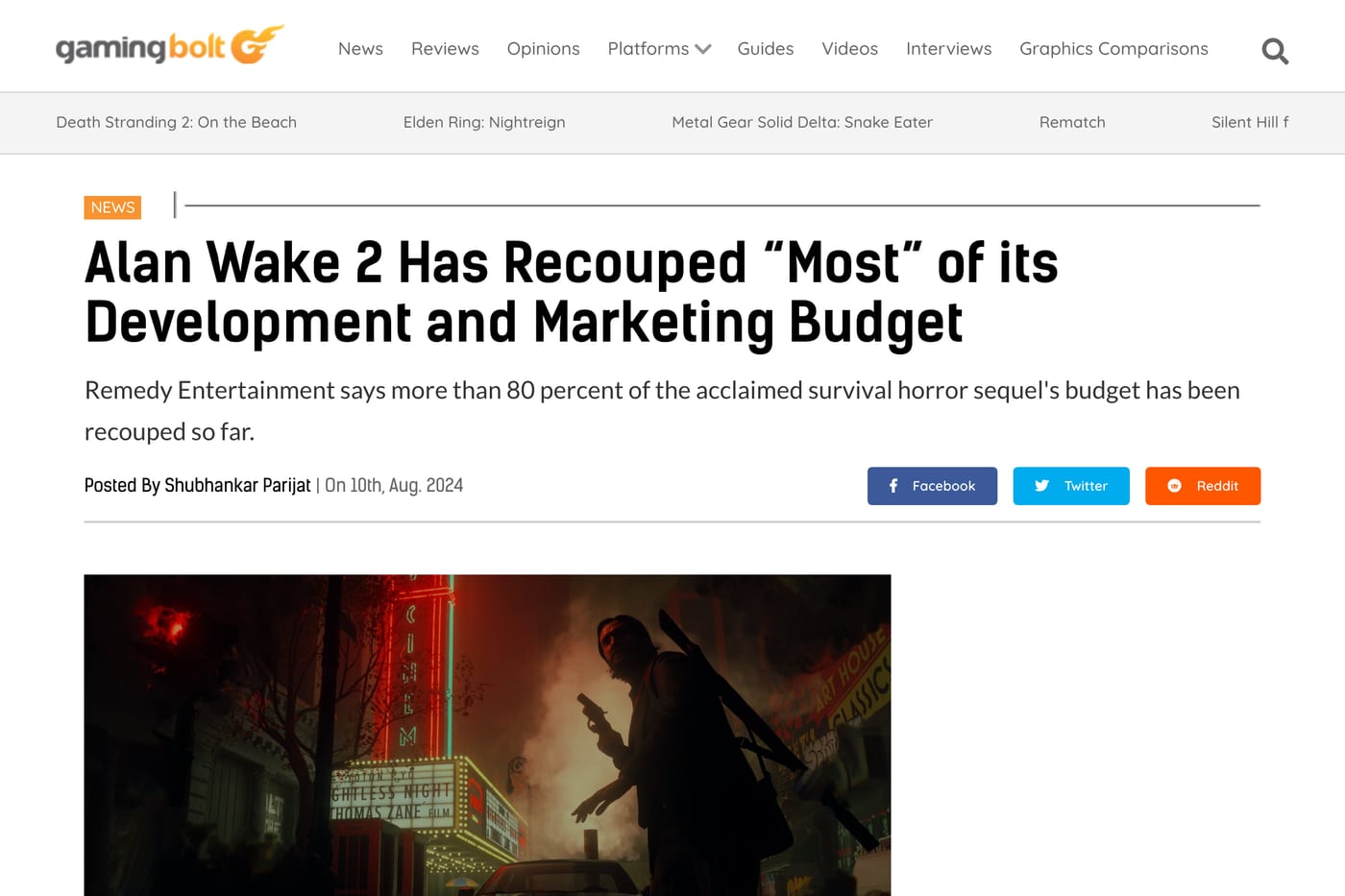
Example: Alan Wake 2 (Remedy, published by Epic) launched as an Epic exclusive on PC in 2023. By mid-2024 it had recouped "most" of its development and marketing costs, with more than 80% recouped per Remedy's investor call (GamingBolt). By the end of 2024 it had passed two million units and fully recouped, so Remedy started earning royalties (Remedy Q4 2024 report, summarized by alanwake.info). That is a funded AAA deal, not a template for indies, but it shows what an Epic Games Publishing deal looks like when it works: slow, but the studio kept its IP and got paid.
If you are deciding between a publisher and going alone, our publisher vs self-publishing guide runs through the math.
Visibility and wishlists on Epic
Epic is a much smaller, more curated store. About 6,000 games versus about 140,000 on Steam, and roughly 60% of Epic users also use Steam (GamesBeat). Fewer games means less competition on lists like New Releases and Coming Soon. It also means there is no deep recommendation engine pushing your game to the right niche the way Steam's queue and tags do.
Things that move the needle on Epic, in order of control you have:
- Your own traffic. Epic's Dev Portal analytics do not track which outside links your wishlists came from, a gap developers have raised on the forum. If you send people to two store links, expect most to click Steam.
- Support-A-Creator. Epic lists this affiliate network as a developer benefit you can activate. It gives creators a reason to point viewers at your Epic page.
- Store sales and editorial. First Run games get featured in sales, events and editorial campaigns, per VGC.
- Free games. The biggest single spike Epic can give a small game, on Epic's terms and timing.
Should you put a "coming soon" page on Epic early? If you plan to launch there the same day as Steam, yes. It costs nothing beyond the $100 fee, and it is required for the Launch Everywhere royalty discount if you use Unreal. Just don't split your launch marketing. Put Steam first in your trailer, posts and press kit, because that is where your wishlists matter most and where most of your revenue will come from.
Real results: Epic vs Steam for indies
This is the part most guides skip. Epic's 2025 year in review reported a record $400M of player spending on third-party PC games, up 57%, out of $1.16B total. That money is spread across about 6,000 games, and Fortnite style hits and big publisher titles take most of it.
For simultaneous launches, the best public estimate is still GameDiscoverCo's from March 2023: most games launching on both stores on the same day made roughly 1 to 2% of their Steam revenue on Epic, based on the author's limited data. His rough rule: a game hoping to gross a couple of million on Steam might see $20,000 to $40,000 from Epic. That was before the 100% revenue share and before Epic's 2025 third-party growth, so your result may be better. But nobody has published data showing indies reaching anything close to Steam parity.
So what should you do?
| Your situation | What to do on Epic |
|---|---|
| Premium indie, Steam is the main plan | Launch on Epic the same day. $100, a few days of page and build work, small extra revenue at 100% |
| Unreal game expecting $1M+ gross | Same day launch for the 3.5% Launch Everywhere royalty alone |
| Game with no Steam traction yet | Don't expect Epic to fix it. Work on wishlists first (how to get more Steam wishlists) |
| Older game with a long tail | Pitch the free games program, ideally next to a sequel or DLC |
| Funded pitch looking for a publisher | Epic Games Publishing is one option among many, with a long PC exclusivity |
| Small game considering First Run | Usually skip. You already keep 100% up to $1M, and six months off Steam is expensive |
If you are also weighing itch.io as a second storefront, we compared it with Steam in itch.io vs Steam. The pattern is similar: secondary stores are cheap to add and rarely move your total much.
What's still changing
Epic said in early 2026 that it planned mobile self-publishing tools and third-party APIs for the summer, a rebuilt launcher, and regional storefronts in the fall (GamesBeat). Check the distribution page before you sign anything, because Epic has changed its developer terms several times since 2023.
FAQ
How much does it cost to publish a game on the Epic Games Store?
A $100 USD submission fee per game, paid before release. Epic calls it recoupable, so it is recovered from your earnings (Epic).
What percentage does Epic take from developers?
Nothing on the first $1M in net revenue per product per calendar year, then 12%. The threshold resets every January 1 (Epic).
Can I publish a Unity or Godot game on Epic?
Yes. Epic says the store is engine agnostic. Only the Unreal royalty benefits are specific to Unreal.
Can I release on Epic and Steam at the same time?
Yes, unless you join Epic First Run, which requires six months of exclusivity against other third-party PC stores. Multiplayer games must support crossplay between the two.
How do I get my game into Epic's free games?
Epic does not publish an application process or its payment terms for giveaway slots. If you have Epic partner contacts, that is where the conversation starts.
Does Epic have wishlists?
Yes. Players can wishlist games, and the Dev Portal shows a cumulative wishlist total per day (Epic forum).
Will my game sell as well on Epic as on Steam?
Almost certainly not. GameDiscoverCo's 2023 estimate was 1 to 2% of Steam revenue for same day launches, and no public indie data since shows parity.
Sources: Epic Games Store distribution page; Epic revenue share announcement; Game Developer on self-publishing; VGC on Epic First Run; CG Channel on Launch Everywhere; GamesBeat on Epic's 2025 year in review; GameDiscoverCo; How To Market A Game; Gematsu on Epic Games Publishing; checked November 2026.
Get a wishlist forecast for your game
Send us your Steam page. We estimate views, creators and cost per wishlist before you spend anything.
Keep reading
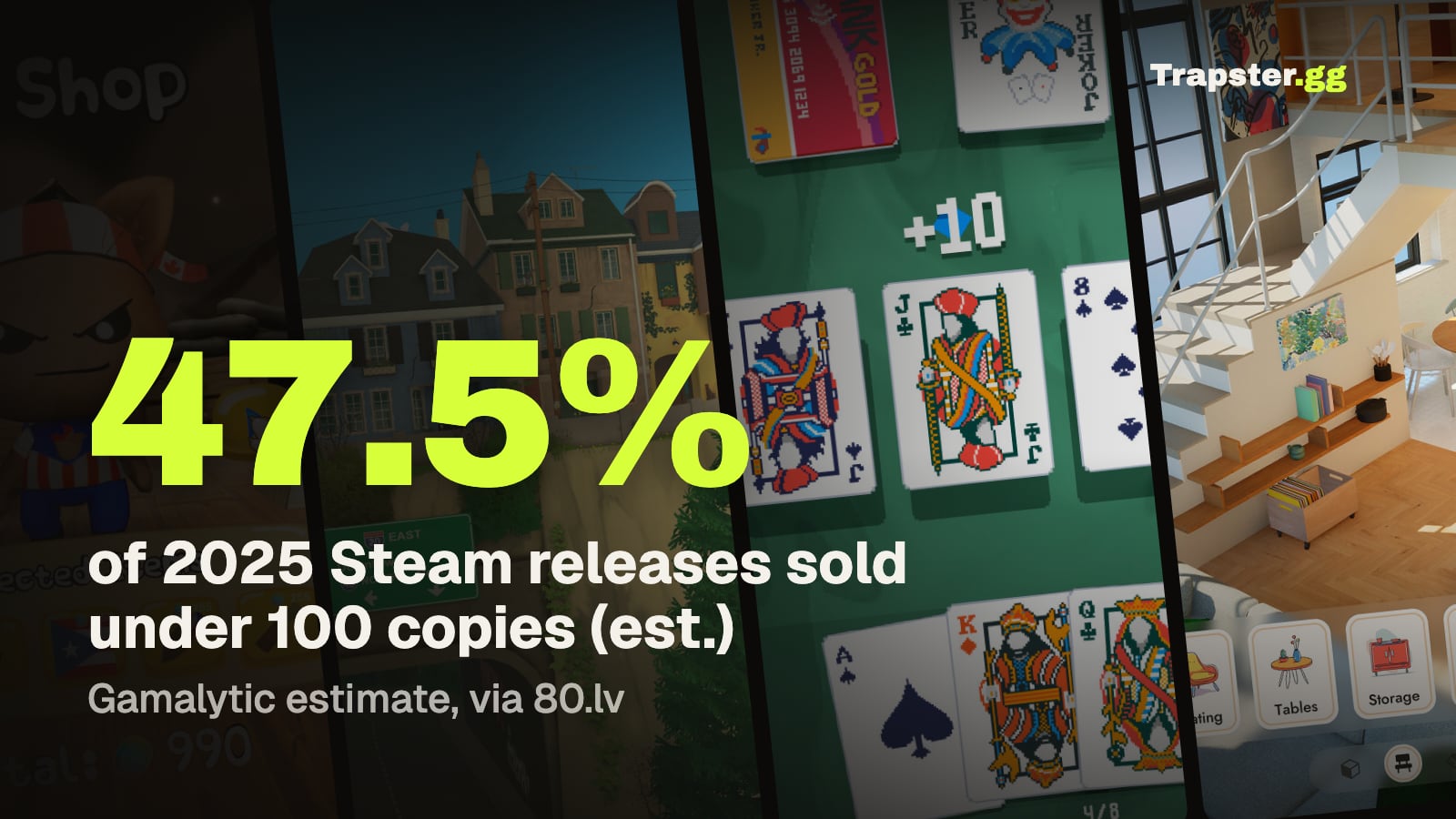
How Many Copies Do Indie Games Sell? Real Steam Numbers by Tier
Most Steam indie games sell under 1,000 copies. Real numbers by tier…
Game Marketing Hook: How to Find, Test and Show Yours
What a game marketing hook is, how to test one cheaply with…
How to Name Your Game: Searchable, Memorable and Legally Safe
How to name your game: pass the Steam, Google and trademark checks…