Publisher vs Self-Publishing Your Indie Game: Real Deal Terms
Real indie publishing deal data: revenue splits, advances, recoup and IP terms from 100+ contracts, plus a decision table and contract red flags.
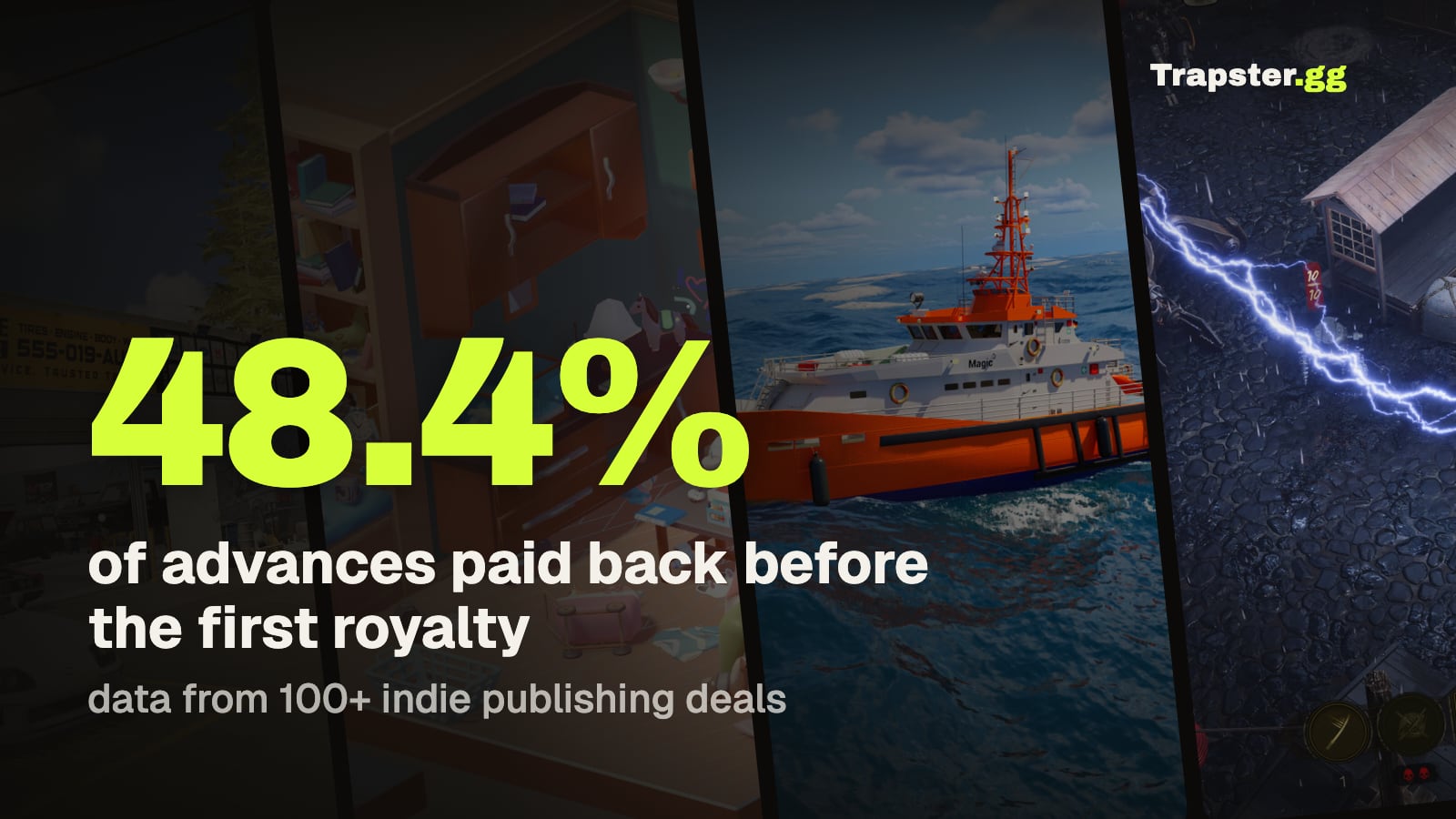
Short answer: Get a publisher if you need money to finish the game or you have no one to run marketing, ports and launch operations. Self-publish if you can fund the game and are willing to do that work yourself, because you keep the full revenue after store fees. Lawyer Kellen Voyer's review of 100+ indie deals found developers get an average of 58.2% of revenue when there is an advance and 67.9% when there is none, and in 48.4% of advance deals the advance was recouped before the first revenue share payout (Voyer Law data via GameDev Reports). Developers kept their IP in 96.4% of advance deals, so losing your IP is not the norm, and a contract that asks for it is a warning sign.
What a typical publishing deal looks like in numbers
The best public dataset on indie publishing terms comes from Voyer Law, a games law firm that analyzed more than 100 developer and publisher agreements signed from 2017 to 2025. The figures below come from that analysis as published by GameDev Reports in May 2025.
| Term | Deals with an advance | Deals without an advance | Console-only deals |
|---|---|---|---|
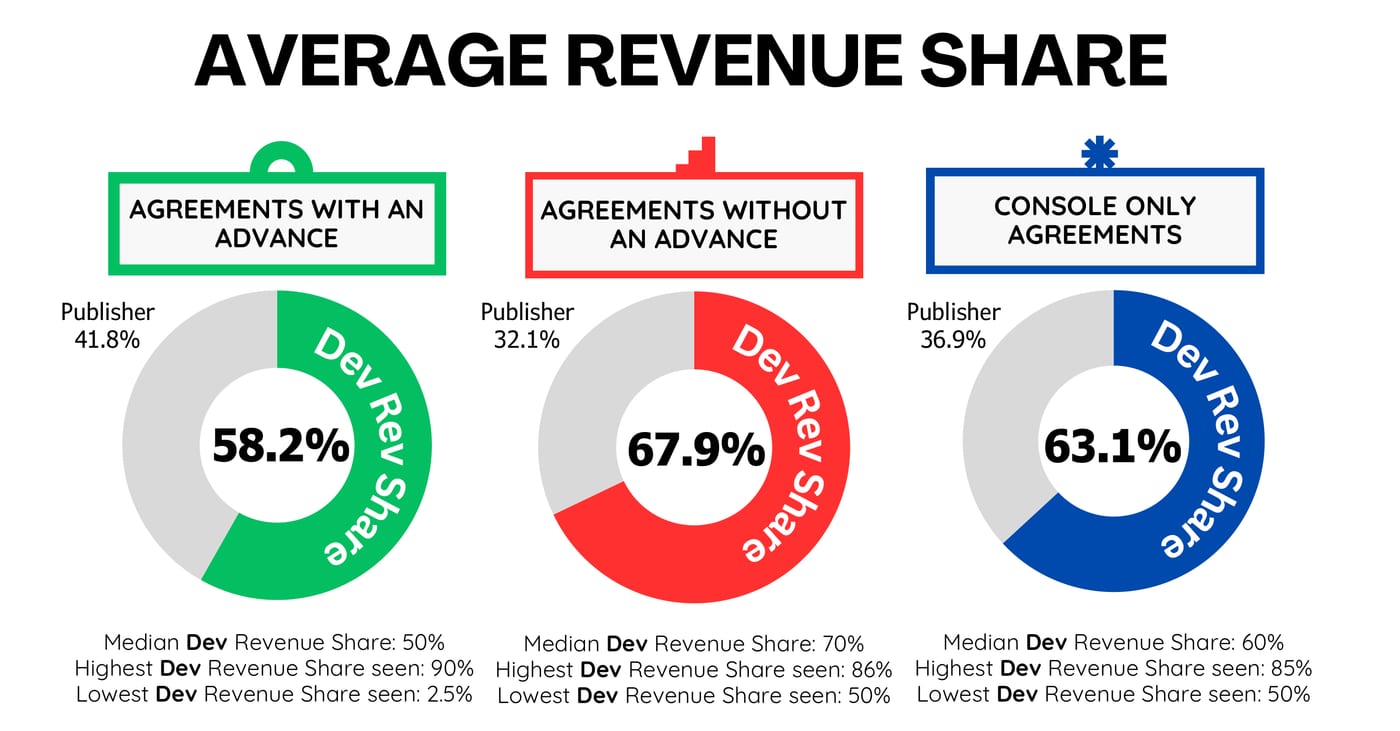
| Developer revenue share, average | 58.2% | 67.9% | 63.1% |
| Developer revenue share, median | 50% | 70% | 60% |
| Developer keeps IP | 96.4% | All deals | All deals |
| Publisher gets sequel rights | 63.49% | 47.06% | 25% |
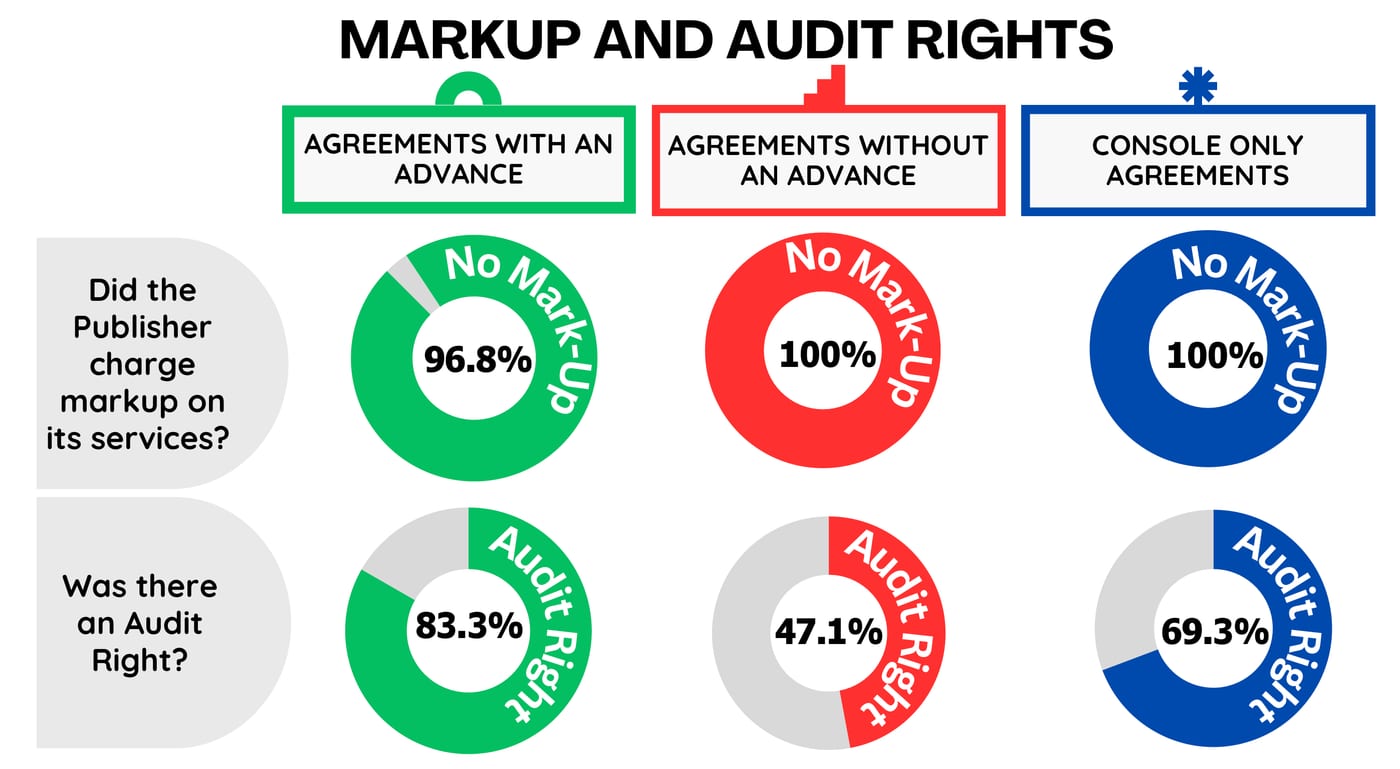
| Developer has audit rights | 83.3% | 47.1% | 69.3% |
| Average term | 6.84 years | 4.18 years | 3.7 years |
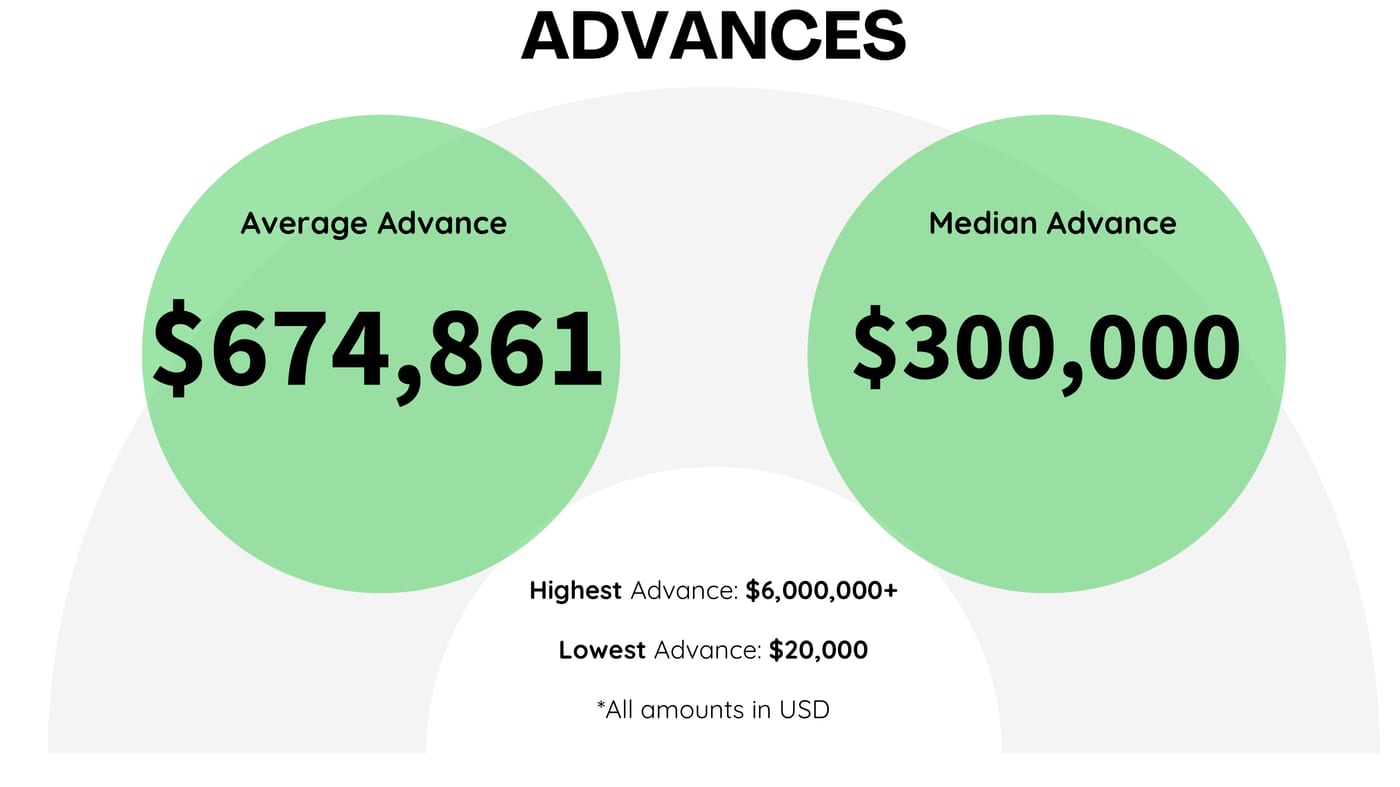
On advances, the average was $674,861 and the median $300,000, with a range from $20,000 to over $6 million. The median matters more for an indie team: one large deal pulls the average up. In 93.9% of cases the advance was recouped from the developer's revenue share, and 79.7% of advances were paid out against milestones rather than as a lump sum. Almost half of agreements (49.2%) renewed automatically, and 15% had no end date at all.
An older sample from Voyer's 2020 GDC talk on 30 indie deals showed a similar picture: an average 60/40 split in the developer's favor, 71% to developers when there was no advance, and 42% of deals requiring full recoup before the developer earned anything (GameDiscoverCo, August 2020).
Four real contracts you can compare
Several publishers have made their terms public. They show how differently "a publishing deal" can be structured.
| Partner | Before recoup | After recoup | What they provide | Source |
|---|---|---|---|---|
| Raw Fury | 100% to publisher until funding plus a 15% markup is repaid | 50/50 of net revenue | Funding, full publishing services | GameDiscoverCo |
| Hooded Horse | No recoup | 65% developer, 35% publisher, fixed | Marketing and distribution | Game Developer |
| Neon Doctrine (sample contract) | 70% publisher, 30% developer | Publisher takes 30% to 50% | Depends on funding and porting | GameDiscoverCo |
| Outersloth (fund, not a publisher) | 50/50 | 85% developer, 15% Outersloth | Money and advice only, no marketing or QA | Mothership |
A few details change how these read. Raw Fury says it typically funds 12 to 24 months of development and that work its own staff does is not added to your recoupable budget. Only externally invoiced costs are (Raw Fury developer resources). Simon Carless called Raw Fury's 50% post recoup royalty a bit more than average and the 15% markup aggressive, while noting it is a full service publisher that believes it is worth it. Outersloth's agreement runs seven years after release whether or not the fund recoups, and the studio keeps the IP. Neon Doctrine's sample contract had a three year term and treated out of pocket marketing as recoupable only up to a pre-agreed amount. If you need money but not a publisher, see indie game grants.
How recoup changes what you actually earn
The headline split tells you less than the recoup structure. Here is an illustrative comparison. Assume a $300,000 advance and $1,000,000 in revenue after store fees. These are hypothetical terms built from the structures above, not any publisher's real offer.
| Structure | Developer royalties | Plus advance | Total to developer |
|---|---|---|---|
| Full recoup of advance + 15% markup, then 50/50 | $327,500 | $300,000 | $627,500 |
| Split recoup (30% to you until repaid), then 60/40 to you | $471,428 | $300,000 | $771,428 |
| No advance, flat 65% to you | $650,000 | $0 | $650,000 |
| Self-published | $1,000,000 minus your own marketing and porting spend | $0 | Depends on spend |
Two things stand out. First, a split recoup is worth real money: Voyer recommended negotiating one unless you expect the game to recoup within a month or two, and Carless agreed (GameDiscoverCo). Second, under full recoup a game that sells modestly can pay you nothing beyond the advance. Hooded Horse co-founder Tim Bender put it bluntly, saying recoup terms are "one horrible thing that exists within the industry" because they cut off a developer's cash flow after launch (Game Developer, May 2024).
Also check the definition of net revenue. In Raw Fury's contract, net is everything the publisher receives minus marketing, services and porting costs. Every cost the publisher deducts before the split comes partly out of your share.
What publishers actually provide
What you get varies more than the split does, so ask each publisher for specifics in writing.
- Funding. The most concrete value. Advances are usually tied to milestones, so plan your production schedule around those dates.
- Marketing. PR, trailers, events, ads and creator outreach. Voyer advises getting the marketing spend and plan written into the contract, to avoid disputes later (Game Developer, March 2023).
- Platform relationships. Contacts at Valve, Microsoft, Sony and Nintendo for featuring and store promotions. Carless names platform holder relationships, and the attention top publishers' games get, as where they give genuine uplift (GameDiscoverCo).
- Porting and console certification. Ports cost money and can be hard to make, as Nicolas Verge of Popagenda put it in a thread GameDiscoverCo quoted (GameDiscoverCo). This is a major reason console deals exist as a separate category.
- QA and localization. Usually handled through outside vendors, which means the cost often becomes recoupable.
- Launch staffing. Carless argues a publisher's most useful contribution may be people around launch and console submission, when a small team has no spare hours.
Do not assume a publisher will carry your marketing alone. The same GameDiscoverCo coverage relays Tavrox's warning that publishers move on from games that do not earn, and that you need to keep working on marketing yourself.
What you must do yourself if you self-publish
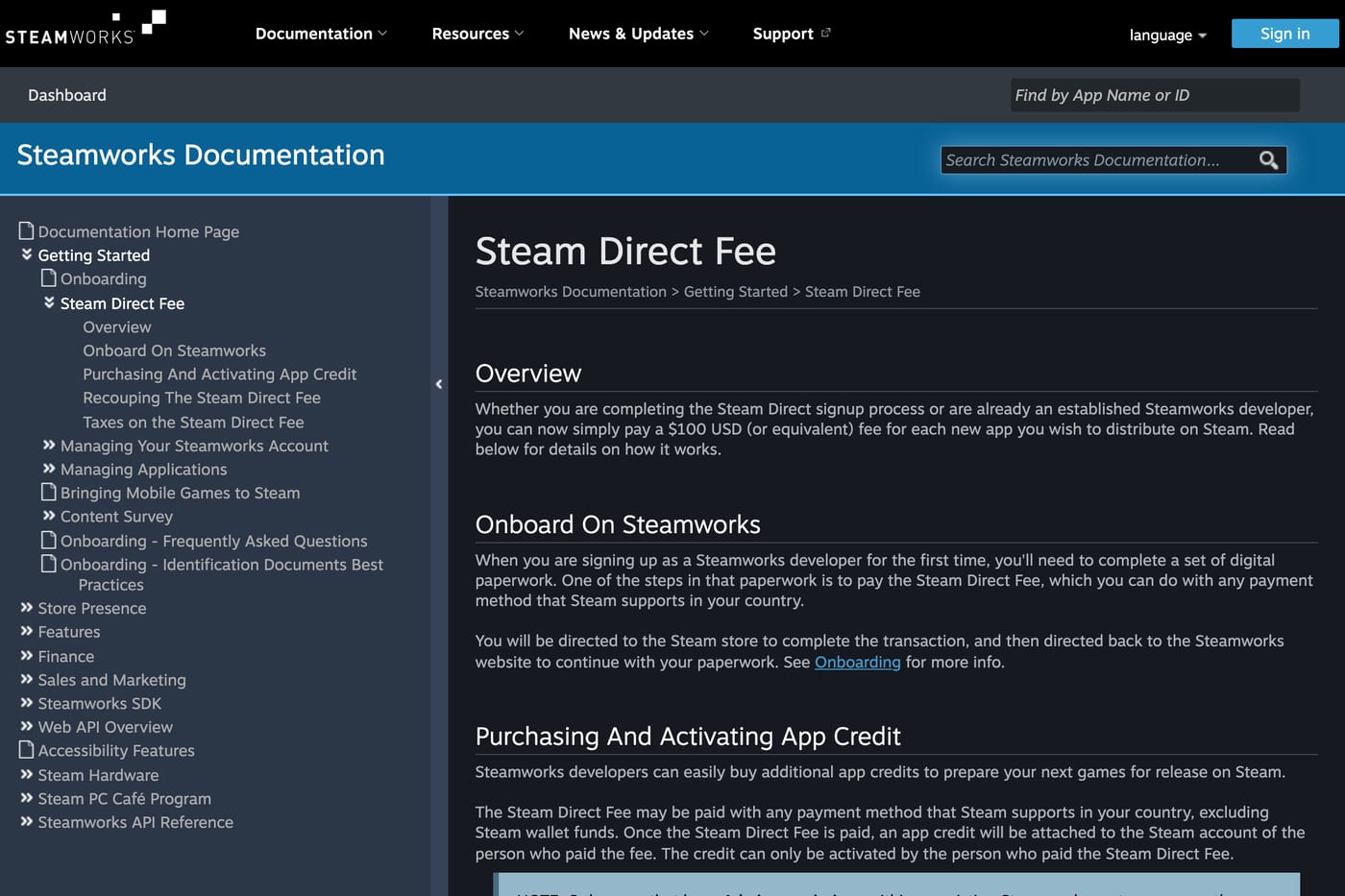
Self-publishing on Steam has a low entry cost. The Steam Direct fee is $100 per app and is recouped once the game earns $1,000 in adjusted gross revenue (Steamworks). Valve then takes its standard revenue share, covered in our guide to Steam fees for developers. Everything else is on you:
- Fund development to the end, plus a marketing budget.
- Build and run the Steam page, trailer, demo and festival plan. Our how to market a game guide covers the full sequence.
- Handle press, creators and community.
- Book QA, and decide on languages using our localization guide.
- Get console access yourself. Microsoft's ID@Xbox program supports independent developers publishing on Xbox, but you still build the port yourself or hire a porting studio. The steps for all three consoles are in how to publish an indie game on consoles.
- Manage builds, store operations, sale calendars and support after launch.
If your team cannot cover several of these, that gap is the honest case for a publisher. If you can, Carless pointed to Noita, which went straight to the top of the Steam charts at launch without a publisher.
Decision table: publisher or self-publish?
| Your situation | Leaning |
|---|---|
| You cannot finish the game without outside money | Publisher or fund |
| You have money but no one to run marketing or launch | Publisher with a marketing-only deal |
| You want console versions and have no porting experience | Publisher, or a porting partner on a console-only deal |
| You have funding and someone who can run marketing full time | Self-publish |
| You already have an audience and strong wishlist growth | Self-publish, or negotiate hard |
| The offer has full recoup, no audit right and a vague marketing plan | Walk away or renegotiate |
If you only need money and not services, look at investment funds like Outersloth, where the post recoup split heavily favors the developer. If you only need services, a no-advance deal keeps your revenue share higher: the median was 70% in Voyer's data.
Contract red flags
These come from Voyer's GDC 2023 talk, reported by Game Developer, plus the data above.
- IP assignment or co-ownership. Voyer warned that under North American law a 50/50 co-ownership can effectively let each owner exploit the IP fully, so the publisher could make other games or DLC without paying you.
- A license wider than the game. If the license covers characters or the world, it can pull in sequels and other works. Limit it to the game.
- Double dipping on costs. Internal marketing or QA staff billed as recoupable, or an extra cut taken on top of platform fees.
- No audit right. Without one you cannot verify any charge. Fewer than half of no-advance deals had it.
- Full recoup plus a markup. Legal, but expensive. Price it out like the table above before you sign.
- Long or perpetual terms with auto-renewal and no rights reversion. If the publisher stops supporting the game, you need a way to get it back.
- Sequel rights. An exclusive right to publish your next game is different from a right to negotiate. Push for the latter.
- Unpaid DLC obligations. If the publisher wants DLC, the contract should say who pays for it.
Have a games lawyer review any offer. A single clause on net revenue or recoup can move more money than the review costs.
How to get an offer worth comparing
Treat this as a sales process. Build a strong vertical slice: Tavrox, quoted by GameDiscoverCo, said a high quality 10 minute demo beats a medium quality 100 minute one. Prepare your deck with our game pitch deck guide, then build a target list from our indie game publishers list. Pitch many publishers at once so you have competing offers to negotiate with. Organic wishlist traction is the strongest evidence you can bring, and short form creator videos are one way to build it before you pitch, as covered in our influencer marketing guide.
FAQ
What is a normal revenue split with an indie game publisher?
In Voyer Law's data on 100+ deals, developers averaged 58.2% when they took an advance and 67.9% without one. Medians were 50% and 70%.
Do publishers take your game's IP?
Rarely. Developers kept the IP in 96.4% of advance deals and in every no-advance and console deal Voyer reviewed. Treat a request for IP as a red flag.
What does recoup mean in a publishing contract?
It is the publisher earning back its advance and recoupable costs from revenue before the normal split applies. In 48.4% of deals with an advance, the advance was recouped before the first revenue share payout.
How big is a typical indie publishing advance?
The median was $300,000 and the average $674,861 in Voyer's 2017 to 2025 sample, ranging from $20,000 to over $6 million.
Is self-publishing on Steam expensive?
Steam's entry fee is $100 per app, recouped after $1,000 in revenue. The real costs are development, marketing, QA, localization and porting, which a publisher would otherwise fund.
Should I get a publisher for my first game?
Only if you need funding or services you cannot supply. If you can fund the game and run marketing yourself, self-publishing keeps more of your revenue.
How long do publishing contracts last?
Deals with an advance averaged 6.84 years and deals without one 4.18 years. About half auto-renew and 15% are perpetual.
Sources: Voyer Law analysis via GameDev Reports; GameDiscoverCo on publishing agreements; GameDiscoverCo on Raw Fury's contract; GameDiscoverCo on whether you need a publisher; GameDiscoverCo on publisher truths; Game Developer on Hooded Horse; Game Developer on contract pitfalls; Mothership on Outersloth; Raw Fury developer resources; Steamworks Steam Direct fee; checked November 2026.
Get a wishlist forecast for your game
Send us your Steam page. We estimate views, creators and cost per wishlist before you spend anything.
Keep reading
How Many Copies Do Indie Games Sell? Real Steam Numbers by Tier
Most Steam indie games sell under 1,000 copies. Real numbers by tier…
Game Marketing Hook: How to Find, Test and Show Yours
What a game marketing hook is, how to test one cheaply with…
How to Name Your Game: Searchable, Memorable and Legally Safe
How to name your game: pass the Steam, Google and trademark checks…