How to Publish an Indie Game on Switch, PlayStation and Xbox
How to get your game on console: Nintendo, PlayStation Partners and ID@Xbox sign-up, dev kits, certification, IARC ratings, porting and real costs.
Short answer: To publish your game on a console you register with each platform holder, get your project approved, get dev hardware, pass that platform's certification and get an age rating. Registering is free on Nintendo and Xbox, and Sony loans hardware: Nintendo says registering for the portal and downloading the tools is completely free, Microsoft says there are no fees to register as an XBOX partner or to apply to ID@XBOX, and Sony offers one complimentary PS5 development kit and one test kit to newly registered partners once their concept is accepted. Digital-only games can get their age ratings through IARC, which Nintendo says costs no fee. The real costs are engineering time, QA and failed certification passes, which is why many indies hire a porting house or sign with a publisher instead.
The three programs at a glance
Each platform holder runs its own developer program, and none of them share accounts or approvals. You apply three times.
| Platform | Program | Who can apply | Dev hardware (official wording) |
|---|---|---|---|
| Nintendo Switch / Switch 2 | Nintendo Developer Portal | Individuals or companies; no business address needed (FAQ) | Pricing not public. Nintendo says you "will find more information on this inside the portal" |
| PlayStation 5 | PlayStation Partners | Publishers and developers who sign up and get a concept accepted | One dev kit and one test kit on loan, returned "within 2 years" (SIE) |
| Xbox Series X/S | ID@Xbox via Xbox Partner Center | 18+, signs an NDA, in a country where Microsoft can do business | Ordered through the Entertainment Developer Store after onboarding (Microsoft) |
Most technical details, including certification checklists for Nintendo and PlayStation, sit behind NDAs. Anything you read on forums about exact kit prices or specific rules for those two platforms is either leaked or out of date. Microsoft is the exception: it publishes its onboarding and certification process openly on Microsoft Learn and devdocs.xbox.com.
Nintendo Switch and Switch 2: how to sign up
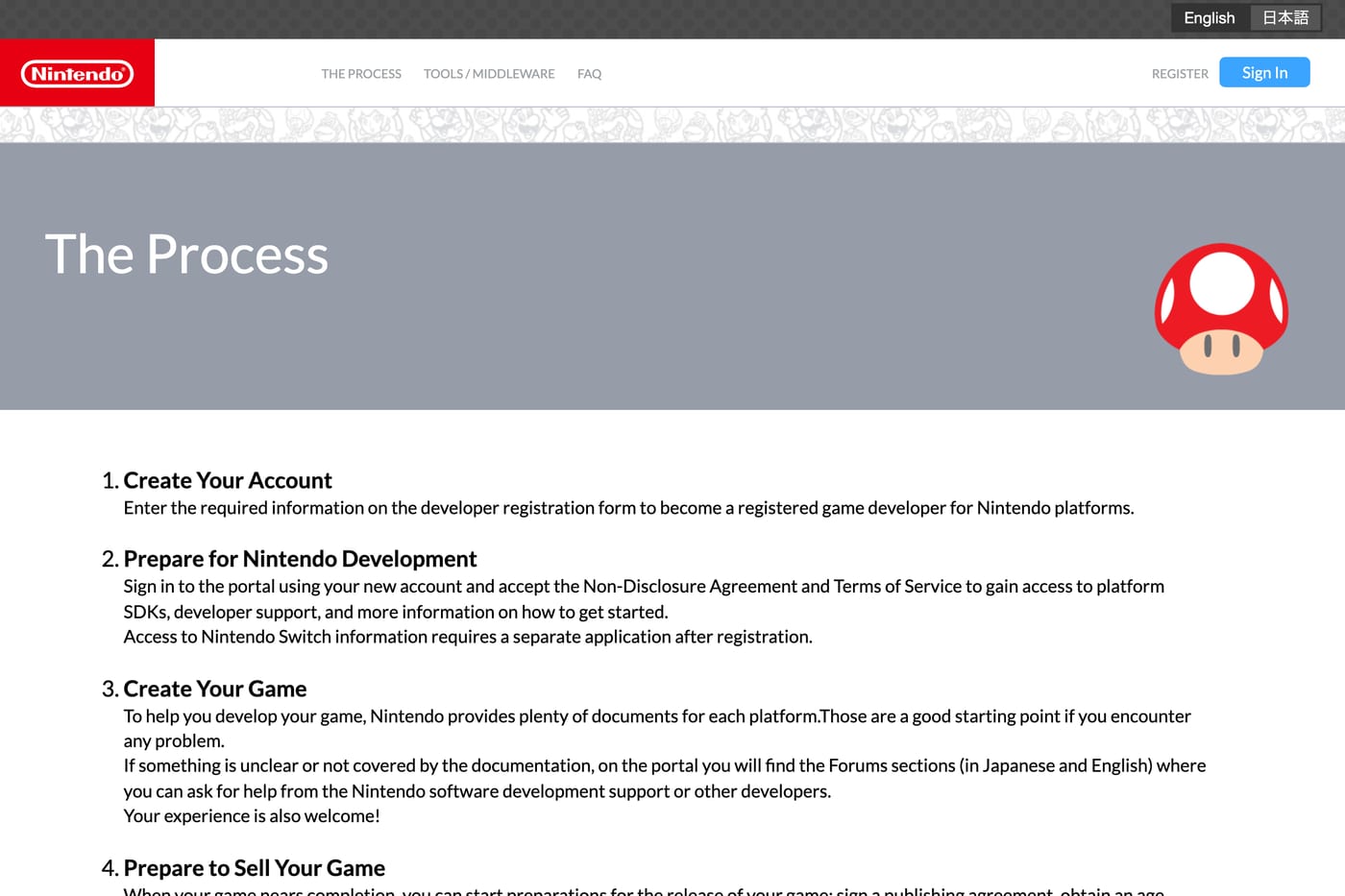
Nintendo's own process page lays out six steps: create your account, prepare for development, create your game, prepare to sell, submit PR materials, then sell and support the game.
- Register on the Developer Portal. Nintendo says you can register even if you are an individual and do not represent a company, and its FAQ says home offices are fine. You must be the legal age of majority in your country.
- Accept the NDA and Terms of Service. That gives you access to general resources.
- Request platform access separately. The registration page says you apply by filling out the "Nintendo Switch Access Request form" in the Getting Started section, describing your "development experience history and information on your planned project." Switch 2 development information is reached from the same portal.
- Sign the publishing agreement and get an age rating when the game is close to done.
- Submit the game for review. Nintendo's wording: "Before you can publish your product, you'll need to submit it to Nintendo for reviewing."
- Provide eShop PR materials and launch.
Nintendo does not publish dev kit prices. The FAQ says details are inside the portal after you register.
PlayStation: how to sign up
Sony's public documentation is the thinnest of the three. What is on the record:
- Sign up at PlayStation Partners. This is the single entry point for developers and publishers.
- Get your game concept accepted. Sony's hardware announcement says you can request kits only once you are registered and "your game concept has been accepted."
- Request the complimentary hardware. Newly registered partners can request one PS5 development kit and one test kit, subject to SIE's standard terms. The kits are a loan and must go back "within 2 years (or earlier, at SIE's request)." Sony announced this in July 2022, so confirm in the partner portal that it still applies to your account.
- Pass Sony's submission and certification process, whose requirements are only visible inside the partner portal.
Xbox: how to sign up with ID@Xbox
Microsoft documents this step by step. Its onboarding overview, updated November 2026, gives four steps:
- Register as an Xbox partner. Use a new Microsoft account made only for this. Have your legal business name ready, a DUNS number if you have one, and a shipping address for dev kits.
- Enroll in Partner Center and verify the account.
- Join ID@Xbox by submitting game information and signing the agreements.
- Complete supplier setup and get Entertainment Developer Store (EDS) access so you can order kits. Microsoft says the ID@XBOX team makes your first kits available to order and that opening the EDS account takes "about a week."
Microsoft also publishes typical timings: the NDA usually arrives "within 20 minutes, but up to three business days," and publishing agreements can take up to 10 business days if flagged for policy review. You can start exploring the GDK in a sandbox before onboarding is finished.
On kit cost, Microsoft's docs do not state a price for ID@Xbox kits. For context, Engadget reported in October 2025 that the standard Xbox Development Kit went from $1,500 to $2,000. Ask ID Setup what your account will pay before you plan around it.
Certification: what actually happens
Certification is where first ports lose the most time. Xbox is the only platform with public numbers. The Xbox certification guide describes three stages: submission checks (Submission Validator and a malware scan), build verification tests, then Xbox Requirement (XR) testing, which it calls "the bulk of the testing." Published turnaround times:
| Xbox submission type | SLA |
|---|---|
| Digital base game, final | 4 business days |
| Digital base game, Fastlane | 48 hours |
| Digital content update | 2 business days |
| Disc submission | 5 business days |
| Optional submission (paid testing service) | 5 business days |
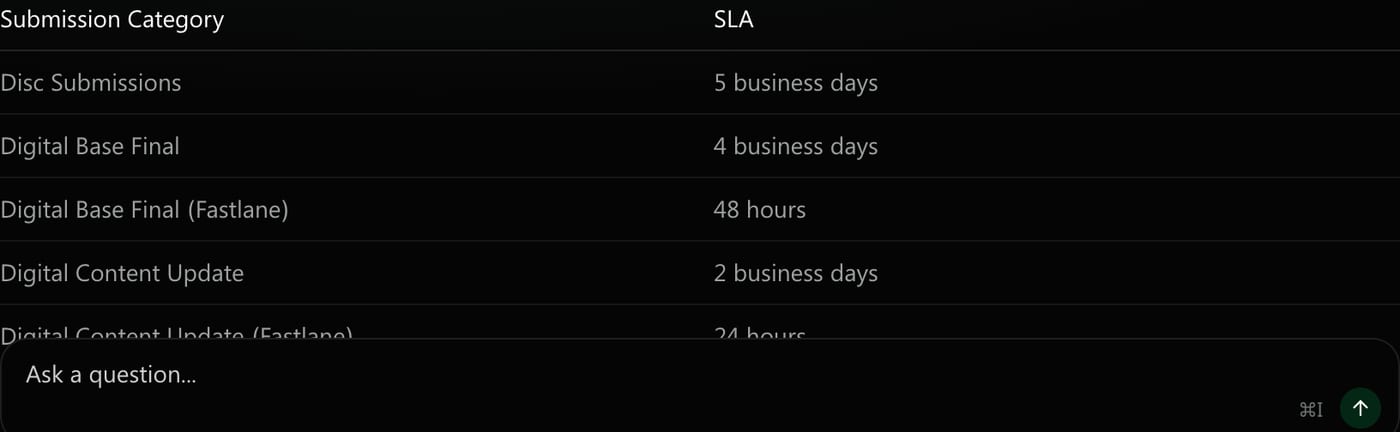
If you fail, you get a report listing every failed requirement, and "all CFRs identified in a fail report must be fixed prior to a resubmission."
Nintendo and Sony also review builds before release, but their checklists and timings are under NDA. One studio's estimate gives a feel for the pain: in a February 2026 MCV piece, the head of marketing at Upscale Studio, a porting and publishing company, wrote that there are "400+ specific requirements" to verify, review queues of 5 to 10 business days, and that many first-time developers need two or three attempts. Treat those as one studio's experience, not platform policy.
Plan your console date with at least two failed passes in the schedule. Each console runs its own review, separate from Steam's build review, so a build that passed on Steam proves nothing here.
Age ratings: IARC or a full rating
For digital-only releases, the International Age Rating Coalition handles ratings through one questionnaire. Its storefront list includes Microsoft, Nintendo and Sony PlayStation, and the process page explains that you answer once and reuse the certificate ID on other IARC storefronts. Nintendo's FAQ says digital-only titles get an IARC rating at no charge.
Physical releases are different. The ESRB says "physical games sold at retail are reviewed prior to release": the publisher submits a questionnaire and gameplay video, and trained raters assign the rating. Other regions (Japan's CERO, for example) have their own boards. If a boxed edition is part of your plan, price the ratings before you commit.
Porting house, publisher or in-house
You have three realistic options:
- Port it yourself. You keep all revenue and learn the platforms, but you need an engine with console export, approved accounts on each platform, kits and someone who has shipped through certification before. The MCV piece estimates 1 to 3 months of console-specific work (controller support, save systems, UI scaling) and advises first-timers to plan for at least 3 months. That is an estimate, not a guarantee.
- Hire a porting house. A porting studio already holds the licenses, kits and certification experience. Deals are typically a fixed fee, a revenue share on the ported platforms, or a mix. Ask for a quote after they assess your build; the price depends on engine, performance targets and how many platforms you want.
- Sign a publisher who handles ports. Many indie publishers fund ports, run certification and get you into platform holder promotions in exchange for a share of revenue. Our guide to publisher vs self-publishing covers that trade-off in detail, and indie game publishers lists who to pitch.
What each route looked like for real games:
- In-house: poncle took Vampire Survivors to Switch on August 17, 2023, ten months after its October 2022 Steam 1.0. The same Steam post announced that the Steam version was "fully moving to a new engine", the rebuild that came with the console versions.
- Porting house: Brotato hit Steam 1.0 on June 23, 2023, and its solo developer announced a Switch release for August 3 "thanks to the hard work of Seaven Studio" (Steam announcement). He noted the port's performance work would also be brought back to the PC version.
- Publisher, day one: Balatro skipped the PC first pattern. Its publisher Playstack announced it for Steam, PlayStation, Nintendo Switch and Xbox on February 20, 2024, all on the same day.
Timeline and costs you can source
Here is what the public record supports, labeled by how solid it is:
| Item | What the source says | Type |
|---|---|---|
| Program registration | Free on Nintendo and Xbox; Sony loans hardware to new partners | Official |
| Xbox onboarding to kit ordering | NDA up to 3 business days, agreements up to 10, EDS about a week | Official |
| Xbox certification | 4 business days per digital final submission | Official SLA |
| IARC rating, digital only | No fee (Nintendo FAQ) | Official |
| Standard Xbox dev kit | $2,000 since October 2025 | Press report |
| Console-specific engineering | 1 to 3 months; plan 3 minimum for a first port | One studio's estimate |
| Certification attempts | 2 to 3 attempts common for first-timers | One studio's estimate |
Nintendo and Sony kit prices, plus porting house rates, are not public. Get quotes.
Real ports: how long after the PC launch
Most successful indies shipped consoles months after Steam, not on day one. Dates below come from developer announcements and release coverage.
| Game | PC release | Console release | Gap | Who released the port |
|---|---|---|---|---|
| Brotato | Steam 1.0, June 23, 2023 | Switch, August 3, 2023 | About 6 weeks | Seaven Studio (Steam) |
| Dave the Diver | Steam 1.0, June 28, 2023 | Switch, October 26, 2023 (Gematsu); PS5/PS4, April 16, 2024 (Gematsu) | 4 and 10 months | MINTROCKET, the developer |
| Vampire Survivors | Steam 1.0, October 20, 2022 | Switch, August 17, 2023 (Steam) | 10 months | poncle, in-house |
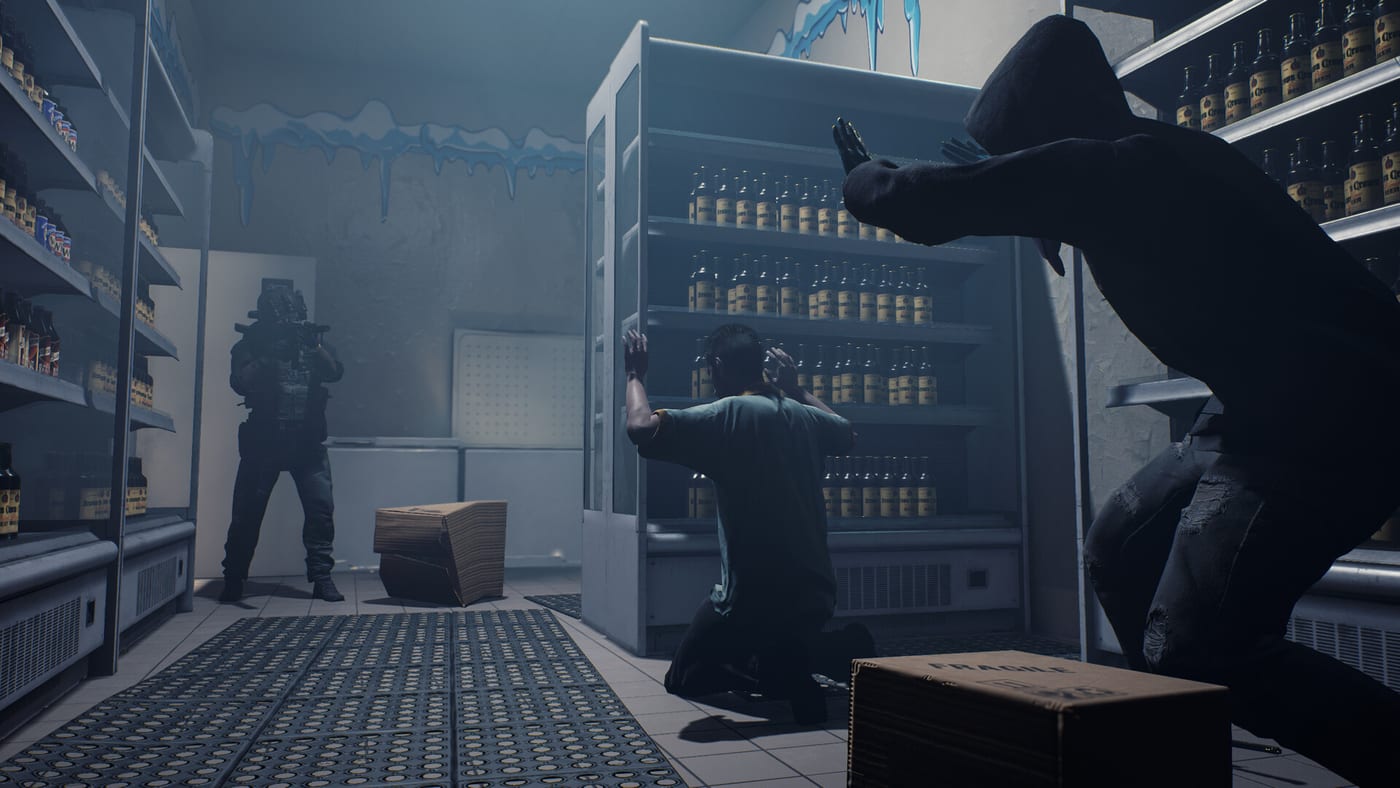
| Ready or Not | Steam 1.0, December 13, 2023 | PS5 and Xbox Series X/S, July 15, 2025 (Steam) | About 19 months | VOID Interactive; porting partner not named publicly |
| The First Tree | Steam, September 2017 | Consoles, November 2018 (GameDiscoverCo) | About 14 months | Solo developer David Wehle; porting partner not named in the source |
| Balatro | Steam, February 20, 2024 | All three consoles the same day | None | Released with publisher Playstack |
Two outcomes worth knowing. Dave the Diver passed 3 million copies across platforms by December 2023, two months after the Switch launch; the studio did not give a platform split. Ready or Not's team announced 1 million console copies in under 4 days, taking the game past 10 million lifetime units. That is the developer's own figure, reported by GameDiscoverCo, and it came after two years of a large PC player base. The console launch also shipped alongside a free PC content update with crossplay between all platforms, so PC players got a reason to come back on the same date.
When consoles are worth it
Consoles add revenue, but rarely in the way people expect. Some data points:
- GameDiscoverCo's 2021 analysis found developers often describe ports as "we made back our porting costs, and it's nice bonus money," and called PC the steadier market.
- In a July 2023 look at the US eShop, GameDiscoverCo estimated that fewer than 10% of the roughly 200 Switch releases each month reach the top 300 downloads, with #200 around 5,000 units and #100 around 10,000 units in the first 14 days. These are estimates from chart positions, since Nintendo publishes no sales data.
- One developer, Thomas Altenburger, reported in 2021 that Switch made 91% of NeuroVoider's first 60 days of revenue in 2017 but only 14% for ScourgeBringer in 2020. He cautioned against spending resources on a Switch port unless you port it yourself.
- Splits vary wildly between studios. In a 2021 Kotaku piece, WhiteThorn Games shared a chart with about 60% of sales on Switch, 30% on Xbox, 7% on Steam and 3% on PlayStation. Those Awesome Guys shared the opposite: 91.5% Steam, 7.6% Switch, 0.6% Xbox and 0.3% PlayStation. Both are single studio reports.
- GameDiscoverCo noted in 2021 that Car Mechanic Simulator sold 10% of its PC launch on Xbox over the same timeframe.
- Ron Gilbert's 2018 breakdown for Thimbleweed Park showed Switch narrowly ahead of Steam, even though the Switch version arrived months after PC, with PlayStation well behind both.
Consoles tend to make sense when:
- Your game already sells on Steam. Port after you have proof. Review counts and wishlist data also help your pitch to platform holders and publishers.
- The genre fits the platform. A game built around a controller ports far more easily than one built around a mouse. Mouse-heavy strategy usually needs a UI rebuild.
- Someone else carries the risk. A publisher, a porting house on revenue share, or a platform holder deal changes the maths.
- You can support it. Every patch goes through certification again on each platform.
If your PC launch has not happened yet, your time is usually better spent on the Steam launch and on wishlists. A console announcement can be a second marketing beat later, and it works well paired with a short-form creator push timed to the console date, as covered in our influencer marketing guide.
FAQ
How do I publish a game on Switch as an indie developer?
Register for free on the Nintendo Developer Portal, then submit the Nintendo Switch Access Request form with your experience and project details. Once approved you get tools and documentation, then you sign a publishing agreement, get an age rating and pass Nintendo's review before release.
Do I need a company to publish on consoles?
Not for Nintendo: its FAQ says individuals can register. Xbox onboarding asks for your legally registered business name. Sony does not publish its entity rules outside the partner portal, so check there when you sign up.
How much does a console dev kit cost?
Sony loans one PS5 dev kit and one test kit to newly registered partners with an accepted concept. Nintendo and Microsoft do not publish ID program prices; Engadget reported the standard Xbox kit at $2,000 in October 2025.
How long does console certification take?
Xbox publishes a 4 business day SLA for a digital base game final submission. Nintendo and Sony timings are under NDA, and every failed pass adds another round.
Do I need an ESRB rating to sell on consoles?
For digital-only games, an IARC rating covers ESRB and other participating regions, and Nintendo says it is free. Physical retail games go through the ESRB's full review process.
Can I publish on consoles without a publisher?
Yes. All three programs accept self-publishers. You still need the platform knowledge, kits and certification time, so many studios hire a porting house instead.
Should I launch on consoles and PC at the same time?
Usually only with a publisher or experienced porting partner. Most indies launch on Steam first and port once the game has proven demand.
Sources: Nintendo Developer Portal FAQ, Nintendo: The Process, SIE complimentary development hardware, Microsoft Learn: Xbox onboarding, Xbox certification guide, IARC, ESRB ratings process, MCV, GameDiscoverCo, GameDiscoverCo on Ready or Not, Kotaku, Steam announcements for Brotato, Vampire Survivors and Balatro; checked November 2026.
Get a wishlist forecast for your game
Send us your Steam page. We estimate views, creators and cost per wishlist before you spend anything.
Keep reading
How Many Copies Do Indie Games Sell? Real Steam Numbers by Tier
Most Steam indie games sell under 1,000 copies. Real numbers by tier…
Game Marketing Hook: How to Find, Test and Show Yours
What a game marketing hook is, how to test one cheaply with…
How to Name Your Game: Searchable, Memorable and Legally Safe
How to name your game: pass the Steam, Google and trademark checks…