itch.io vs Steam: Where to Sell Your Indie Game in 2026
itch.io vs Steam vs Epic vs GOG: real fees from official pages, audience size, when to use itch.io before Steam, and a decision table for indie devs.
Short answer: For a commercial PC release, Steam is where the paying audience is, and itch.io is where you test ideas cheaply before you commit. itch.io lets you set your own revenue share, with a default of 10%, and you can publish for free. Steam charges a $100 Steam Direct fee per game, recouped once the game makes $1,000, and takes 30% until a game passes $10 million. Epic currently lets you keep 100% of the first $1M in net revenue per product, per year, which is the best headline rate of the three, but the store works very differently. Most indies end up doing both: prototypes, jam games and early demos on itch.io, then the full game on Steam, with Epic and GOG as extra storefronts once the game exists.
The fees, side by side
Every number below comes from the platform's own pages, checked in November 2026.
| itch.io | Steam | Epic Games Store | GOG | |
|---|---|---|---|---|
| Upfront fee | None. Publishing is free | $100 per app, recoupable after $1,000 Adjusted Gross Revenue | $100 per game, recoupable | Not published. Curated by submission |
| Store cut | You choose 0 to 100%. Default 10% | 30%, then 25% above $10M, 20% above $50M | 0% on the first $1M net revenue per product per year, then 12% | Not stated on GOG's submission pages |
| Payment processing | On top: itch.io lists $0.30 + 2.9% per transaction for PayPal and Stripe | Included | Included | Not stated |
| Who gets in | Anyone | Anyone who passes Steam Direct and review | Anyone through self-publishing tools | GOG picks |
itch.io. The revenue share is a slider. When itch.io introduced open revenue sharing, it set the default at 10% and let sellers pick anything "from 0 to 100%". On top of that, PayPal and Stripe each take their own fee per transaction, which itch.io's payments docs list as $0.30 + 2.9%. On a cheap game that fixed 30 cents is a real slice. You choose between two payout modes. "Collected by itch.io, paid later" means itch.io handles EU VAT for you, revenue becomes available 7 days after purchase (up to 30 days in some cases), and you need at least $5 to request a payout. "Direct to you" sends money straight to your PayPal or Stripe account, but then VAT collection and remittance is your job.
Steam. The $100 fee is per app and comes back to you in the payment after the game reaches $1,000 in Adjusted Gross Revenue, according to the Steam Direct fee page. The revenue split has not changed since Valve's 2018 Distribution Agreement update: above $10 million a game moves to 75/25 "on earnings beyond $10M", and above $50 million to 80/20. For an indie, the practical rate is 30%. GameDiscoverCo estimated in March 2026 that Valve's effective take across all third-party games was 24% in 2025, but that average is pulled down by the biggest hits, and their breakdown says most individual developers sit on the 30% tier. For the full Steam picture, including taxes and what the $1,000 threshold means in practice, see our guide to Steam fees for developers.
Epic. Epic's distribution page says you keep 100% of the first $1M in net revenue per product, per year, and then "return to our standard 88%/12% model." The program started June 1, 2025, and per Epic's revenue share FAQ, from 2026 the $1M threshold resets every January 1. It applies to payments processed by Epic across PC, Mac, iOS and Android. There is a recoupable $100 submission fee per game. If your game is built on Unreal, Epic waives engine royalties on in-store purchases that use Epic's payment system. There is also an opt-in exclusivity program, Epic First Run, that gives 100% for your first 6 months regardless of revenue. Epic adds two requirements worth knowing early: multiplayer games must support crossplay across all PC stores, and games onboarded after March 9, 2023 that have achievements on other PC stores must enable them on Epic too.
GOG. GOG is curated. You apply through its submission page, and its release FAQ says GOG can't give feedback on games in early development and encourages you to submit once the game is near final or already released elsewhere. Games are sold DRM-free. GOG does not publish a revenue split on these pages, so ask during the deal rather than trusting old forum numbers.
Audience size and discovery
The fee table makes Epic and itch.io look better than Steam. The audience table goes the other way. The Epic process itself is in how to publish a game on the Epic Games Store.
Steam is the biggest PC store by a wide margin. Valve's own charts page showed about 42 million players online when we checked in November 2026. More important than the raw number: Steam has wishlists, follower notifications, Next Fest, seasonal sales, tag pages and recommendation queues that route players to games they did not search for. Demos on Steam are a separate free app tied to your game, and Valve's demo docs say they "can appear anywhere in Steam that a free game could appear," including New & Trending and tag pages.
Epic says it reaches "over 295 million" users across 187 countries, a figure from its 2024 year in review of PC users. That is Epic's own number, and it counts accounts, many created for Fortnite or the weekly free games. Epic has wishlists and storewide promotions, but nothing like Steam's tag pages and queues for indie discovery.
itch.io does not publish user numbers. What it does publish is telling: its jams page says 626,153 games have been made for jams hosted there. itch.io is a creator community first. Players come to browse jams, try free browser games and follow small developers. They are much less used to paying for games than Steam players are.
The best public data on itch.io traffic is Chris Zukowski's survey of 169 developers in May 2025. The median game in that sample had 1,582 lifetime views. The average was 54,483, pulled up by a few hits. Zukowski notes most itch.io games get almost no traffic after their first month.
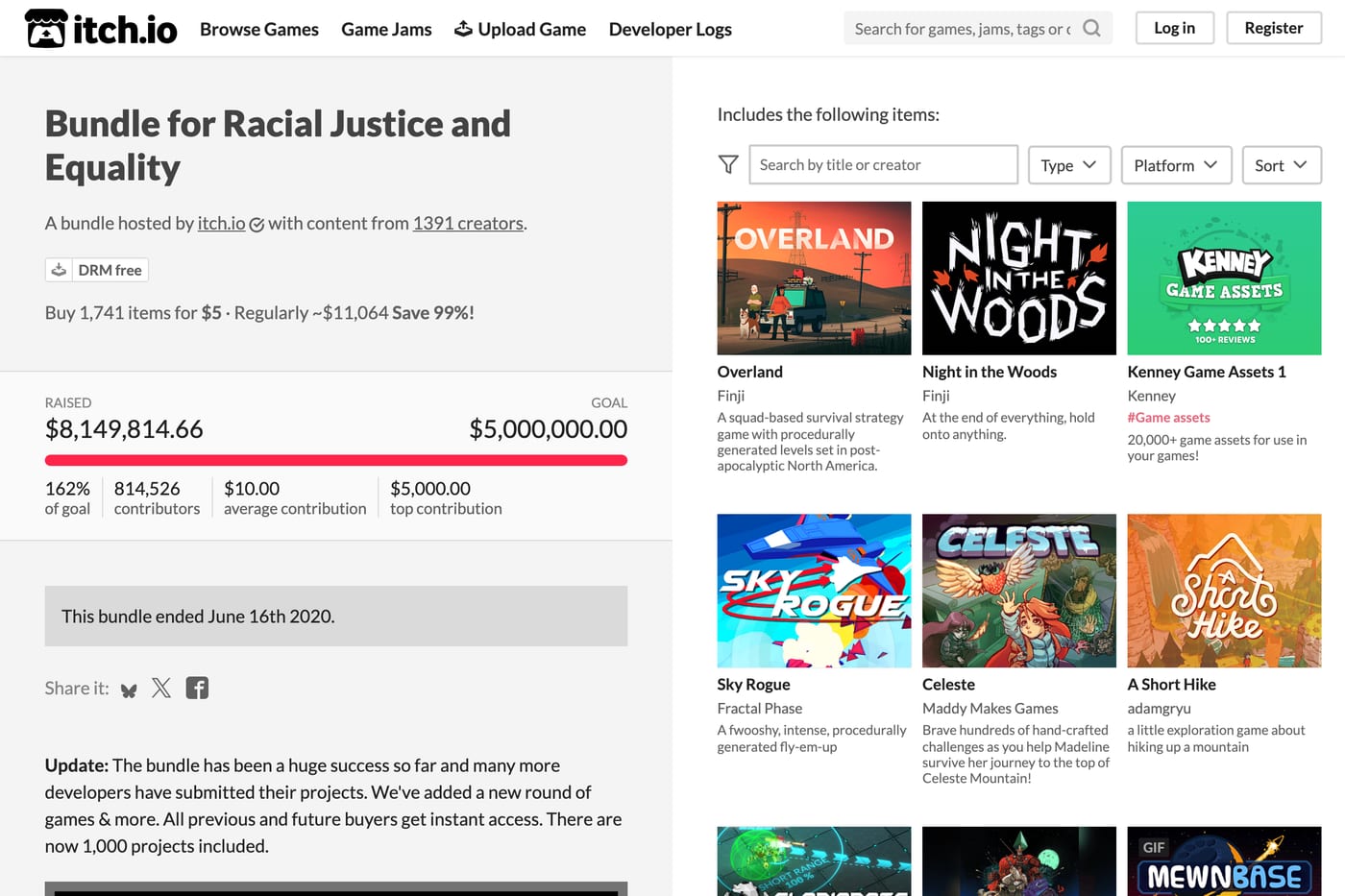
The exceptions show what itch.io is good at. Killer Chat!, a Spooktober Visual Novel Jam 2024 entry, reached about 645,000 views and 188,000 downloads on itch.io, per Zukowski's tracking. The free version of The Roottrees are Dead earned $3,000 in tips in its first month, as reported in Zukowski's case study. And itch.io's Bundle for Racial Justice and Equality raised $8,149,814 from 814,526 buyers in June 2020, with 1,391 creators contributing. That bundle is a one off, but it proves itch.io buyers will pay when the cause or the game gives them a reason.
GOG has a smaller, loyal audience that cares about DRM-free ownership and classics. It is a good extra storefront for a finished game that fits that taste, and not a place to launch a first game into.
Example: Weather Factory published its store split for Cultist Simulator in February 2019. Of roughly 105,000 copies, Steam sold 93,000 (1.46 million USD gross), Humble 7,400, GOG 3,100 (58,300 USD gross) and itch.io 170 (3,500 USD gross). The data is older and from one studio, but the shape matches what most indies report: the extra stores add a few percent, not a second launch.
What each store is good for
Use itch.io for:
- Game jams. "Anyone can instantly create and host a jam," as the jams page puts it, and jam players actually play and comment.
- Prototypes and vertical slices you want real strangers to test before you commit years of work.
- Browser builds. itch.io supports HTML5 games played in the page, with limits of 1,000 files and 500MB extracted. Browser play removes the download step, which matters a lot for a first impression.
- Pay-what-you-want releases, small experimental games and anything you want to sell with almost no store cut.
Use Steam for:
- Your commercial launch. This is where wishlists, reviews and sales events live.
- The demo you want to bring to Next Fest. See our guide to marketing a Steam demo.
- Long tail sales through seasonal sales and discounts years after release.
Add Epic when the game is finished and you can support another build and storefront. The 100% share on your first $1M makes every Epic sale worth more than a Steam sale, but expect fewer sales unless you get featured or are part of an exclusive deal.
Example: Blood West, developed by Hyperstrange and published by New Blood, was one of Epic's free holiday games on December 20, 2025. New Blood CEO Dave Oshry posted that it "sold like 200% more on Steam that day," and that Epic's lump sum for the giveaway went entirely to the developer, as reported by Wccftech. That is one publisher's own report with no absolute numbers, but it shows a common pattern: Epic exposure can feed Steam sales rather than replace them.
Using itch.io before Steam
itch.io works best as a test bench for a Steam game, not as a replacement for one. Zukowski's follow up on itch.io games that moved to Steam calls a strong itch demo "a necessary (but not sufficient) condition for doing well on Steam." His best case, Die in the Dungeon, was a 2021 jam prototype with over 1.4 million itch.io views that launched in Steam Early Access in February 2025 and had 1,694 reviews when Zukowski wrote about it in May. His cautionary case, Tiny Kingdom, had about 198,000 itch.io views and over 10,000 Steam wishlists, but only 107 reviews at launch. The developer pointed to a game that was too hardcore at launch, marketing that sold it as cozy when it played as strategy, and launch emails sent only four days before release.
More games that took this route:
| Game | itch.io start | Steam result (as reported) |
|---|---|---|
| The Roottrees are Dead | Global Game Jam 2023 game, free browser build on itch.io from November 2023 | Rebuilt paid version launched January 15, 2025 at $19.99. About 13,000 wishlists at launch, over 1,000 reviews in 3 weeks and over $1 million in revenue, per Zukowski. The Steam page showed 5,252 English reviews, 96% positive, in November 2026 |
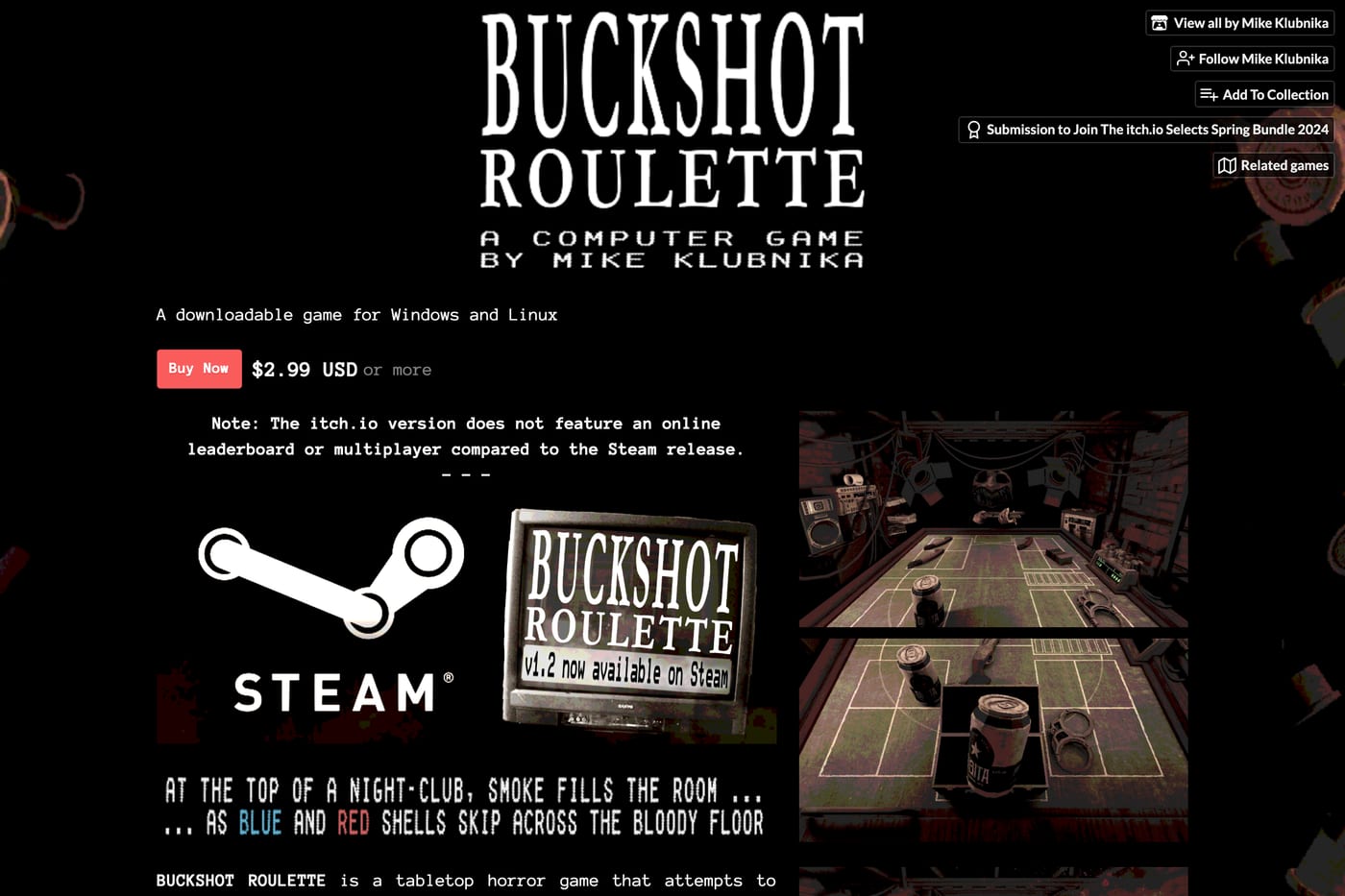
| Buckshot Roulette | Paid itch.io release ($2.99) with devlogs from December 29, 2023 | Launched on Steam on April 4, 2024 with an update and online multiplayer the itch.io build does not have. Crossed 1 million units sold in just over a week, per its publisher |
| NIMRODS | itch.io build from May 2023, about 123,000 views | Steam Early Access on October 28, 2024, 1,203 reviews when Zukowski checked in May 2025 |
| Dome Keeper | Ludum Dare entry "Dome Romantik", the team's most reviewed of 14 itch.io games | Signed with Raw Fury, over 189,000 wishlists before its 2022 launch and $1 million within a day, per the publisher's CEO |
The common thread: each Steam version was a bigger, rebuilt game, and the itch.io build did the job of a free demo before a Steam page had any traffic.
A practical sequence:
- Ship a small build on itch.io. A jam entry or a free prototype, browser playable if your engine allows it. Example: before Dome Keeper, Bippinbits had released 14 games on itch.io, 12 of them from Ludum Dare jams. Co-founder Rene, quoted in Zukowski's case study: "I feel like we needed 10 game jam games to get good enough to make a proper good game."
- Watch for a pickup signal. Zukowski suggests looking for things like a featured spot, a top ranking, or a single day with 1,000+ views. No signal after a fair try is useful information too.
- Collect feedback there, not in Early Access. itch.io comments and devlogs are a cheap feedback loop. Steam reviews are permanent.
- Open your Steam page once the idea is proven. Link it from your itch.io page and in the game's menus so itch.io players can wishlist it. Our guide on when to make a Steam page covers timing.
- Make the Steam version clearly bigger. Better art, more content, new systems. Keep the old itch.io build up, labeled as the original prototype. Example: the Steam version of The Roottrees are Dead was rewritten in Godot, replaced the jam version's AI generated art with illustrations and added a second chapter, while the free original stayed on itch.io.
Two Steam rules to plan around. First, if you also sell the game on itch.io with Steam keys, Valve's key rules say "It is important that you don't give Steam customers a worse deal than Steam Key purchasers." Discounts on other stores are fine as long as you give Steam customers a comparable offer within a reasonable time. New developers must also wait three weeks after creating an App ID before requesting keys. Second, your first Steam release has its own clock: a 21 day wait after paying the fee, a public Coming Soon page for at least two weeks, and build review that normally takes 3 to 5 business days but was running up to 12 business days in November 2026. The full process is in how to publish a game on Steam.
A prototype that already plays well also makes it easier to get creators to cover the game when you work with influencers.
Decision table
| Your situation | Best fit | Why |
|---|---|---|
| Jam game or weekend prototype | itch.io | Free, instant, jam players give feedback |
| Testing whether an idea has a hook | itch.io, browser build | Low effort for players to try, traffic shows interest |
| Pay what you want or experimental game | itch.io | You set the cut, down to 0% |
| First commercial PC game | Steam | Largest paying audience plus wishlists and sales events |
| Demo for a festival or Next Fest | Steam | Demos appear where free games appear |
| Finished game, extra revenue | Epic, after Steam | 0% on first $1M per year, but expect lower volume |
| Unreal game with Epic payments | Epic as a second store | Engine royalties waived on Epic processed purchases |
| Polished, DRM-free friendly game | GOG, after release | Curated, loyal audience, submit when finished |
FAQ
Is itch.io better than Steam for indie developers?
For prototypes and jam games, yes: it costs nothing and the default cut is 10%. For a commercial release, Steam usually earns far more because its audience buys games and the store has wishlists and sales events built around it.
How much does itch.io take from sales?
Whatever you set. The default is 10%, and you can choose anything from 0 to 100%. PayPal or Stripe processing fees ($0.30 + 2.9% per transaction, per itch.io's docs) come on top.
How much does Steam take?
30% of revenue until a game passes $10 million, then 25%, and 20% above $50 million. You also pay a $100 Steam Direct fee per game, which is recouped once the game reaches $1,000 in Adjusted Gross Revenue.
Is Epic still 0% on the first $1 million in 2026?
Yes. Epic's distribution page says developers keep 100% of the first $1M in net revenue per product, per year, with the threshold resetting each January 1. After that it is 88/12.
Can I sell my game on itch.io and Steam at the same time?
Yes. If you sell Steam keys through itch.io, Valve's key rules require that Steam customers don't get a worse deal, so keep pricing and discounts comparable.
Should I put my game on itch.io before Steam?
It is a good idea for early prototypes and jam builds, because it shows whether players care before you spend years on it. Make the Steam version clearly bigger and better than the free itch.io build.
Where should I sell my indie game?
Launch on Steam for the main audience, use itch.io before that to test and build early fans, and add Epic or GOG once the game is finished and you can support more storefronts.
Sources: itch.io payments docs, itch.io open revenue sharing, itch.io HTML5 docs, itch.io jams, Steam Direct fee, Steam Direct, Valve revenue share tiers, Steam pre-release review update, Steam keys, Steam demos, Steam charts, Epic distribution, Epic revenue share FAQ, GOG submission, GOG release FAQ, GameDiscoverCo, How To Market A Game: itch.io traffic, How To Market A Game: itch.io to Steam, How To Market A Game: The Roottrees are Dead, How To Market A Game: Dome Keeper, Buckshot Roulette on itch.io, Buckshot Roulette 1 million sold, itch.io Bundle for Racial Justice, Weather Factory sales by store, Wccftech on Blood West; checked November 2026.
Get a wishlist forecast for your game
Send us your Steam page. We estimate views, creators and cost per wishlist before you spend anything.
Keep reading
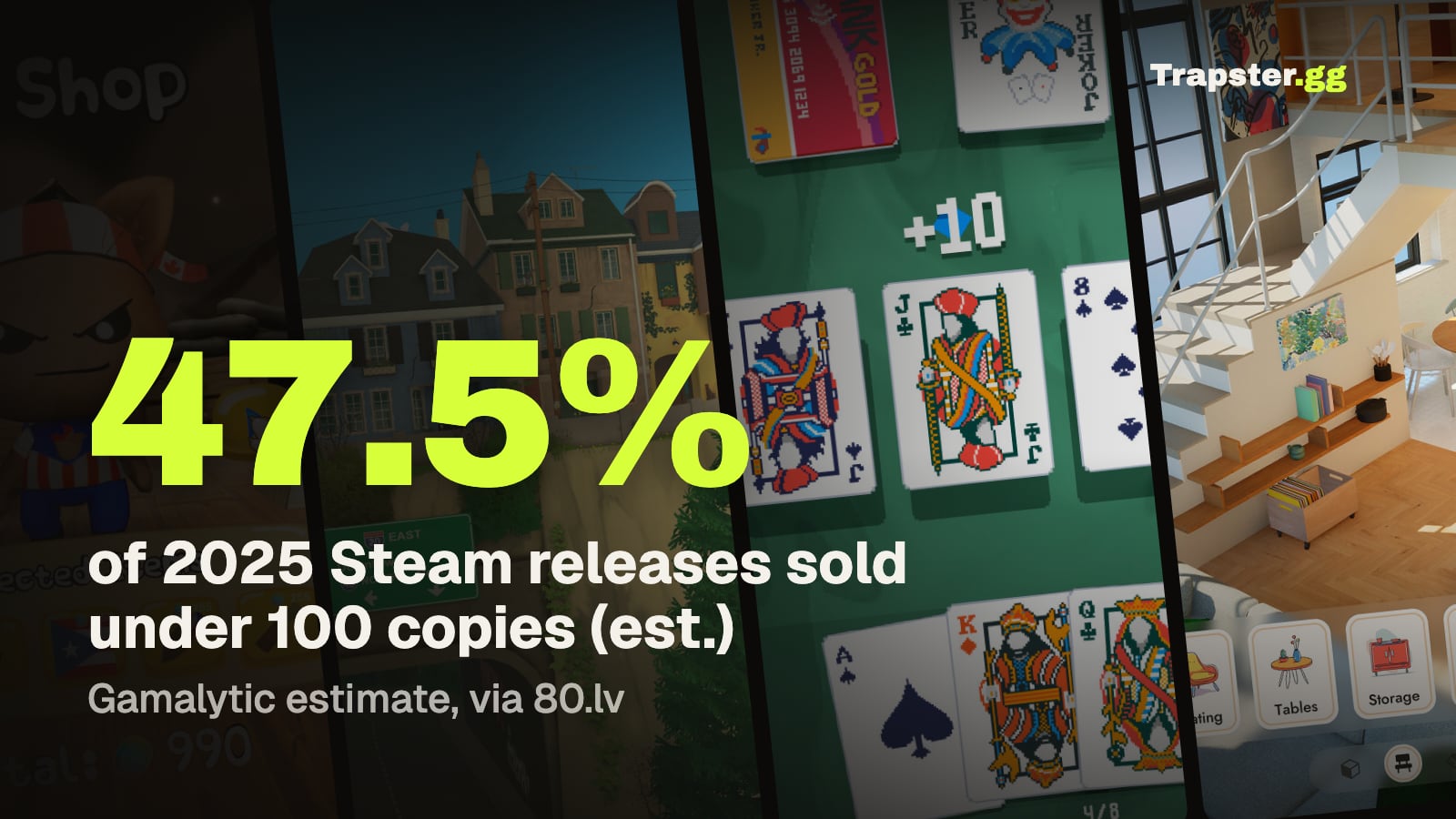
How Many Copies Do Indie Games Sell? Real Steam Numbers by Tier
Most Steam indie games sell under 1,000 copies. Real numbers by tier…
Game Marketing Hook: How to Find, Test and Show Yours
What a game marketing hook is, how to test one cheaply with…
How to Name Your Game: Searchable, Memorable and Legally Safe
How to name your game: pass the Steam, Google and trademark checks…