How to Get More Steam Reviews (Within Valve's Rules)
How Steam reviews and scores work, what Valve forbids, and what actually brings more reviews, with data from creator campaigns.
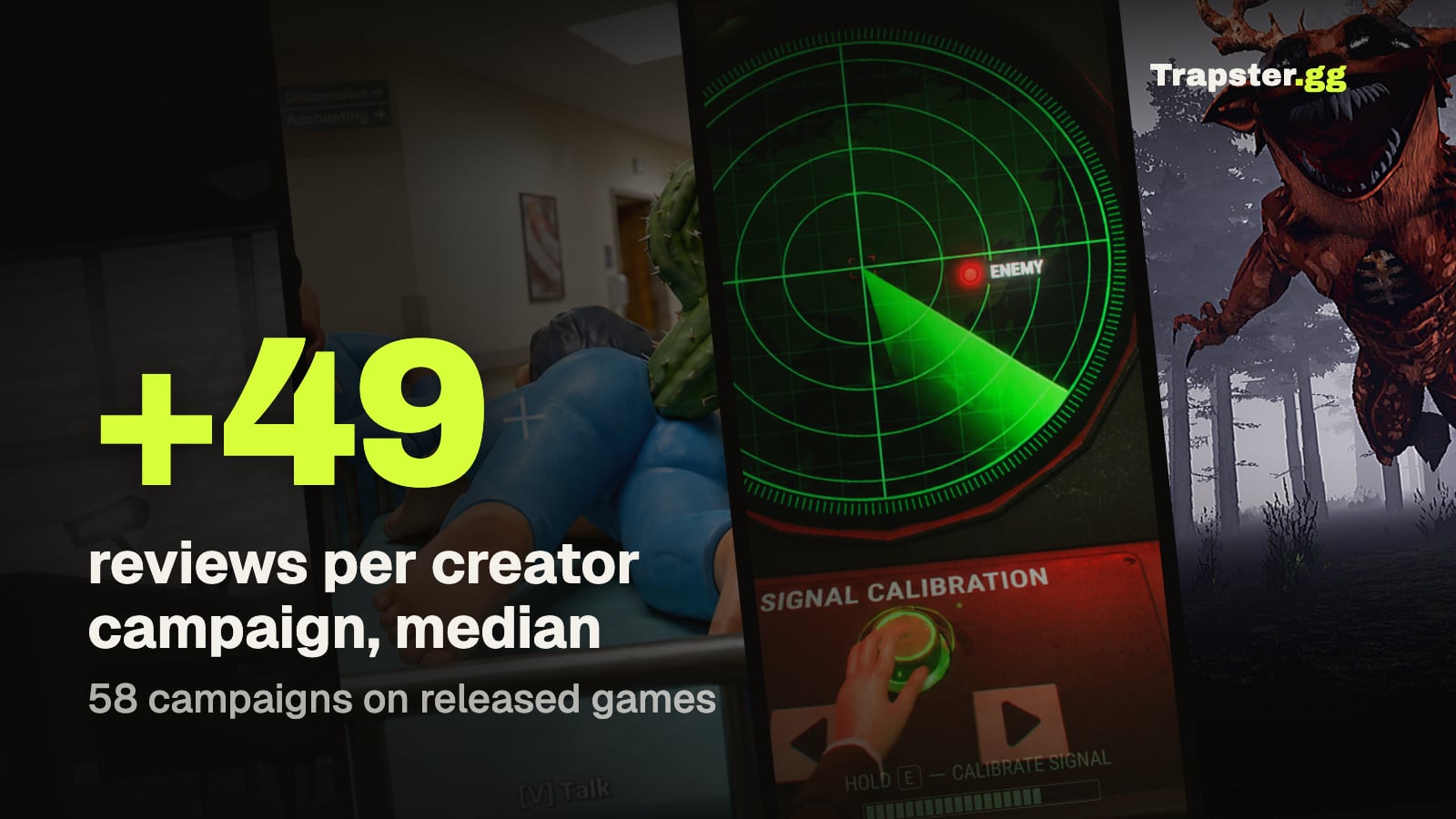
Short answer: Steam reviews come from players who bought the game on Steam and played it, so the way to get more is to get more players and make it easy for them to say something. Valve forbids offering anything in exchange for reviews and forbids asking for reviews inside the game (Steamworks review rules). What works: concentrate players at launch, answer reviews and discussions, ship updates, and bring new players with creator videos. On released games that ran creator campaigns on Trapster, the median game added about 49 reviews over the campaign and the two weeks after.
How Steam reviews work
- Who can review: anyone with playtime, including key activations, free weekends, free games and Family Sharing.
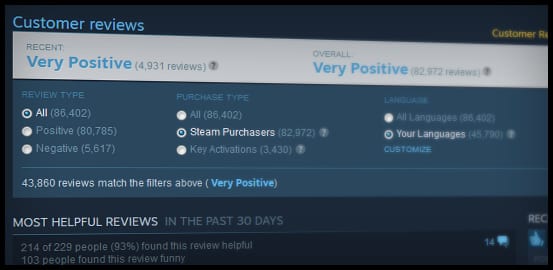
- Who counts in the score: only players who bought the game on Steam and played it. Reviews from key activations don't count in the score, and neither do copies received free, for example as a gift or during a free weekend. For free to play games, all reviews count.
- Two scores: the last 30 days and lifetime. Every label and threshold is in Steam review score explained.
- Minimum: a game needs 10 qualifying reviews before Steam shows an overall score (Valve, 2025).
- Language scores: games with more than 2,000 public reviews, and at least 200 written reviews in one language, show players the score from reviews in their own language by default.
Sources: Steamworks review docs, Valve on key activations (2016), Valve on free copies (2017).
That's why a key giveaway doesn't fix a low review count: those reviews show up on the page, but they don't move the score.
What Valve forbids
From the Steamworks review rules:
- No rewards for reviews. Don't solicit reviews in exchange for games, DLC, money or other rewards. Copies sent to press and creators are the exception.
- No in-game prompts. "Don't ask customers to review your product from within your application."
- No manipulation. "Don't attempt to abuse or artificially manipulate the review system." Valve says it "decisively ban[s] partners who engage in review manipulation" (Valve, 2019). In 2016 it removed key activations from review scores after finding at least 160 titles with a substantially higher share of positive reviews from key activators (Valve, 2016).
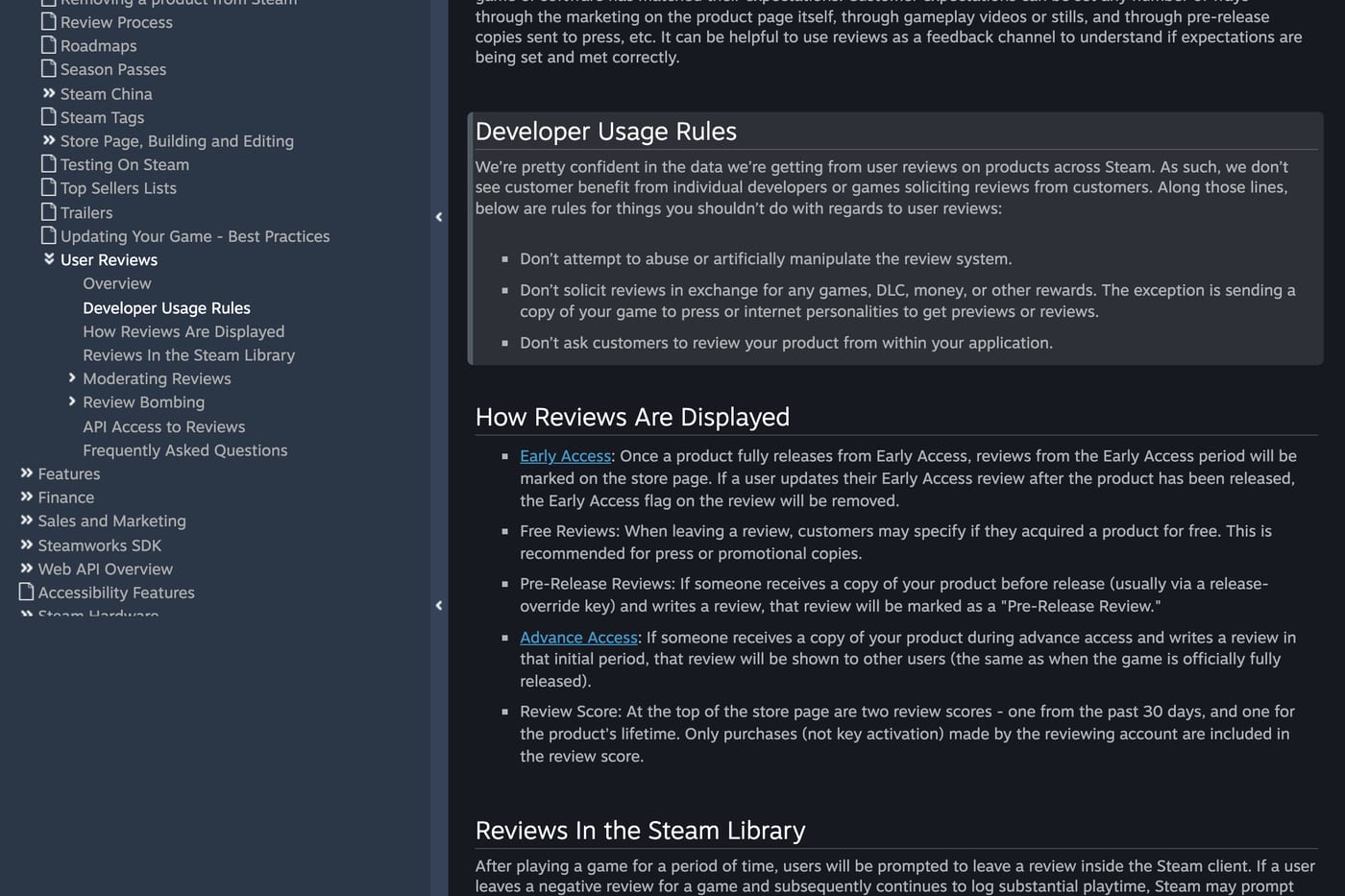
Valve also says it doesn't see customer benefit from developers soliciting reviews at all. Asking on your own social channels isn't explicitly banned, but keep it neutral ("tell us what you think on Steam"), never tied to a reward, and never inside the game.
Steam already asks players for you
Steam prompts players to review a game after they've played it for a while, and if someone keeps playing a lot after a negative review, Steam may prompt them to update it (review docs). So the best lever you have is simply more people playing.
What actually gets you more reviews
1. More players in the same window
Reviews follow players. A launch where wishlist emails, creator videos and your own posts land in the same days brings a wave of players and, a few hours of playtime later, a wave of reviews. The plan is in how to market your Steam launch week.
Our data shows the same after launch. Across 58 creator campaigns on games that already had at least 10 reviews, the median game added about 49 reviews from campaign start to two weeks after it ended. That's about 6% more reviews than it started with, or roughly 6 new reviews per 100,000 campaign views. These are all reviews in that window, including ones the game would have got anyway.
2. Answer reviews, especially negative ones
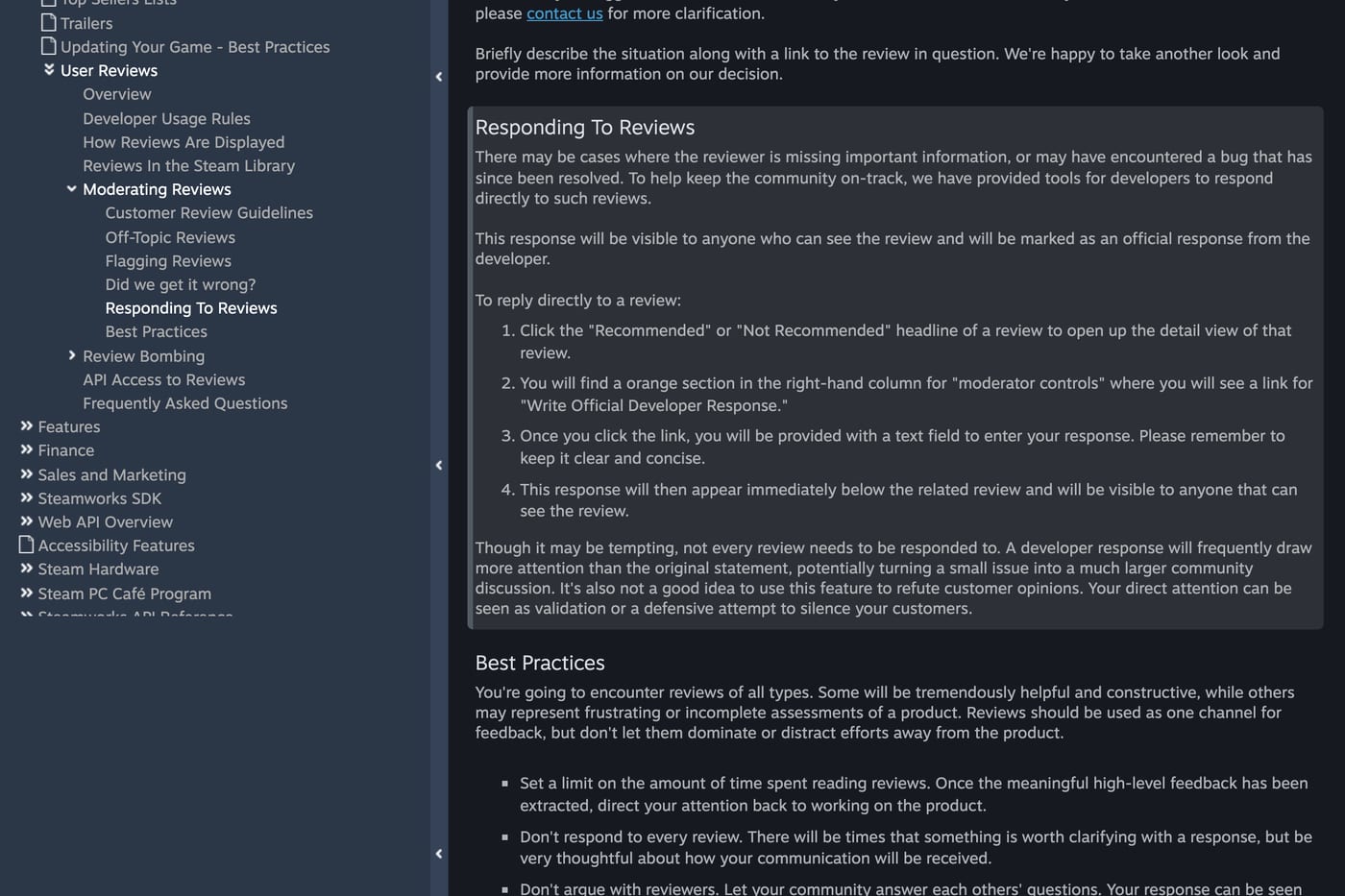
Steam has a "Write Official Developer Response" option. Valve's advice: not every review needs a reply, don't argue and don't try to refute opinions (review docs). What works is thanking players, explaining what you've fixed, and saying when a fix is coming. Players read those replies, and a player whose issue you fixed often updates the review.
3. Fix what people complain about, then tell them
Most negative reviews in the first week are about bugs, performance or a confusing first hour. Patch fast, post an update announcement, and the players who left negative reviews see it in their feed.
4. Get the first ten
Without 10 qualifying reviews, the page shows no score, which makes new visitors hesitant. Your community, Discord members and early supporters who buy on launch day are the most likely first reviewers. Tell them the game is out and that their honest opinion helps, without offering anything for it.
5. Keep the score above 40%
Valve gives games a small visibility boost by review bucket. It's essentially the same for every bucket from Mixed (40% positive) upward, and much smaller below 40% (Valve, 2019). Going from 80% to 90% helps players decide but not the algorithm. Falling under 40% hurts. More in how Steam's algorithm decides who sees your game.
What doesn't work
- Key giveaways for reviews. Key activations don't count in the score, and offering keys for reviews breaks Valve's rules.
- Review exchanges with other developers. That's manipulation.
- An in-game "please review us" popup. Explicitly forbidden.
- Arguing with negative reviewers. It makes the next visitor trust the reviewer more.
Review bombs
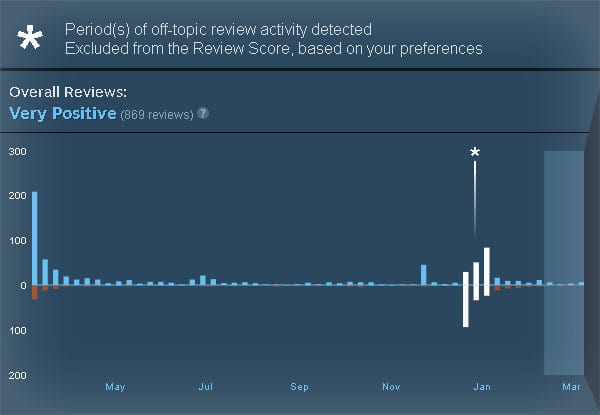
If a wave of off-topic reviews hits your game (about something outside the game itself), Valve can flag the period, exclude those reviews from the score and leave them visible. Players can opt out of this in their store preferences (Valve, 2019). Individual reviews flagged as off-topic get reduced visibility but still count, and developers can't delete reviews, only report them (review docs).
FAQ
How do I get more Steam reviews for my game? Get more people playing it on Steam, especially in the same week, answer reviews, patch and announce fixes. Steam itself prompts players to review after some playtime.
Can I give away keys for reviews on Steam? No. Valve forbids offering anything in exchange for reviews, and reviews from key activations don't count in the review score anyway.
How many reviews does a Steam game need to show a score? At least 10 qualifying reviews from players who bought the game on Steam.
Can I ask players to review my game? Not inside the game, and never for a reward. Valve says it sees no customer benefit in developers soliciting reviews.
Do Steam reviews affect visibility? Only at the low end. Above 40% positive the score isn't a visibility factor. Below 40%, Steam is less likely to feature the game.
Can I delete negative Steam reviews? No. You can reply with an official developer response, and report reviews that break Steam's rules.
Sources: Steamworks documentation on reviews; Valve announcements on key activations (2016), free copies (2017), review bombs (2019), review score boosts (2019) and language specific scores (2025). Review growth figures come from 58 Trapster creator campaigns on released games. Checked November 2026.
Get a wishlist forecast for your game
Send us your Steam page. We estimate views, creators and cost per wishlist before you spend anything.
Keep reading
How Many Copies Do Indie Games Sell? Real Steam Numbers by Tier
Most Steam indie games sell under 1,000 copies. Real numbers by tier…
Game Marketing Hook: How to Find, Test and Show Yours
What a game marketing hook is, how to test one cheaply with…
How to Name Your Game: Searchable, Memorable and Legally Safe
How to name your game: pass the Steam, Google and trademark checks…