Steam Review Score Explained: Every Label, Threshold and Rule
Exact percentages and review counts behind every Steam label, what counts toward the score, language scores, review bombs, and how it affects visibility.
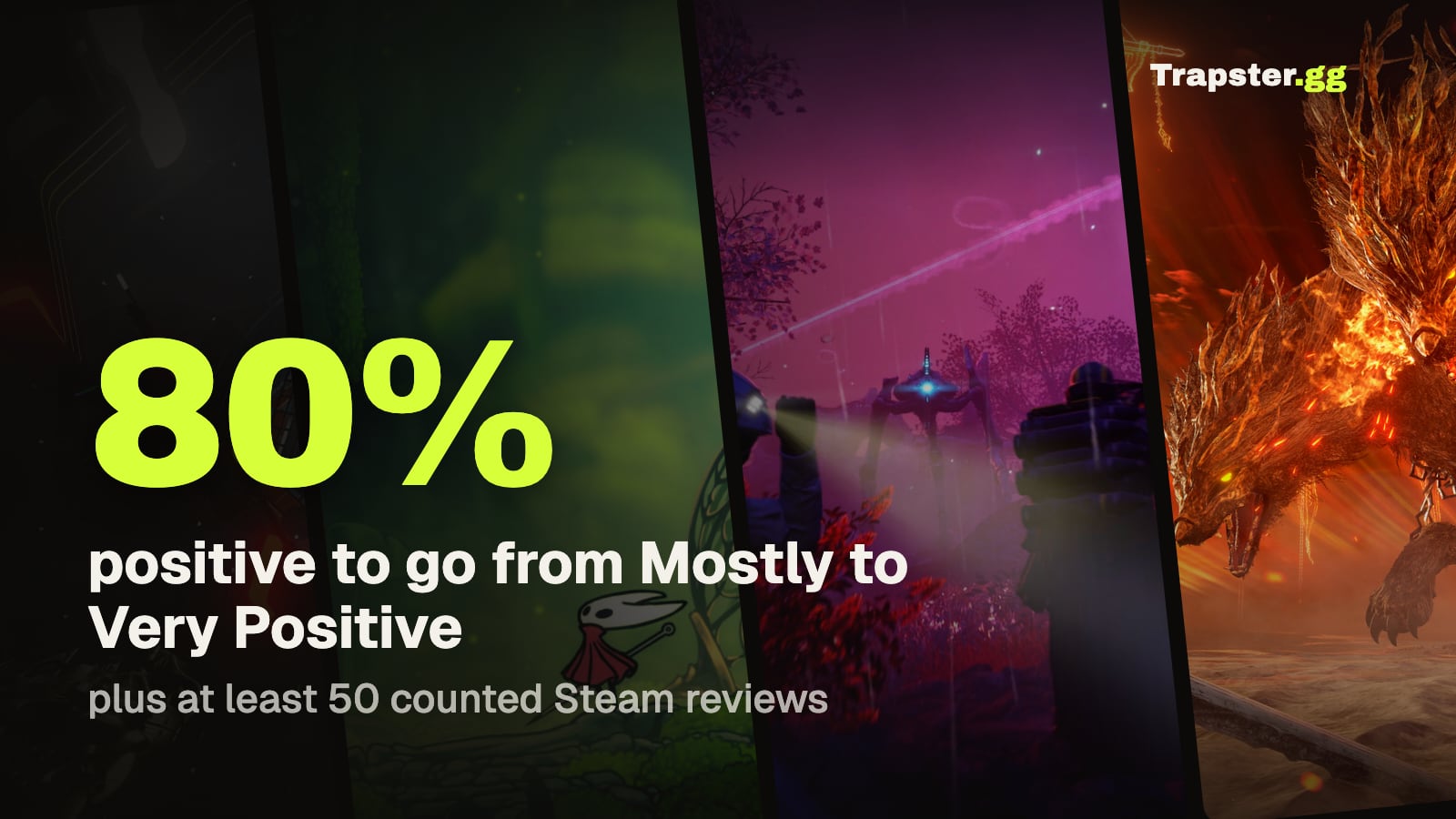
Short answer: Steam's review score is the share of positive reviews from people who bought the game on Steam, turned into a label. 70 to 79% positive is "Mostly Positive", 80% and up with at least 50 reviews is "Very Positive", and 95% and up with at least 500 reviews is "Overwhelmingly Positive". Valve needs 10 reviews before it shows any score, excludes key activations from the math, and shows a 30 day "Recent" score next to the lifetime one. Since August 2025, many players see a score built from reviews in their own language. On visibility, Valve's own docs say that while you stay at Mixed (40%) or above, review score "is not a factor in algorithmic visibility".
This guide covers how the number is built and what moves it. If you want tactics for getting more reviews in the first place, read how to get more Steam reviews first.
The nine Steam review labels and their thresholds
Valve does not publish the full threshold table in the Steamworks docs. The table below is the one players documented by watching store pages, first posted in a Steam Community thread in November 2016 and still consistent with how labels behave today. The one change since then: Valve now says a game needs 10 reviews to calculate an Overall Review Score, so below 10 you see a review count but no label.
| Label | Positive share | Number of counted reviews |
|---|---|---|
| Overwhelmingly Positive | 95 to 100% | 500 or more |
| Very Positive | 80 to 94% | 50 or more |
| Very Positive | 95 to 100% | 50 to 499 |
| Positive | 80 to 100% | 10 to 49 |
| Mostly Positive | 70 to 79% | 10 or more |
| Mixed | 40 to 69% | 10 or more |
| Mostly Negative | 20 to 39% | 10 or more |
| Negative | 0 to 19% | 10 to 49 |
| Very Negative | 0 to 19% | 50 to 499 |
| Overwhelmingly Negative | 0 to 19% | 500 or more |
Three things follow from this table that surprise a lot of developers:
- Volume gates the top labels. A game at 98% with 40 reviews shows "Positive". The same game at 98% with 300 reviews shows "Very Positive". It only becomes "Overwhelmingly Positive" once it crosses 500 counted reviews.
- The middle labels ignore volume. Mostly Positive, Mixed and Mostly Negative depend on the percentage alone.
- Hovering over the label shows the real number. The store tooltip shows the exact percentage and review count, so players who care can see that your "Mostly Positive" is 79% and not 70%.
Mostly Positive vs Very Positive
The difference is one line: 80%. At 79% you are "Mostly Positive" no matter how many reviews you have. At 80% with 50 or more counted reviews you are "Very Positive".
That line is harder to cross than it looks, because every new review is diluted by every old one. A worked example with 1,000 counted reviews at 78% positive (780 positive):
- If every new review is positive, you need 100 more reviews to reach 80%.
- If 90% of new reviews are positive, you need about 200 more.
- If 85% of new reviews are positive, you need about 400 more.
- If new reviews come in at 80%, you never cross. You only approach the line.
Sean Murray of Hello Games put it simply when No Man's Sky finally crossed 80%: "Each percentage point becomes exponentially harder as you move up the ratings" (Engadget). This is why the Recent score matters so much more than the lifetime score for a game that has improved: the lifetime number moves slowly, the 30 day number reacts to what you ship.

Recent reviews vs all reviews
The Steamworks documentation says the top of your store page shows "two review scores - one from the past 30 days, and one for the product's lifetime". Steam's own reviews page adds that the recent score appears only "if your game has released more than 45 days ago and has enough recent reviews".
Both scores use the same labels and thresholds. In practice:
- Launch month: you only have one score. A rough first week sets your lifetime number, and that is the number people see for months.
- After 45 days: a good patch shows up in Recent within weeks. A player comparing "Recent: Very Positive" with "All: Mixed" reads that as a game that got fixed, which is exactly the story you want them to read.
- Long tail: Valve noted back in 2017 that most games slowly trend downwards over time even without changes, because early buyers are more likely to be your core audience than later ones. Expect the lifetime percentage to drift down a little as you reach broader players through sales.
Language-specific scores (the August 2025 change)
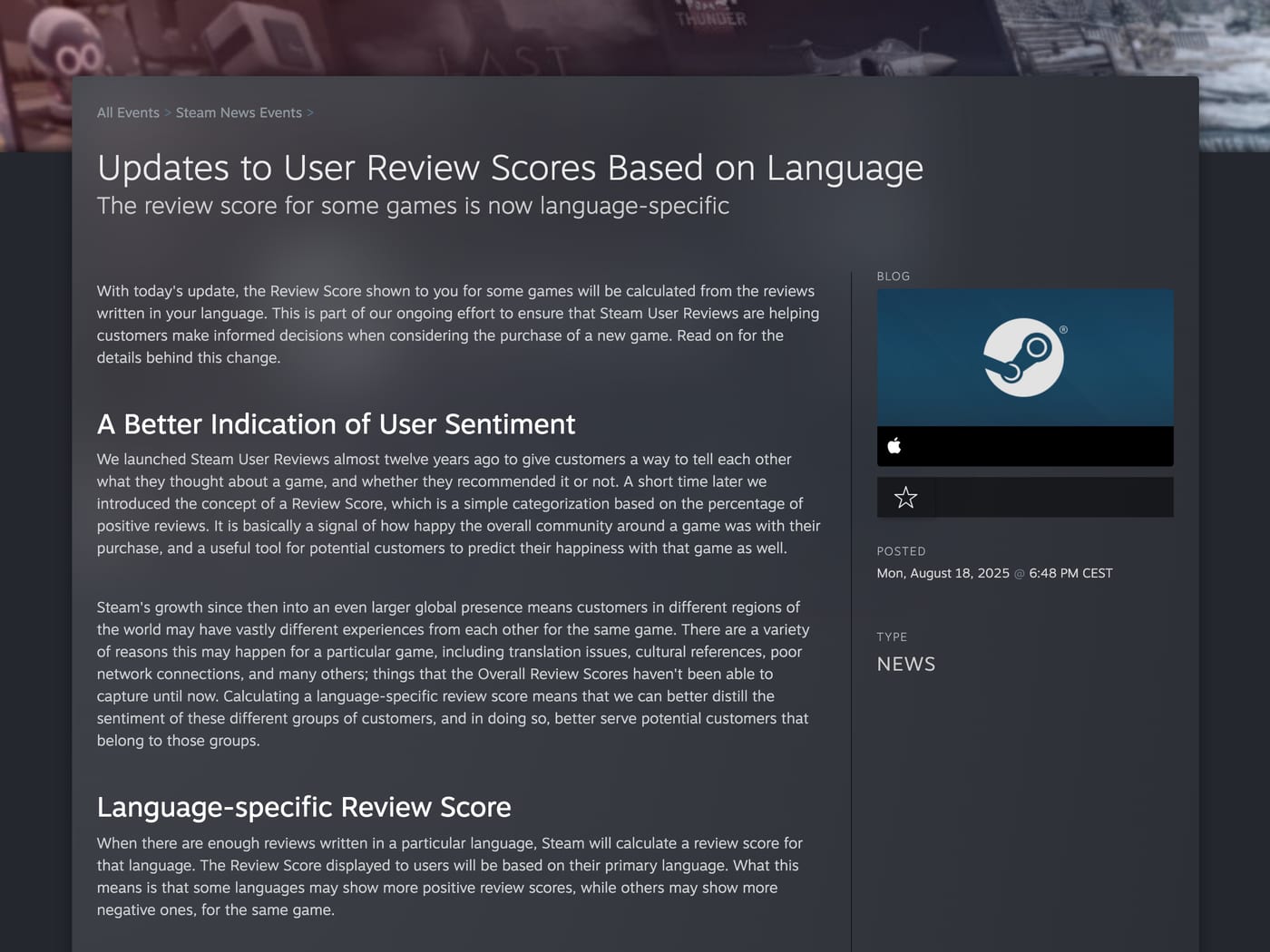
On 18 August 2025 Valve announced Updates to User Review Scores Based on Language. The key rules from that post:
- The score a player sees is based on reviews written in their primary language.
- It applies to games with more than 2,000 publicly visible reviews and at least 200 written reviews in at least one language.
- It is on by default. Players can switch back to the overall score in their store preferences, and the store page has a "See language breakdown" link.
So the same game can show different labels to different players. Valve's stated reason: players in different regions may have very different experiences because of "translation issues, cultural references, poor network connections".
Example: Hollow Knight: Silksong. Days after launch, 80.lv reported that the overall score had dropped to 77% while Simplified Chinese reviews sat at 38% positive, against roughly 90% and up in most other languages. The complaint was the translation itself, and Team Cherry promised localization fixes. With language scores on, that means Chinese-speaking players see a much worse label than players in most other languages.

What this means for you: below 2,000 reviews the change does not apply and everyone sees the overall score. Once you are above it, a weak translation can cost you a label in that market without touching your English one. If you localize, budget for a native review pass. Our guide to game localization on Steam covers how to pick languages.
Which reviews count toward the score
Anyone with playtime can write a review. Far fewer reviews count. From the Steamworks review docs:
| Source of the copy | Can review | Counts toward score |
|---|---|---|
| Bought on Steam by the reviewing account | Yes | Yes |
| Steam key activated (Humble, Fanatical, press, creators, Kickstarter) | Yes | No |
| Free Weekend | Yes | No |
| Family Sharing | Yes | No |
| Received as a gift | Yes | No |
| Free-to-play game | Yes | Yes |
The exact wording: "Only reviews posted from an account that has purchased on Steam and played the game will count toward the review score." Valve's 2017 announcement extended this to gifts and free weekends, and noted that for free or free-to-play games, reviews from all users still count.
Two practical consequences:
- Keys you hand out do not help your score. Reviews from press, creators and Kickstarter backers are readable on your page, but they do not move the label. If you plan to hand out keys at launch, read game key distribution so you know what those keys can and cannot do.
- Backer-heavy launches can look thin. If most of your early players came through Kickstarter keys, your store page may show a small counted number even though your community is large.
Valve's rules also forbid paying for reviews, coercing players, or using multiple accounts, and say anyone who got a free copy should disclose it in the review (Steamworks docs). Valve has said it "decisively ban[s] partners who engage in review manipulation".
Early Access and pre-release reviews
Reviews written during Early Access are labeled as such on your store page. If the reviewer updates the review after full release, the label goes away. Reviews written with release-override keys are labeled "Pre-Release Review". All of this is in the Steamworks review docs. The score itself does not reset when you leave Early Access, so the reviews you earn in EA follow you into 1.0. See Steam Early Access marketing for how to plan that phase.
Steam also nudges players over time. Users are prompted to review after playing for a while, and the docs say that if a player leaves a negative review and keeps logging substantial playtime, "Steam may prompt them to update their review". That is one of the few built-in ways an old negative can flip.
Review bombs and the off-topic filter
Valve defines a review bomb as players posting "a large number of reviews in a very compressed time frame, aimed at lowering the Review Score". In March 2019 it announced in User Reviews Revisited that it would remove off-topic review bombs from the score. How it works:
- A tool flags anomalous review activity on every game in close to real time.
- A team at Valve investigates why.
- If the cause is unrelated to whether future buyers will enjoy the game, Valve marks that time period as off-topic and notifies the developer.
- Reviews from that window stay on the page but stop counting toward the score. Players can opt back in through store preferences.
Valve counts DRM and EULA changes as off-topic in that post. It also says it decided not to unilaterally go back and remove older bombs. The Steamworks docs tell you to contact Valve through Partner Support if your score is being hit, and add that in their experience the surge "will calm down after a few days".
Note the difference between this and a single off-topic review. Moderators can flag individual reviews as "Off-Topic", which reduces their visibility, but those reviews "will still contribute to a product's review score". Only a confirmed rules violation removes a review's contribution.
Example: Helldivers 2 (May 2024). After Sony announced that Steam players would need a PSN account, the game took over 211,000 negative reviews in three days. When Sony reversed the decision, daily reviews swung from 98% negative on a Sunday to 80% positive the next day and 94% positive by Tuesday, as players edited their reviews. This was an on-topic protest about the Steam version itself, and it was the fix, not the filter, that moved the score.

Example: Assassin's Creed Unity (2019). After the Notre-Dame fire, Ubisoft gave the game away on Uplay and positive Steam reviews spiked. Valve wrote a whole post on whether this was a positive review bomb and decided to leave it alone: the overall score only moved from 59.7% to 61%, both inside Mixed.
The helpfulness system and which reviews players see
Your score is one thing. The reviews players actually read are another, and they are chosen by helpfulness.
In August 2024 Valve launched a new helpfulness system. Reviews identified as unhelpful, such as one-word reviews, ASCII art and in-jokes, are sorted behind the rest. Valve uses user reports, moderators and machine learning to find them, and says thumbs up or down "are not a factor" in that judgment. It also says plainly: "This change doesn't impact how review scores are generated for each game." Helpful votes from players still count toward sort order.
The Steamworks docs add that the most prominent reviews on your page are picked from "recently-written, helpful reviews", and that older reviews "will phase out over time". So a launch-week rant about a crash you fixed months ago should sink as newer, detailed reviews arrive. That only happens if new players keep reviewing.
Developer responses: when to reply
You can post an official developer response under any review. It appears right below the review, marked as official, and is visible to anyone who can see that review. You cannot delete reviews. You can only flag abusive ones for moderators (Steamworks docs).
Valve's own advice is restrained, and it matches what experienced community managers do:
- Reply when there is information missing. A bug that has since been fixed, a setting that solves the problem, a feature that exists but is hidden.
- Do not reply to opinions. Valve warns that a response "will frequently draw more attention than the original statement" and can be "seen as validation or a defensive attempt to silence your customers".
- Do not argue during a review bomb. Valve says it has "never seen it work at stopping negative reviews". It suggests communicating from an anonymous developer account so no one on your team becomes a target.
A reply does not change the score. What changes the score is the reviewer coming back to a better game and editing their thumbs down, or new players reviewing the fixed version.
How the score affects Steam visibility
Valve has answered this twice, and the answers agree.
The Steamworks FAQ: "As long as your game's reviews are Mixed or above (40%+), review score is not a factor in algorithmic visibility. If your game dips below 40% into Mostly Negative, your game will be less likely to be featured." (source)
The more detailed version, from Valve's 2019 positive review bomb post: games get a small boost in some store lists based on their review bucket, the boost is "essentially the same for all the Mixed or above review buckets", and there is a big drop once a game falls below Mixed. A Mixed game gets over 500% more boost than a Mostly Negative one, but Valve stresses the boost is "small relative to many other store factors". At the time, 71.7% of titles were Mixed or above.
So for Steam's algorithm, the line that matters is 40%, not 80%. The jump from Mostly Positive to Very Positive is a conversion question: it changes what a player thinks when they land on your page from a creator video, a sale or a recommendation. For how those other store factors work, see how the Steam algorithm works.
Real examples of games that recovered their score
| Game | Where it started | What they did | Outcome |
|---|---|---|---|
| No Man's Sky (Hello Games) | Overwhelmingly Negative after the 2016 launch | 35 free updates in the three years before the milestone | Lifetime score reached Very Positive in November 2024, about 80% of nearly 246,000 reviews (Engadget) |
| Cyberpunk 2077 (CD Projekt Red) | Troubled December 2020 launch | Months of patches, then ongoing updates | Very Positive with 80% of 546,249 reviews in July 2023, before Phantom Liberty shipped (VGC) |
| Pathway (Robotality, Chucklefish) | About 350 positive and 210 negative in launch month, April 2019 | Adventures Wanted update nearly doubled content, a second trailer reset expectations, Hardcore mode and controller support followed | New reviews turned mainly positive and the overall score returned to Positive (GameDiscoverCo) |
| Broken Roads (Drop Bear Bytes) | Rough 2024 launch | 10 patches and hotfixes | 82% of players after the late May patch recommended it, Recent reviews hit Very Positive (developer's own figures, dev blog) |
| Hotel Barcelona (White Owls, Swery65) | Mixed after its 2025 launch | "Under New Management" overhaul in March 2026 | Moved from Mixed to Mostly Positive in June 2026 (VGC) |
| Elden Ring Nightreign (FromSoftware) | Mixed at 67% at launch | Patch 1.01.1 added solo revives and extra runes | Very Positive at 80% within a month (PCGamesN) |

What the recoveries have in common:
- They fixed the thing reviews complained about. Pathway's developer told GameDiscoverCo that it is "nearly impossible to get people to change their review", so the job is winning over new players, not arguing with old ones.
- They gave lapsed players a reason to come back. Big named updates bring returning players, and returning players with more playtime are the ones Steam prompts to update a negative review.
- They used Recent as the proof. A Recent label above the lifetime one tells a new visitor the game changed, long before the lifetime number catches up.
What to do with all this
- Know your exact number. Hover the label. If you are at 77%, plan for the 80% line; if you are at 38%, every effort goes to getting above 40%.
- Get to 50 and 500 counted reviews. Those are the volume gates for Very Positive and Overwhelmingly Positive. Remember that keys do not count.
- Fix before you promote. Driving a sale or a big traffic push into a known problem adds negative reviews at volume.
- Ship a named update, then watch Recent. The 30 day score is where improvement shows first.
- Check your language breakdown once you pass 2,000 reviews. A single weak translation can show a worse label to a whole market.
- Reply sparingly and factually. Answer missing information, never opinions.
- Report review bombs to Valve. Off-topic bombs can be removed from the score. On-topic ones are fixed by fixing the cause.
FAQ
What percentage is Very Positive on Steam?
80% or more positive with at least 50 counted reviews. Between 50 and 499 reviews, anything from 80 to 100% is Very Positive; at 500 or more reviews, 95% and up becomes Overwhelmingly Positive.
What is the difference between Mostly Positive and Very Positive?
Mostly Positive is 70 to 79% positive at any review count of 10 or more. Very Positive starts at 80% and needs at least 50 counted reviews.
How many reviews do you need for a Steam review score?
Ten. Valve says the overall score needs 10 reviews, and those must be counted reviews from Steam purchases, not key activations.
Do Steam key reviews count?
No. Reviews from activated keys, free weekends, gifts and Family Sharing appear on the page but do not count toward the score, except for free-to-play games where all reviews count.
Does a low review score hurt Steam visibility?
Only below 40%. Valve says review score is not a factor in algorithmic visibility at Mixed or above, and that games below 40% are less likely to be featured.
Why does my game show a different review score in another language?
Since August 2025, games with more than 2,000 reviews and at least 200 in one language show players a score based on reviews in their own language. Players can switch back to the overall score in store preferences.
Can developers remove negative Steam reviews?
No. You can flag reviews that break Steam's rules, and Valve removes those. Off-topic reviews lose visibility but still count, and only off-topic review bombs identified by Valve are taken out of the score.
Sources: Steamworks: User Reviews, Steam: language-based review scores (2025), Steam: new helpfulness system (2024), Steam: User Reviews Revisited (2019), Steam: Positive "Review Bombs" (2019), Steam: User Reviews (2017), Steam Community threshold thread (2016), GameDiscoverCo on Pathway; checked November 2026.
Get a wishlist forecast for your game
Send us your Steam page. We estimate views, creators and cost per wishlist before you spend anything.
Keep reading
How Many Copies Do Indie Games Sell? Real Steam Numbers by Tier
Most Steam indie games sell under 1,000 copies. Real numbers by tier…

Game Marketing Hook: How to Find, Test and Show Yours
What a game marketing hook is, how to test one cheaply with…
How to Name Your Game: Searchable, Memorable and Legally Safe
How to name your game: pass the Steam, Google and trademark checks…