Steam Early Access: Rules, Visibility and How to Market It
Valve's Early Access rules, how wishlist emails and visibility work at Early Access and 1.0, and why most games sell less at 1.0.
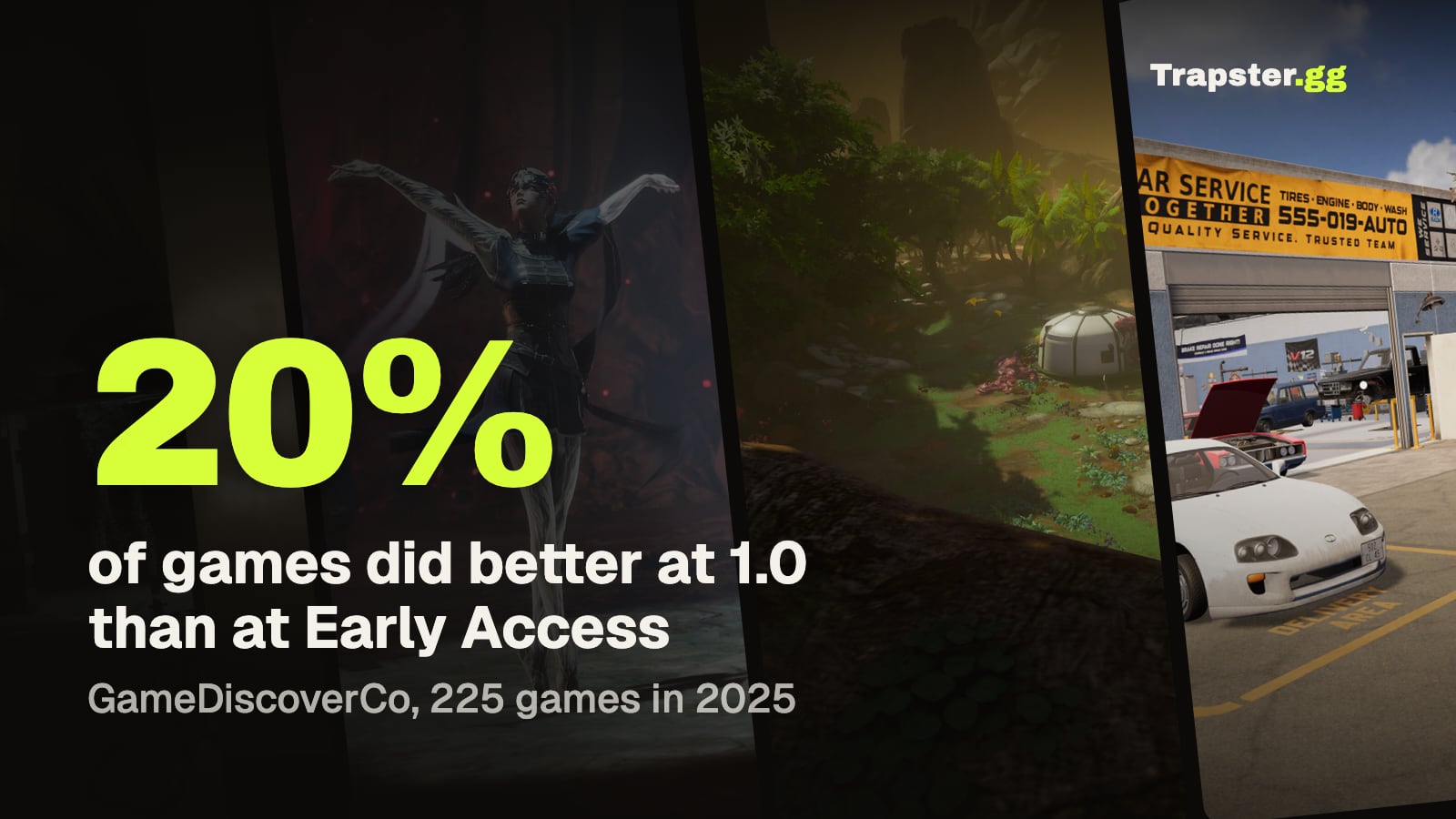
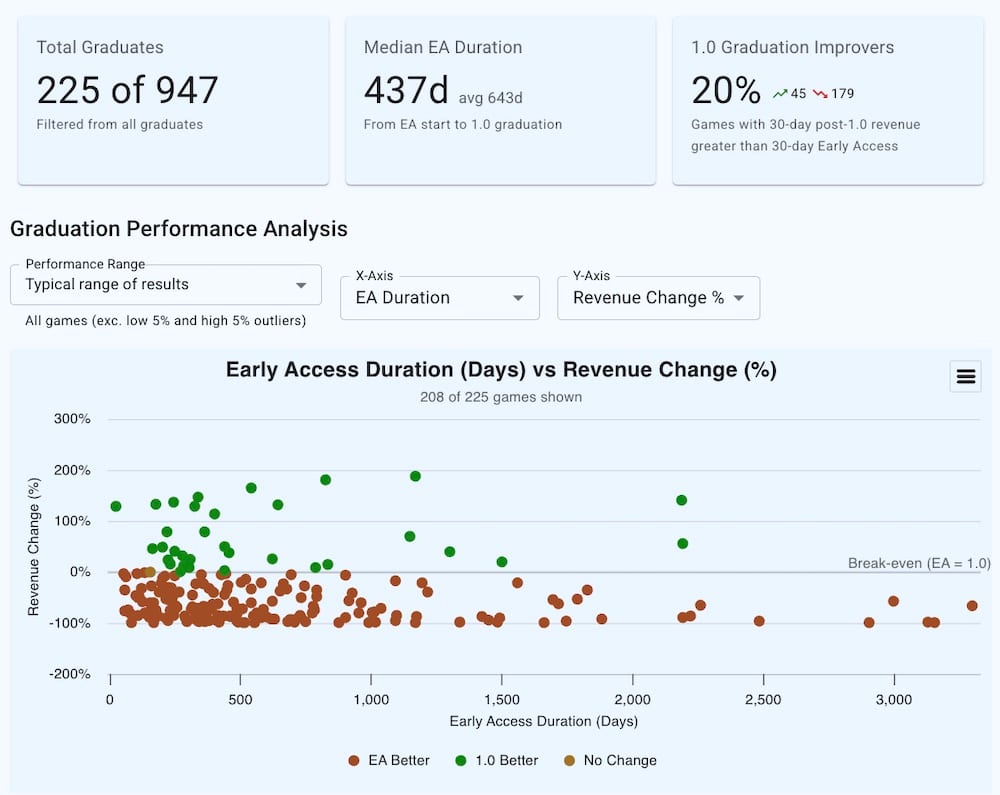
Short answer: Early Access lets you sell an unfinished game on Steam, but it splits your launch in two. Wishlisters get an email at Early Access launch and another at 1.0, and the full 1.0 launch counts as a first release for Steam's visibility. The catch is in the numbers: across 225 games that left Early Access in 2025 after selling over 5,000 copies there, only 20% did better at 1.0 than at their Early Access launch (GameDiscoverCo). So treat the Early Access launch as your real launch and plan 1.0 as a second, smaller one.
What Valve allows in Early Access
Valve's Early Access rules come down to seven points:
- Show the Early Access state everywhere you sell Steam keys, including the Early Access questionnaire.
- Don't make specific promises about the future. Valve's wording: "Do not ask your customers to bet on the future of your game."
- Sell on Steam no later than anywhere else.
- Don't charge Steam players more than other stores do.
- Set expectations honestly, for example warn players up front if updates will break save files.
- Don't launch without a playable game, with a trailer that shows gameplay.
- Don't launch in Early Access if development is finished.
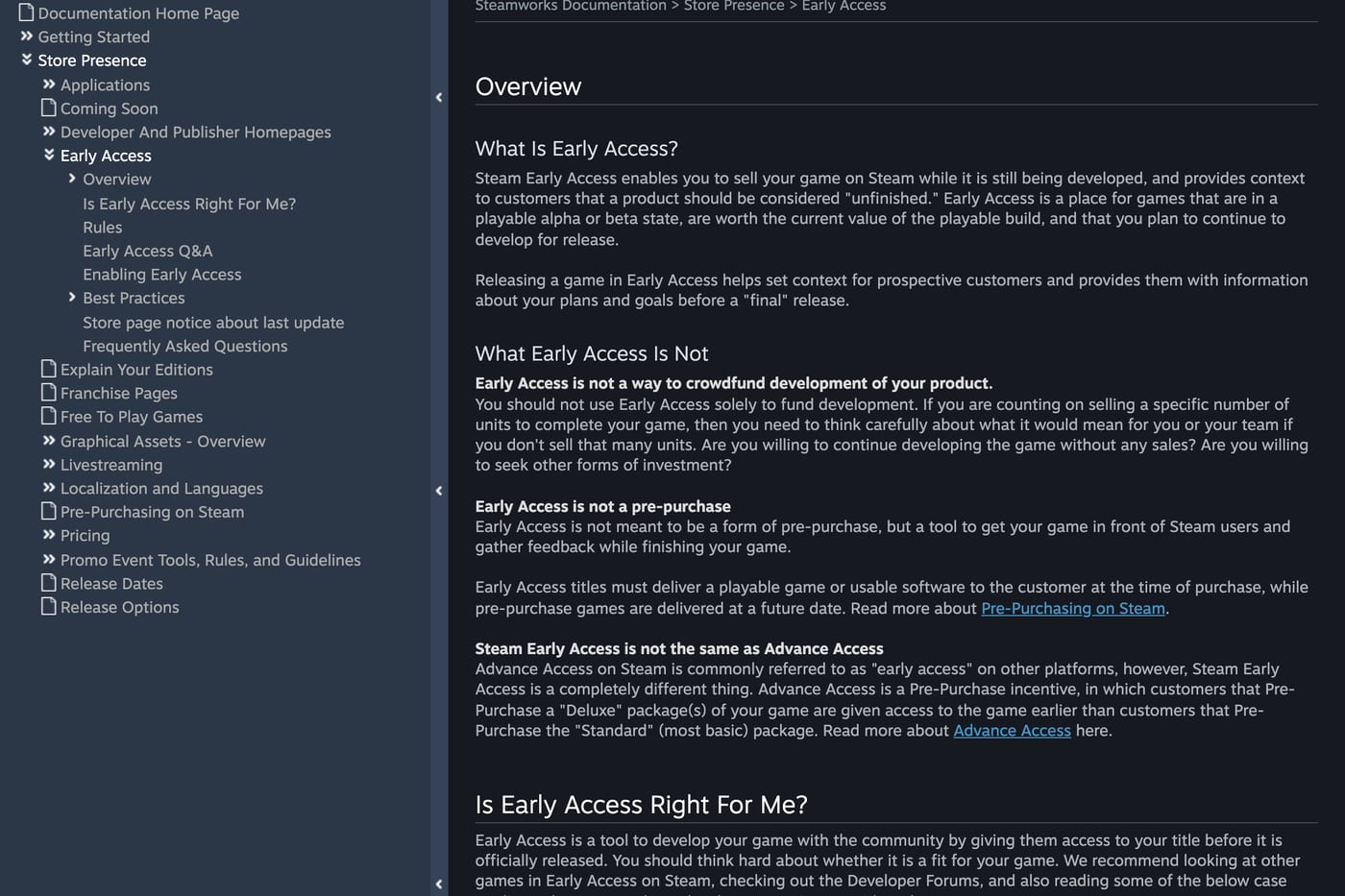
Valve also says what Early Access is not: it is not a way to crowdfund development and not a form of pre-purchase.
The six questions on your store page
Every Early Access page must answer these, and store review checks that all of them are filled in (review process):
- Why Early Access?
- Approximately how long will this game be in Early Access?
- How is the full version planned to differ from the Early Access version?
- What is the current state of the Early Access version?
- Will the game be priced differently during and after Early Access?
- How are you planning on involving the community in your development process?
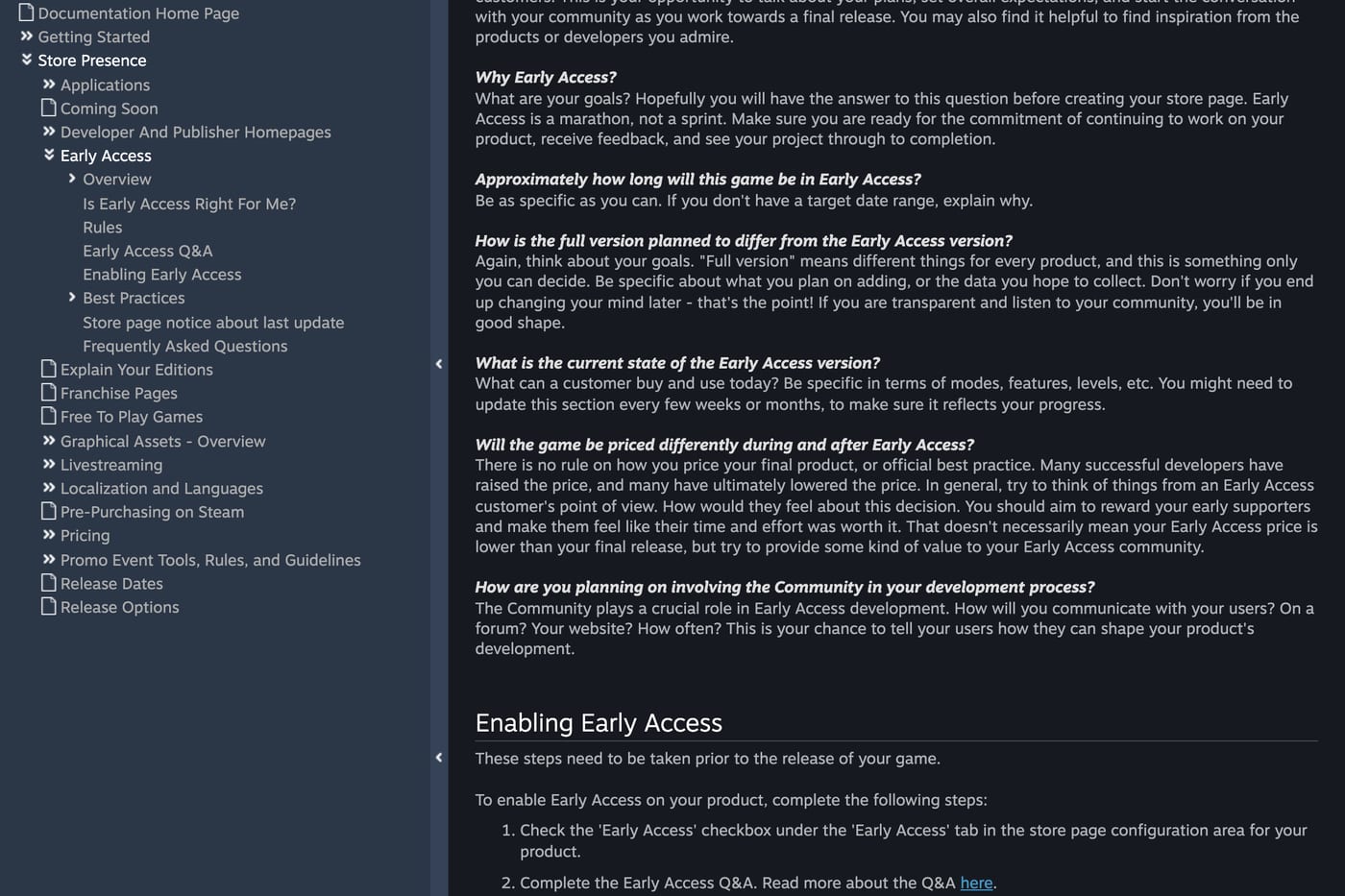
Players read these answers. Vague ones ("as long as it takes") read as a warning sign. Give a range, name two or three concrete features coming in 1.0, and describe how players can give feedback today.
Pricing rules
Most studios start below their planned 1.0 price, but Valve allows a higher Early Access price too. The hard rules are elsewhere:
- You can't run a permanent discount in Early Access. If you want to be cheaper, set a lower base price.
- After any price increase, you can't discount for 30 days. If you raise the price for 1.0 within 30 days of leaving Early Access, you lose the launch discount.
- Valve asks you to request the price increase for 1.0 a couple of days ahead (pricing docs).
Keep the page alive
Steam adds a notice to an Early Access page when no build has been pushed to the default branch for more than 12 months, or when no update event has been posted for 12 months. Valve asks you to revisit the Early Access answers at least once a year. You can also set a 1.0 date on the Early Access tab, which shows on the store page and in players' calendars.
How Steam treats Early Access and 1.0
This is where Early Access changes your marketing plan.
| Early Access launch | 1.0 launch | |
|---|---|---|
| Wishlist email | Yes, to everyone who wishlisted | Yes, a second automatic email |
| Launch visibility | Smaller: New Releases inside the Early Access section | Full, "treated the same as a title releasing fully for the first time" |
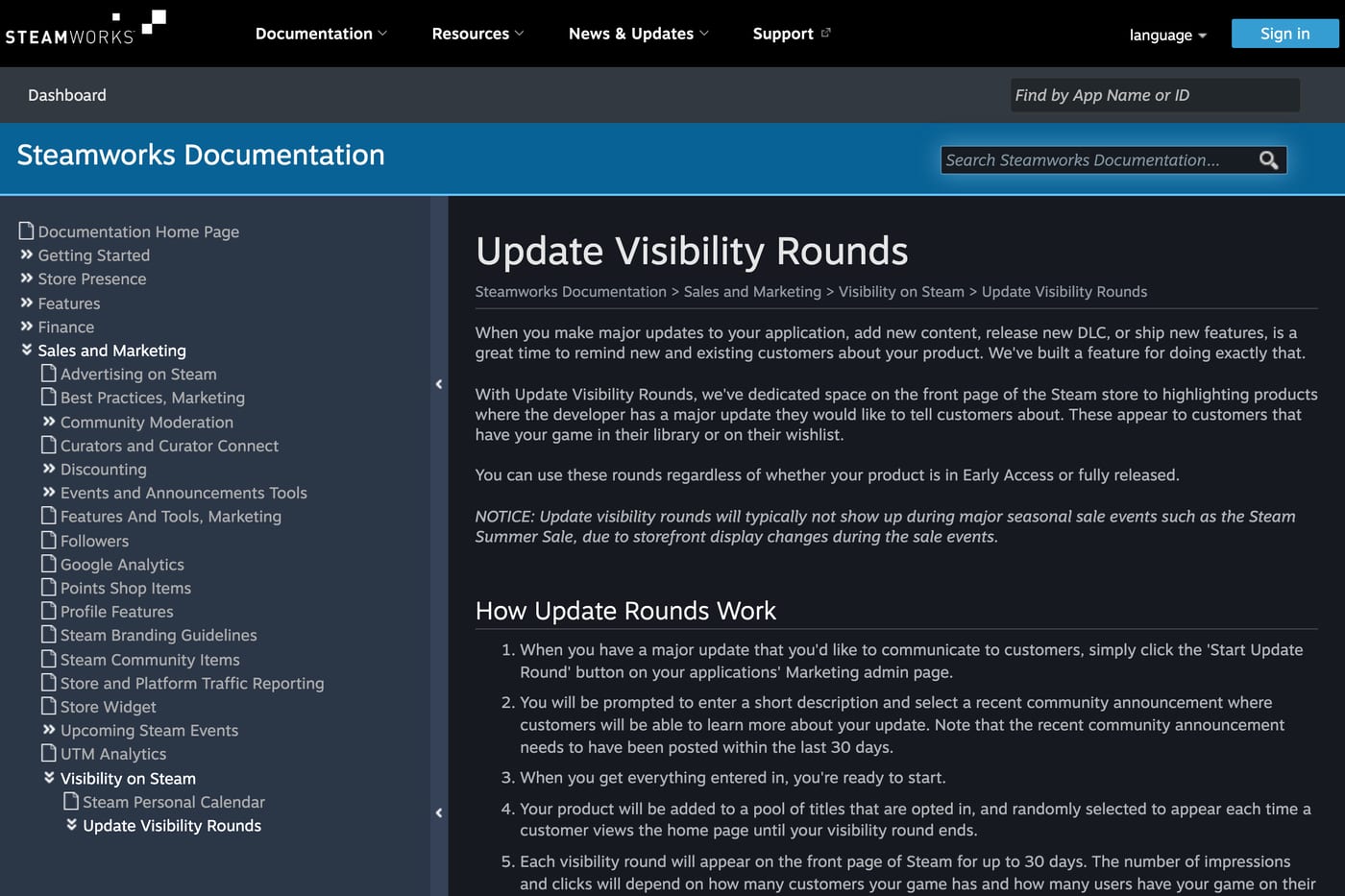
| Update visibility rounds | Available two weeks after launch | Whatever is left of the same five |
| Discount after launch | Blocked for 30 days | Blocked for 30 days after a price increase |
Sources: Early Access docs, visibility docs, update visibility rounds.
Two details trip studios up:
- The five update visibility rounds are shared. Spend all five during Early Access and you have none left after 1.0. Treat them as a budget across the whole life of the game. How rounds work is in Steam update visibility rounds explained.
- The Early Access launch gets less launch visibility than a full release. You still get the wishlist email, so the size of your wishlist pool on Early Access day matters as much as it would for a full launch.
What the numbers say about Early Access and 1.0
GameDiscoverCo has tracked this for years, and the picture is consistent:
- Most 1.0 launches sell less than the Early Access launch. Of 225 games with more than 5,000 Early Access copies that left Early Access in 2025, only 45 (20%) did better at 1.0. Median 30 day revenue at 1.0 was about 40% of the median 30 days at Early Access launch. Median time in Early Access was 437 days (GameDiscoverCo, December 2025).
- The longer you stay in Early Access, the smaller 1.0 gets. Across more than 1,500 games from 2015 to 2023, the median 1.0 launch sold about 0.7 times the units of the first three months of Early Access, and the multiplier fell the longer games stayed in Early Access (GameDiscoverCo, November 2023).
- Early Access converts wishlists a bit less well. In GameDiscoverCo's developer survey, Early Access launches sold a median of 0.16 copies in the first week per launch wishlist, against 0.22 for full releases (GameDiscoverCo). More on what to expect in Steam wishlist conversion rate.
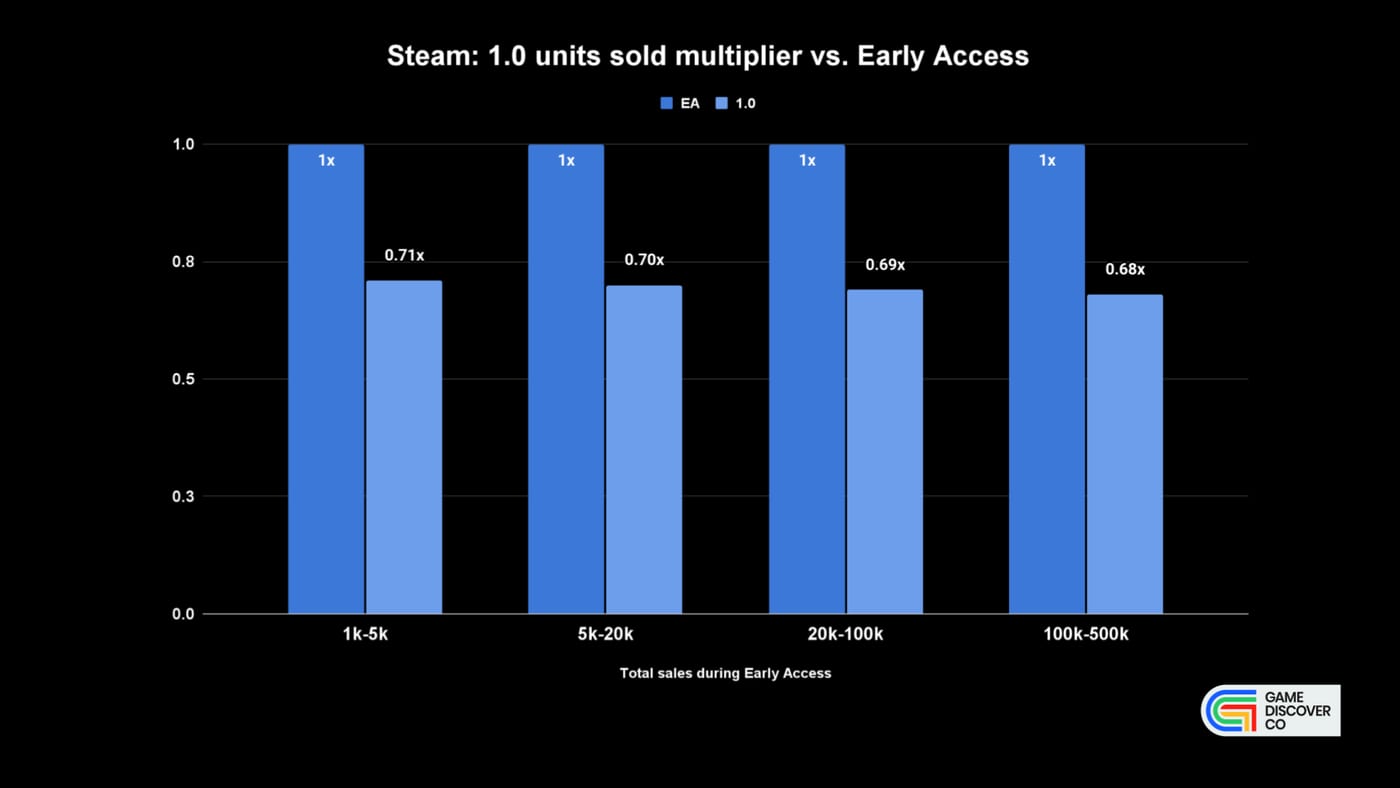
The lesson is not "avoid Early Access". It is that the Early Access launch is the one that usually matters most, so it deserves your full launch plan, not a soft opening.
How to market an Early Access launch
Before launch: build the wishlist pool
Treat it exactly like a full launch. The Early Access email goes to everyone on your wishlist, so every wishlist you add before that day turns into a notification. The playbook is the same as for any game: a store page that converts, a demo or festival slot, and creator videos timed to land before the date. See how to get wishlists on Steam before launch and the stage by stage plan in how to market a game.
Launch week: be honest about the state of the game
Creators and players respond well to "this is early, here is what's coming". Put the roadmap in the creator brief so videos set the same expectations as your store page. Rule 5 applies to marketing too: if creators promise features that aren't in the build, reviews will say so. Timing for creator videos is in how to market your Steam launch week.
During Early Access: give people reasons to come back
Each major update is a new moment: a community announcement, an update visibility round, and a creator push in the same week. Space them out so you don't burn all five rounds in the first year. For examples of creator campaigns around updates and sales on released games, see how to boost sales of a game that's already out.
At 1.0: run it like a second launch
1.0 gets full launch visibility and a second wishlist email, including to everyone who wishlisted during Early Access and never bought. Plan a launch discount, a creator campaign for release day, and keep at least one visibility round for the months after.
Should you launch in Early Access?
It fits when the game is fun now, players can shape what comes next, and you can ship updates on a predictable rhythm. Systems heavy games like survival, colony sims and roguelikes often fit well.
It fits poorly when the game is a story you only get to tell once, or when you need the money from launch to finish development. Valve is explicit that Early Access is not crowdfunding, and the data says the 1.0 launch is usually smaller. If you need one big moment, a full launch gives you all of it at once.
FAQ
Do wishlisters get notified twice with Early Access? Yes. Steam emails wishlisters when the game launches in Early Access and again when it leaves Early Access for full release.
Does a 1.0 launch get Steam visibility after Early Access? Yes. Leaving Early Access is treated the same as a game releasing fully for the first time, while the Early Access launch itself gets smaller launch visibility.
Do update visibility rounds reset at 1.0? No. Each game starts with five rounds shared between Early Access and full release. Valve may grant extra rounds to games that sell well.
Can my Early Access price be higher than the final price? Valve allows it, though most studios start lower. You can't run a permanent discount, and you can't price higher on Steam than on other stores.
How long do games stay in Early Access? Among games that left Early Access in 2025, the median was 437 days, per GameDiscoverCo.
Do games sell more at 1.0 than at Early Access launch? Usually not. In GameDiscoverCo's 2025 data, only 20% of graduating games did better at 1.0.
Sources: Steamworks documentation on Early Access, store review, pricing, visibility and update visibility rounds; GameDiscoverCo issues from November 2023, December 2025 and its developer survey.
Get a wishlist forecast for your game
Send us your Steam page. We estimate views, creators and cost per wishlist before you spend anything.
Keep reading
How Many Copies Do Indie Games Sell? Real Steam Numbers by Tier
Most Steam indie games sell under 1,000 copies. Real numbers by tier…
Game Marketing Hook: How to Find, Test and Show Yours
What a game marketing hook is, how to test one cheaply with…
How to Name Your Game: Searchable, Memorable and Legally Safe
How to name your game: pass the Steam, Google and trademark checks…