How to Measure Wishlists From a Creator Campaign
How to measure Steam wishlists from a creator campaign: baseline, net adds, the right window, cost per wishlist, and why UTM links undercount.
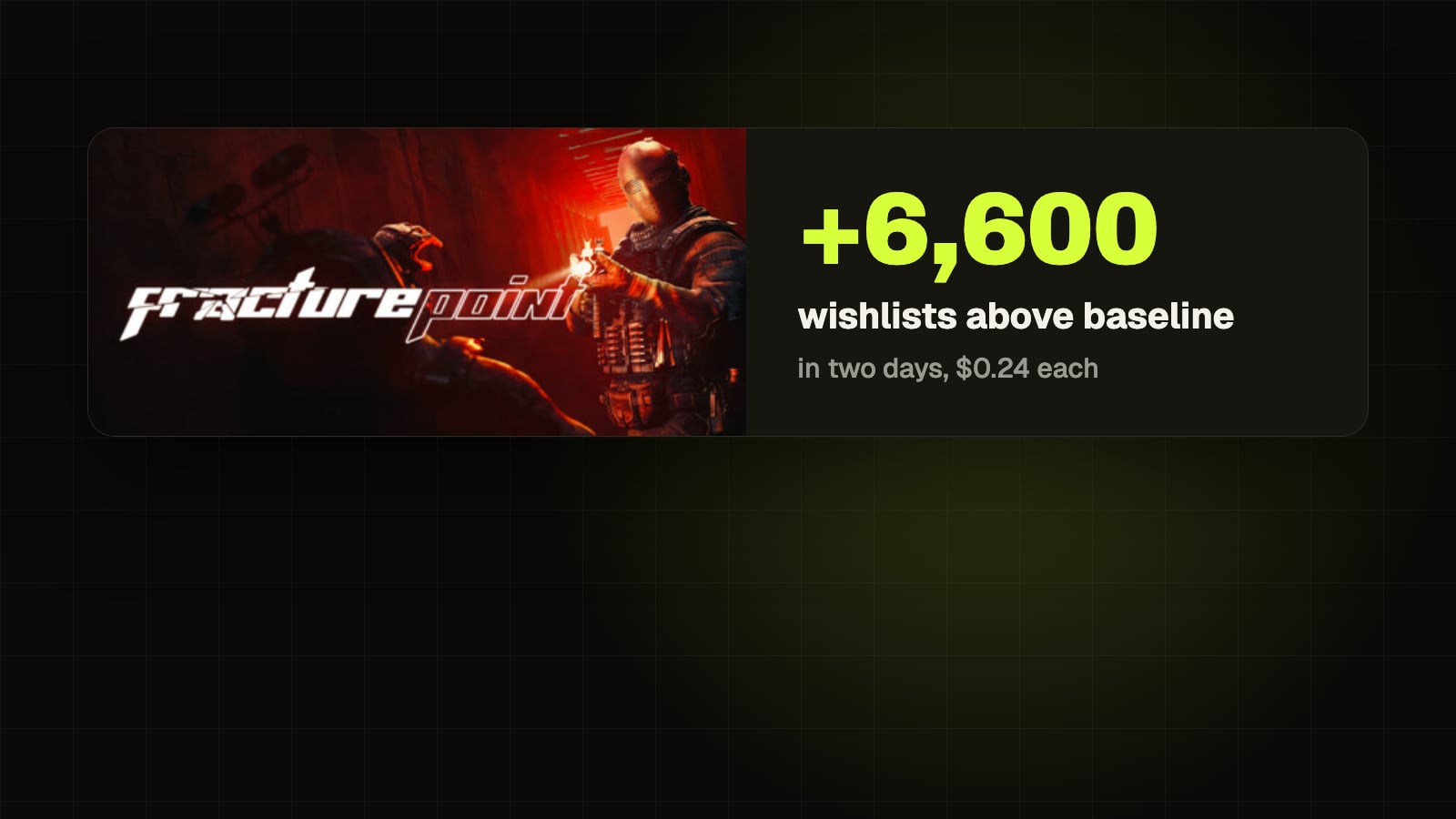
Short answer: measure in Steamworks, not in views. Write down your normal daily wishlist rate before the campaign, count only what comes in above it during the campaign window, and subtract deletions. Then divide what you paid creators by that number. UTM links help for traffic from your own channels, but most creator viewers click from inside TikTok or Instagram, where they are rarely logged in to Steam, so UTM numbers undercount a creator campaign. Fracture Point measured it the baseline way: 6,600 wishlists above its normal rate in two days, at $0.24 each.
Views are easy to count and easy to celebrate. They are also not what you paid for. You paid for players, and before launch the best stand in for players is a wishlist. Here is how to count them properly.
Where do the numbers live?
In Steamworks. The wishlist report shows additions, deletions and purchases from wishlists, updated daily with data through the previous day (Steamworks wishlist reporting). That is your source of truth. Creator dashboards and platform stats tell you about views; Steamworks tells you what those views did.
Step 1: take your baseline
Before the campaign starts, look at the last one or two weeks and write down your average wishlist adds per day. That number is what the page does without you.
It changes the result a lot. Fracture Point's page was already adding about 1,400 wishlists a day on its own. Counting the full daily totals would have added about 2,800 wishlists over two days that the campaign didn't bring. UnLoop averaged 244 a day before its campaign and hit 1,439 on its biggest day, close to six times its usual pace. That is a clear signal because the baseline was written down first.
Step 2: count net, not gross
Some people wishlist a game and remove it later. Steamworks shows both. Catch Meow If You Can reported its result from the studio's Steamworks Wishlist Actions data: 12,402 adds, 441 deletes, 11,961 net over 8 to 24 September. Use the net number.
Step 3: pick the window before you look
A campaign usually produces a spike and then a tail. Catch Meow If You Can took about 3,400 wishlists the day after the first wave of videos, then 450 to 650 a day for two weeks without dropping back to baseline. Fracture Point measured over two days.
Decide the window when you plan the campaign (for example, launch day plus 7 days), not after you see the chart. Picking the window afterwards always flatters the result.
Step 4: work out the cost per wishlist
| Formula | |
|---|---|
| Extra wishlists | Net wishlists in the window minus (baseline per day × days in the window) |
| Cost per wishlist | Creator spend ÷ extra wishlists |
With made up numbers: a page that normally adds 200 a day runs a 7 day campaign and gets 5,000 net wishlists in that week. 5,000 minus 1,400 (200 × 7) is 3,600 extra wishlists. At $3,000 of creator spend, that is about $0.83 per wishlist.
What counts as a good number is covered in how much game influencer marketing costs. All Trapster case studies use the same basis: creator spend, platform fee excluded, divided by wishlist growth.
What about UTM links?
Steam supports UTM links on store pages (UTM analytics docs). The useful parts:
- A link needs
utm_sourceorutm_campaign.utm_medium,utm_contentandutm_termare also supported. - A wishlist or purchase counts if it happens within 72 hours of the click.
- Visit counts update hourly. Conversions are finalized 4 days after the visit.
- Conversions are only reported for visits where the person was logged in to Steam.
That last point is the catch for creator campaigns. Steam's own docs note that social apps make it hard to send traffic outside the app, so people clicking from them are rarely signed in. Many viewers also don't click at all: they search for the game later, on another device. Use UTM links for your own posts, newsletter and Discord, where they work well, and treat UTM numbers from a creator campaign as a floor, not the full result.
Read the regional split
Steamworks also shows where wishlists came from, in the Regional Sales Report. It often surprises studios. Catch Meow If You Can didn't target any region, and its adds came from Western Europe (3,195), North America (2,775), Central Asia (1,868) and Latin America (1,637). That is useful for localization, pricing and the next campaign's targeting.
Keep a simple log
Every day of the campaign, write down what went live and when. When the wishlist chart jumps, you'll know which videos to thank and which hooks to reuse. On Trapster the campaign dashboard shows views and spend day by day, so the log mostly writes itself. Global Rescue checked hourly wishlist snapshots during its 7 day campaign to see which creators were converting viewers.
If you are comparing platforms, see TikTok, YouTube Shorts or Instagram Reels.
FAQ
Why don't my UTM numbers match the wishlist jump?
UTM conversions only count logged in visits within 72 hours of the click. Viewers who watch on their phone and wishlist later on their PC, or who search for the game instead of clicking, don't show up there. The baseline method catches them.
How long should I keep counting after a campaign?
Pick the window in advance. A week after the last video is a reasonable default; some campaigns keep a tail for two weeks.
Should I subtract deletions?
Yes. Report net wishlists.
What if my baseline is close to zero?
Then almost everything during the campaign is extra, which makes the math simple. Clay Clinic started from zero and added 16,750 wishlists.
See the numbers move
Every Trapster campaign comes with a dashboard that tracks views and spend day by day, so you can put it next to your Steamworks data. See Trapster for studios or book a call.
Sources: Steamworks documentation on wishlist reporting and UTM analytics. Campaign figures come from Trapster case studies, based on studio Steamworks data where the studio shared it. Cost per wishlist excludes the platform fee.
Get a wishlist forecast for your game
Send us your Steam page. We estimate views, creators and cost per wishlist before you spend anything.
Keep reading
How to Market Your Game's Steam Launch Week
A launch week plan for Steam: what Steam does on release day…
How to Boost Sales of a Game That's Already Out
How to boost Steam sales after launch: discount rules, update visibility rounds…
How to Market a Simulator Game
How to market a simulator game: find the watchable moment, keep the…