Steam Popular Upcoming: How It Works After the 2026 Change
What Steam Popular Upcoming is, what Valve says decides it, the June 2026 change, how it relates to the Personal Calendar and what your studio can do.
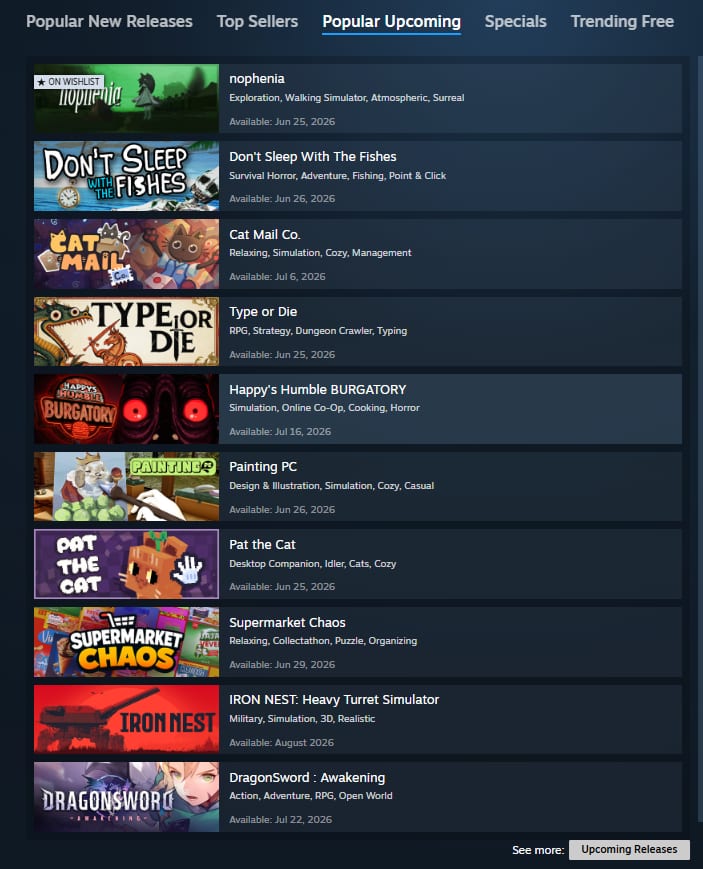
Short answer: Popular Upcoming is the tab on the Steam home page that lists unreleased games with the most pre-release interest. When Valve launched it in 2018, it said the list takes into account "wishlists, pre-purchase, and a developer's or publisher's past titles", and Valve's current visibility documentation names it as one of the few places where wishlists are a factor. On June 4, 2026, Valve changed the tab to "better capture the most anticipated releases of the coming month" and pointed players to the Personal Calendar for more niche games. For most indie games, the Personal Calendar is now the more realistic pre-launch placement, and both depend on a public release date and real wishlists.
What Popular Upcoming is
Popular Upcoming is a tab on the Steam store home page. You can also open it as a full list through Steam search with the Popular Upcoming filter, and Steam keeps a separate All Upcoming list that is not filtered by popularity.
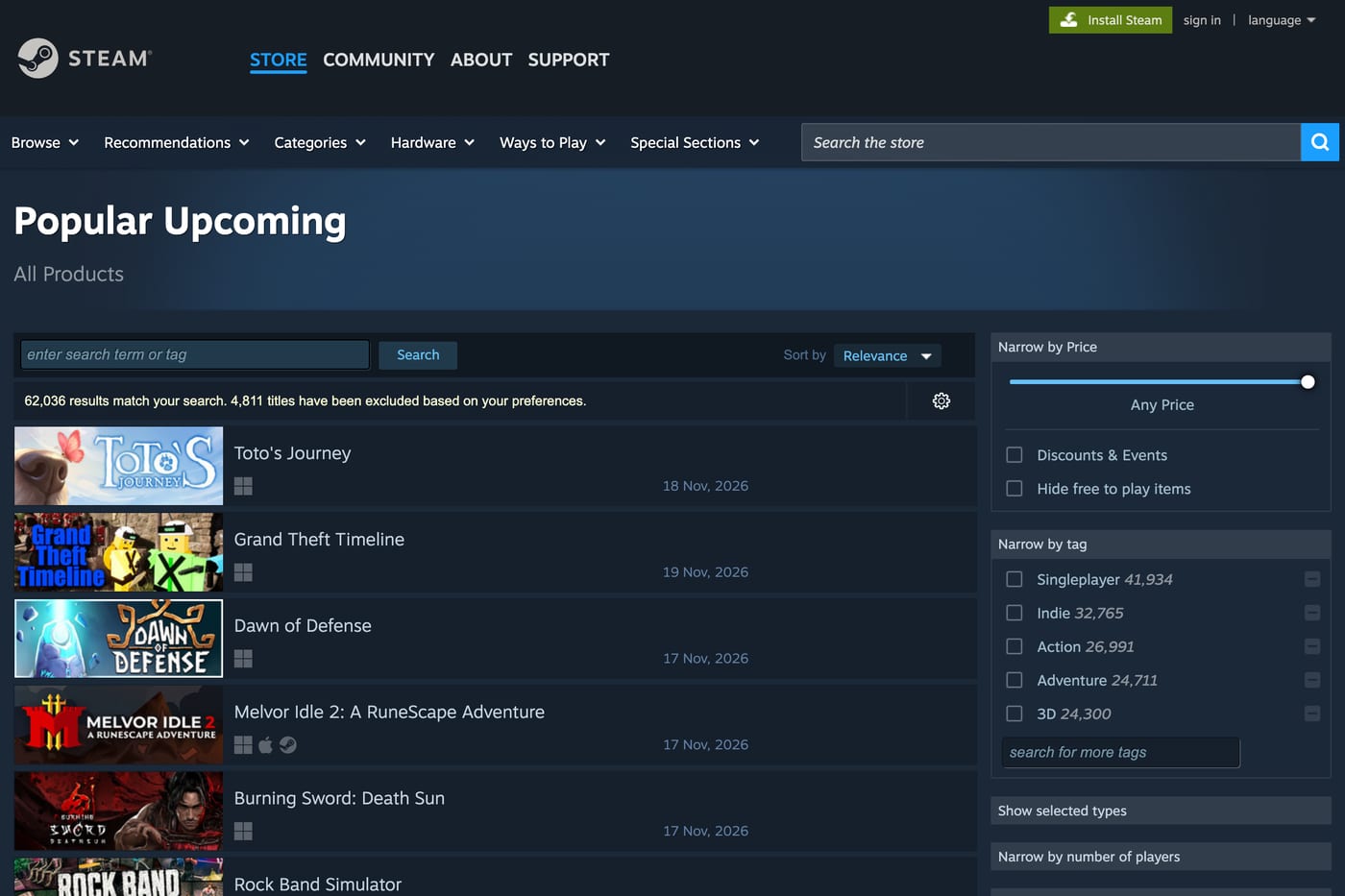
It replaced an older "Upcoming" tab that was a plain chronological list. In the July 2018 announcement, Valve said that old list was clicked by "less than half of one percent of customers", while Top Sellers was clicked by almost four percent. The new tab was meant to show players upcoming games that real interest says they might want, instead of a random slice of everything.
The tab only covers games that have not launched yet. Developers tracking it report that a game drops off the day it launches, and from then on it has to earn placement in post-launch sections. For how those work, see our guide on how the Steam algorithm works.
How Valve says games get onto Popular Upcoming
Valve has never published a formula. Here is everything Valve itself has said, in its own words:
| Source | What Valve says |
|---|---|
| Popular Upcoming launch post, 2018 | The list "will take into account the pre-release interest in a game", meaning "data we gather through wishlists, pre-purchase, and a developer's or publisher's past titles." |
| Same post, Q&A | Asked whether friends wishlisting a game can push it to the front page: "Yes but probably no." Valve says it monitors the system so it is not manipulated and promotes games when interest is "a natural trend across Steam's diverse customer set." |
| Visibility on Steam doc | "With a few exceptions like the Popular Upcoming tab, wishlists are not a factor in your game's algorithmic visibility on Steam." |
| Release Dates doc | "Visibility on lists and pages such as Popular Upcoming depend on release date." |
| Wishlists doc | Before launch, a game "may appear on lists featuring upcoming games according to various filters, such as release date, popularity, tag, or other categories." |
| Home page refresh, June 2026 | The tab was "updated in response to player feedback in order to better capture the most anticipated releases of the coming month." |
Two things follow directly from Valve's wording. First, Popular Upcoming is one of the rare places where Valve openly says wishlists count. Do not stretch that into "wishlists boost your Steam visibility" in general: the same doc says that outside these exceptions they mostly do not. Second, the signal Valve describes is interest from many different players. Valve says it watches for manipulation, so wishlists from a small circle of friends or from bought traffic are not what the list is built to reward.
The June 2026 change: "the coming month"
The refreshed Steam home page went live on June 4, 2026, after a beta that started April 1. Under the heading "Popular Upcoming: Now more popular", Valve wrote that the tab now aims at "the most anticipated releases of the coming month" and added: "If you're looking for more niche upcoming releases, check out your Personal Calendar."
That is all Valve said about the mechanics. It did not publish a new threshold or a new number of slots.
What developers report after the change (these are observations from outside Valve, not Valve data):
- Chris Zukowski of How To Market A Game tracks the tab with a daily scrape. In his June 2026 analysis he reports that before the change about 10 new games entered the list every day and even strong games got 1 to 2 days on it. After the change he saw 1 to 3 new games per day, with games staying much longer, though he notes part of that sample fell during Next Fest, when fewer games launch.
- In his updated wishlist benchmarks, he says the old rule of thumb of 5,000 to 7,000 wishlists came from the 10-game, date-ranked list. Surveying one day in June 2026, he estimated the games on the tab at 8,470 wishlists at the 30th percentile, 13,270 at the median and 20,000 at the 70th percentile. Elsewhere on that page he estimates wishlists from public follower counts, so treat these as rough ranges.
- He also saw some games under 7,000 wishlists still make the list, and very large games sitting on it for weeks or even two months before launch. The opening of his Personal Calendar post says the bar moved "to somewhere around 100,000 wishlists", which does not match his own survey, so use the survey numbers, not the headline.
Our read: the tab now behaves less like a short daily rotation of near-launch indies and more like a showcase of the biggest games due in the next few weeks. Plan your launch on the assumption that you may not appear there at all, and treat a spot on it as a bonus.
How Popular Upcoming relates to the Personal Calendar
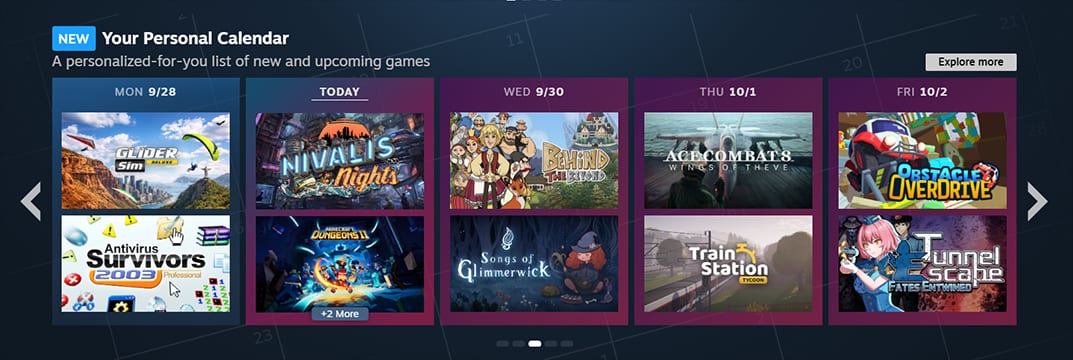
Valve itself sends players from one to the other, so you need to understand both. We cover the calendar in depth in our Steam Personal Calendar guide. The short comparison:
| Popular Upcoming | Personal Calendar | |
|---|---|---|
| Who sees what | One list, aimed at "the most anticipated releases of the coming month" | Personalized per player, built from what similar players have wishlisted |
| Role of wishlists | Named by Valve as an exception where wishlists matter | "The more wishlists your game has, the more likely it is to appear," but no hard threshold |
| Time window | Upcoming releases only | An 8-week horizon ahead, plus recent releases |
| What you control | Release date display and the interest you build | A visible Coming Soon page with a specific release date, set early |
The Personal Calendar left Steam Labs on October 23, 2026 and is now a full store feature. Valve's calendar doc says you need a specific release date to be eligible, and recommends setting it at least 60 days ahead for the dedicated calendar page and at least three weeks ahead for the front page widget.
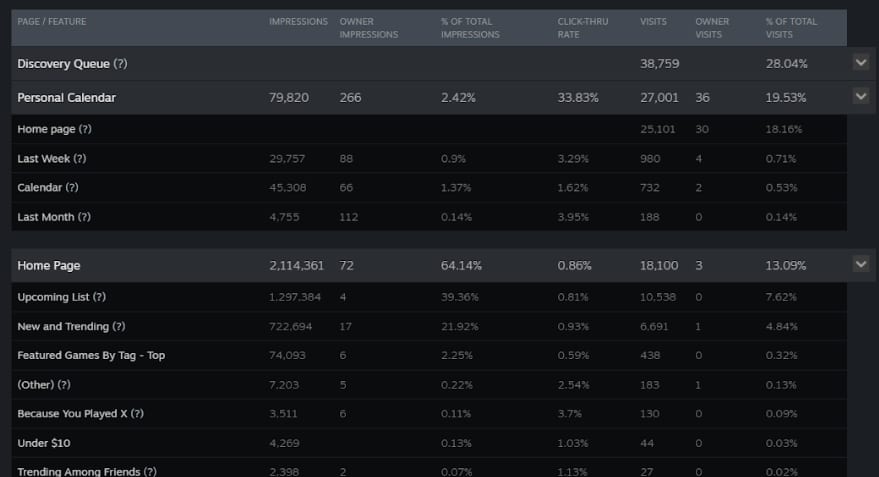
Developers who launched during the switch shared numbers with Zukowski that show why this matters. One game (Focus Grove) got 1,297,384 impressions from Popular Upcoming at a 0.81% click-through rate (10,538 visits) against 79,820 impressions from the Personal Calendar at 33.83% (27,001 visits), as reported in his post. That is one developer's data from around the switch, not a benchmark, but it shows a smaller, better-matched audience can send more visits than a broad list.
Release date display rules that affect upcoming lists
Your release date settings are the one lever Valve documents for list placement. From the Release Dates doc:
- You always set an exact intended date in Steamworks. Players do not see it unless you choose to show it.
- You choose one of five display formats: exact date, month and year, quarter, year, or just "Coming Soon".
- Vague dates sort late. Valve lists your game "at the last possible date of that time range". "March 2027" sorts as March 31. A quarter sorts as the last day of the quarter. "Coming Soon" with no date sorts behind every game with a more specific date.
- The two-week window. The Release Dates doc says you can change your date up to two weeks before it, and that inside that window "your game will start showing up more in 'upcoming releases' lists" and you can no longer adjust the date. The Personal Calendar doc describes the same window from the calendar side: if you delay by more than 24 hours once you are within two weeks of launch, your game is removed from the calendar until it releases. Moving the date earlier does not hurt calendar visibility.
- Weekends are hidden. The date picker does not offer weekend dates, because the Steam team is not available to help with launch problems then.
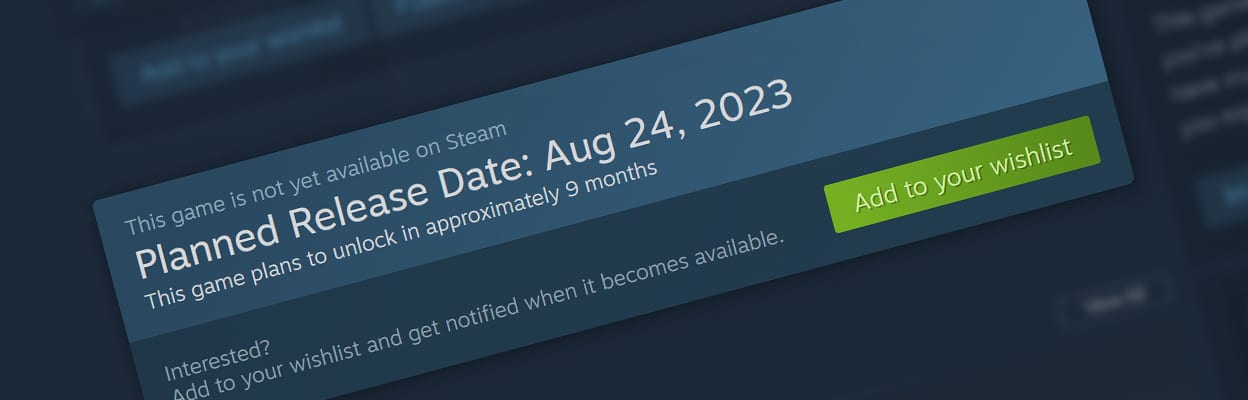
The practical point: a vague date costs you nothing in the early months, but once you are inside the window where upcoming lists matter, a specific public date is what places you correctly. Settle it well before the two-week lock.
What studios can do
None of this is a trick. It is the normal pre-launch work, timed so the systems Valve describes can see it.
- Get your Coming Soon page up early. Valve requires a public page at least two weeks before release and asks you to submit it for review at least 7 business days before you want it live. In practice you want it up months earlier so wishlists can build. See when to make a Steam page.
- Lock a specific public date at least 60 days out. That is Valve's own recommendation for the Personal Calendar, and it also gives upcoming lists a correct date to sort you by.
- Do not plan on a late delay. A delay of more than 24 hours inside the last two weeks removes you from the calendar until launch.
- Build interest from many real players. Valve's 2018 wording rewards "a natural trend across Steam's diverse customer set". Wishlists from a wide audience help on Popular Upcoming and on the calendar. Our guide on how to get more Steam wishlists covers the channels. Short-form creator videos are one way to reach players outside your own followers; we break down how creator views turn into wishlists.
- Get your tags right. Valve's visibility doc lists tags among the things that matter for where Steam shows your game. The calendar itself, per Valve, matches games through what players with similar playtime have wishlisted.
- Measure, do not guess. Steamworks traffic reports show impressions and visits per placement. After launch, check which upcoming placements actually sent players.
FAQ
How many wishlists do you need for Steam Popular Upcoming?
Valve has not published a number. Chris Zukowski estimated the median game on the tab at about 13,000 wishlists in one June 2026 survey, with some games under 7,000, but that is a developer estimate, not a Valve rule.
Do wishlists affect Steam visibility?
Valve says wishlists are mostly not a factor in algorithmic visibility, "with a few exceptions like the Popular Upcoming tab". The Personal Calendar doc also says more wishlists make an appearance more likely.
How long does a game stay on Popular Upcoming?
Valve does not say. Developer tracking found games used to get 1 to 2 days, and after June 2026 fewer games enter but many stay longer, some for weeks.
Can Early Access games appear on Popular Upcoming?
Valve does not spell this out. Zukowski reports that Popular Upcoming showed first Early Access launches but not the later move to 1.0. For 1.0, Valve lets you set a planned date that shows on the Personal Calendar.
Does a "Coming Soon" date hurt my placement?
On upcoming lists, yes. Valve says a game with no date displayed appears behind all games with a more specific date.
Can I change my release date to stay on Popular Upcoming longer?
Not inside the last two weeks. Valve's docs say the date locks in that window, and a delay of more than 24 hours removes you from the Personal Calendar until you launch.
What replaced Popular Upcoming for indie games?
Nothing replaced it, but Valve now points players to the Personal Calendar for "more niche upcoming releases". For most indie games that is the more realistic pre-launch spot.
Sources: Valve, Improvements to the Upcoming tab (2018); Valve, A Refreshed Steam Store Home Page (June 2026); Valve, Personal Calendar Full Release (October 2026); Steamworks: Visibility on Steam; Steamworks: Personal Calendar; Steamworks: Release Dates; Steamworks: Coming Soon; Steamworks: Wishlists; Chris Zukowski, How the Steam Personal Calendar affects your launch; Chris Zukowski, wishlist benchmarks; checked November 2026.
Get a wishlist forecast for your game
Send us your Steam page. We estimate views, creators and cost per wishlist before you spend anything.
Keep reading
How Many Copies Do Indie Games Sell? Real Steam Numbers by Tier
Most Steam indie games sell under 1,000 copies. Real numbers by tier…
Game Marketing Hook: How to Find, Test and Show Yours
What a game marketing hook is, how to test one cheaply with…
How to Name Your Game: Searchable, Memorable and Legally Safe
How to name your game: pass the Steam, Google and trademark checks…