Steam UTM Tracking: How It Works, Where It Fails, Real Data
How Steam UTM Analytics counts visits, wishlists and sales, why it undercounts, how to name campaigns, and what real developers saw in their data.
Short answer: Steam UTM tracking works by adding utm_source or utm_campaign to a link that points at your Steam app page or a Steam sale page. Steamworks then counts visits from that link and credits a wishlist, purchase or activation to it if a logged-in user takes that action within 72 hours of the click, according to Valve's UTM Analytics documentation. Only visits from people signed in to Steam in the same browser can convert, so the report always shows a floor, not the full number. Developers who compared UTM data against total wishlist lift report that Steam caught somewhere between a quarter and about 80% of the wishlists their campaigns actually drove. Use it to compare channels against each other, not to calculate exact cost per wishlist.
How Steam UTM Analytics works
Valve added UTM Analytics to Steamworks in April 2021. GameDiscoverCo covered the launch and got some extra answers from Valve at the time. The idea is the same as UTM tags in Google Analytics, with one big difference: you never see individual users or sessions. Steam records an anonymized event when a tagged visit happens and later shows you summary totals.
The report lives in Steamworks under your game's Marketing & Visibility section, on the UTM Analytics tab. Valve says the tab only shows up for accounts with the "View Marketing Traffic Data" permission, so if a teammate cannot see it, check permissions first (Steamworks docs).
You do not need to create campaigns in Steamworks before using them. Any link that meets the format rules starts reporting the first time someone clicks it. Chris Zukowski made the same point in his 2021 walkthrough of the feature: you just start using tags and they appear.
The link format
Valve's own example link is:
https://store.steampowered.com/app/480?utm_source=homepage&utm_campaign=summer_sale&utm_medium=web
The rules from the Steamworks documentation:
- Destination must be an app page or a sale page. That means
store.steampowered.com/app/YOUR_APP_IDorstore.steampowered.com/sale/SALE_NAME. Valve states: "Links to other pages on Steam are not currently supported." Developer homepages and bundle pages will not report. - Include
utm_sourceorutm_campaign. At least one is required. Without either, the visit does not count. - Optional parameters.
utm_medium,utm_contentandutm_termare also supported, which gives you room for ad group and creative IDs. - Store widgets work. If you embed the Steam store widget on your own site, append the UTM parameters to the end of the widget's iframe URL.
- Sale pages pass tags through. Since April 22, 2025, UTM parameters on external links to a Steam sale page pass through to the individual games on that page. That covers regional, themed, showcase and developer or publisher sale pages. If you run a publisher sale and link it from your newsletter, each game on the page gets credit.
- Test before you publish. The report has a "Test a UTM Link" button that tells you whether a link meets the requirements. Valve also recommends opening the link in a browser yourself.
What the report measures
The report splits visits into three layers and only counts conversions from the last one.
| Metric | What Steam counts |
|---|---|
| Total Visits | Every visit to your page with a UTM code in the URL, each time the link is opened |
| Trusted Visits | Total Visits minus bots and search crawlers |
| Tracked Visits | Visits where the user was logged in to Steam, minus abnormal behavior such as repeated visits at a high rate |
| Wishlists | Tracked visitors who added the game to their wishlist |
| Purchases | Tracked visitors who bought the game |
| Activations | Tracked visitors who got a free to play license or redeemed a key |
Source: Steamworks UTM Analytics.
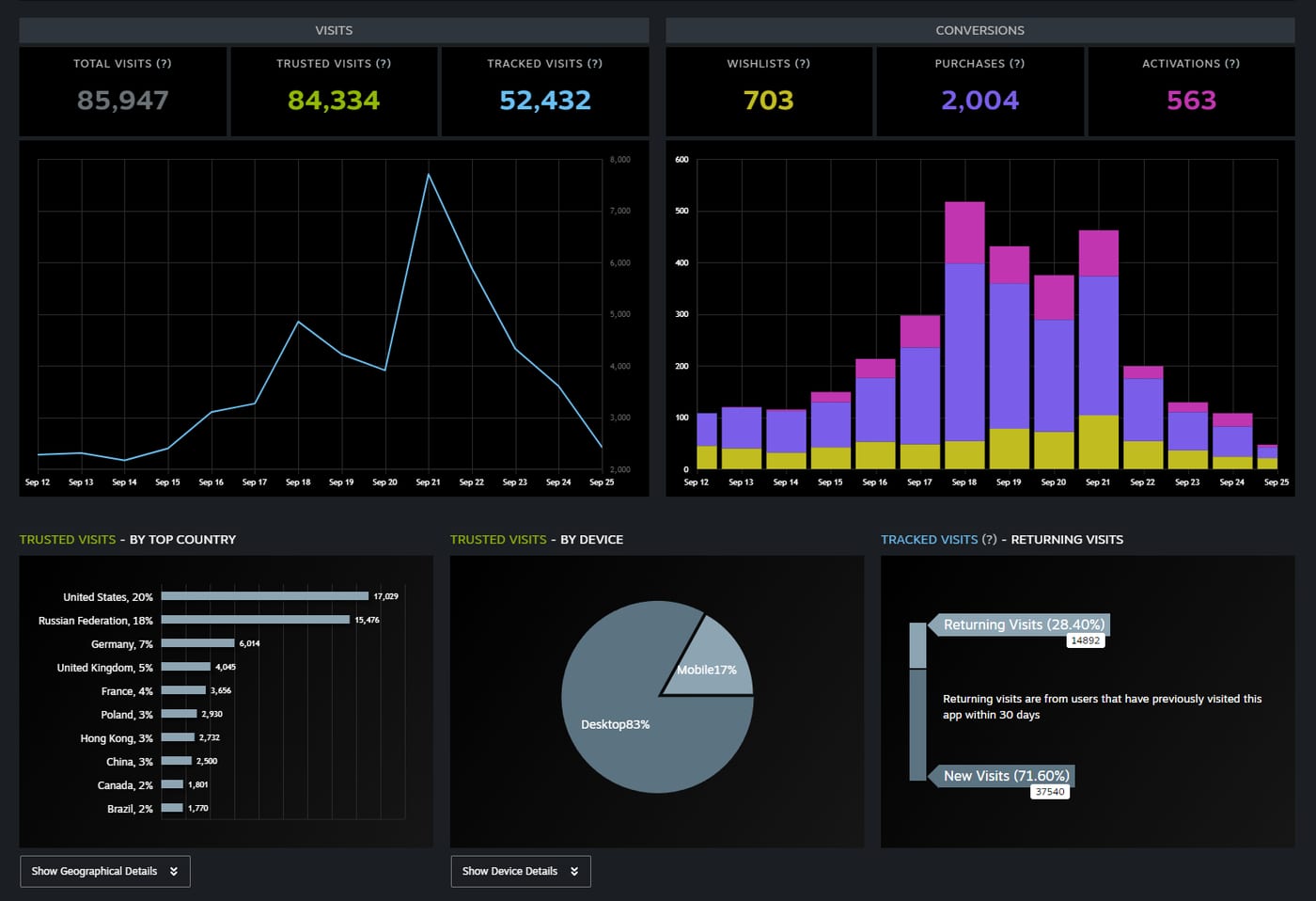
A few rules decide what counts as a conversion:
- Same App ID only. If someone clicks a link to your game and buys a different game in your catalog, it does not count.
- Demos and DLC do not count, unless the DLC package includes the base game.
- In-game purchases and Playtest apps are not tracked.
- Key redemptions show up as Activations, not purchases.
- One conversion per user per type. Valve told GameDiscoverCo that if one person clicks several of your UTM links, only one visit gets credit, so repeat clicks do not inflate the number. A single user can still produce one wishlist and one purchase.
The 72 hour window and the 4 day finalization
Valve's wording: "Steam will count it as an conversion if the user takes that action within 72 hours of clicking through your UTM link." The user can browse other pages in between and it still counts. After 72 hours, nothing is credited. Someone who wishlists today and buys at launch six months later shows up as a wishlist conversion, but the purchase is not tied back to the link. Zukowski flagged this exact gap in his 2021 post.
Visit counts update hourly. "Conversions are finalized 4 days after the visit," and refunds after that point are not removed from the report. So do not judge yesterday's ad by its conversion column. Wait four days.
Thresholds and privacy
Steam never shows Steam IDs or personal data. Rows in the breakdown table are hidden when visits for a UTM combination "do not meet minimum thresholds." Valve does not publish the threshold number. In practice this means tiny tests, like a single tweet with 15 clicks, may never appear as a row. If you split a small budget into dozens of utm_content variants, you can end up with a report full of hidden rows. Fewer, larger buckets give you readable data.
Some users are not tracked at all, depending on browser settings and cookie choices. Steam's cookie settings include a "Third Party Links (UTM)" option, and users who decline it drop out.
Why Steam UTM undercounts
This is the part most guides skip, and it matters more than the link format. The core rule: "Tracked visits are by users who logged into Steam in the browser where they opened the UTM link." Only tracked visits can convert.
Here is where that breaks in practice:
- Social app in-app browsers. When someone taps your link inside TikTok, Instagram, X or Reddit, the page usually opens in the app's built-in browser. Valve notes that these rarely have users signed in to Steam. The user sees your page, closes it, opens Steam later and wishlists there. Steam has no way to connect the two.
- Switching to the Steam client by hand. If a player reads your ad, then searches for your game in the Steam client or desktop app, Valve says it "can't link those actions to the original ad."
- The open-in-Steam banner. Logged-out desktop visitors see a banner prompting them to open the page in the Steam client. Logged-out mobile visitors see one prompting them to open the Steam mobile app. Valve says conversions can be followed when the user takes that route. Many do not.
- Cookie opt-outs. Users who declined the UTM cookie are not tracked.
One thing that does work, and is often reported wrong: cross-device journeys while signed in. Valve says a click on a phone followed by a purchase on a computer, with the user signed in, still counts. The report just does not tell you which device was used.
Example: In Zukowski's 2021 #ScreenshotSaturday test, nine developers with unreleased games posted tagged links on Twitter (now X) to their followers. Together they produced 5 wishlists. On average about 90% of visitors were not logged in to Steam, and around 8.4% of logged-in visits became wishlists. One tweet with 38 likes and 15 retweets drove zero.
Example: Green Man Gaming's performance team described a campaign in a February 2026 post for an unnamed indie title from a known publisher, with YouTube for awareness and Reddit for wishlist calls to action. They measured total wishlist lift during a window with no other paid media and minimal organic activity. Steam UTM attributed only 24% of the wishlists the campaign drove. Their reported cost per wishlist was £3.30 on UTM data and £1.71 on the lift estimate. Keep in mind GMG sells ad services, and the two CPW figures do not fully reconcile with the 24% figure.
How to name your campaigns
Steam does not care what you put in the parameters. Your team does, six months later, when someone exports the CSV. Pick a scheme once and write it down.
A naming scheme that holds up:
| Parameter | Use it for | Examples |
|---|---|---|
utm_source |
The platform or partner | reddit, tiktok, youtube, newsletter, discord, press_pcgamer |
utm_medium |
Paid, organic or owned | paid, organic, owned |
utm_campaign |
The push or beat | nextfest_feb27, release_date_reveal, demo_launch |
utm_content |
Ad group, creative or creator | cozy_subs_v2, trailer_cut_b, creator_handle |
utm_term |
Rarely needed | keyword, if you run search ads |
Rules that save pain later:
- Lowercase everything, use underscores, no spaces.
Redditandredditbecome two rows. - Keep it simple enough that people actually use it. Zukowski's warning was blunt: "don't make your utms too complicated," or the team stops tagging and you get no data.
- Keep one shared sheet of links. List every live tagged link, who owns it and where it is posted. Anyone posting about the game pulls a link from there.
- Give each ad group its own
utm_content. That is how you find out which audience or creative works, which is the main thing the report is good for. - Tag your evergreen placements once. Your X bio, Discord welcome channel, YouTube description template, press kit and website button should each carry a permanent tag. Then they run in the background.
Example: Patrick Tang of Poking Water Games tracked each ad group with its own UTM link, and recommends doing so, while promoting This Grand Life 2 in 2024, as reported by Game World Observer. He spent $4,365, mostly on Reddit, for about 4,000 wishlists, an average of roughly $1.10 each, with ad groups ranging from $0.80 to $2.50. His wishlist to tracked visit ratio ran from 0% to 25% depending on audience, which is exactly the spread you only see when every ad group has its own tag. The game reached Popular Upcoming at 5,228 total wishlists. (Single developer numbers.)
Turning UTM numbers into real estimates
Since UTM is a floor, studios that run paid traffic usually estimate a multiplier and apply it. There is no official multiplier. Every one below is a single team's estimate, and they vary a lot.
| Game / team | Channel | UTM wishlists | How they estimated the real total |
|---|---|---|---|
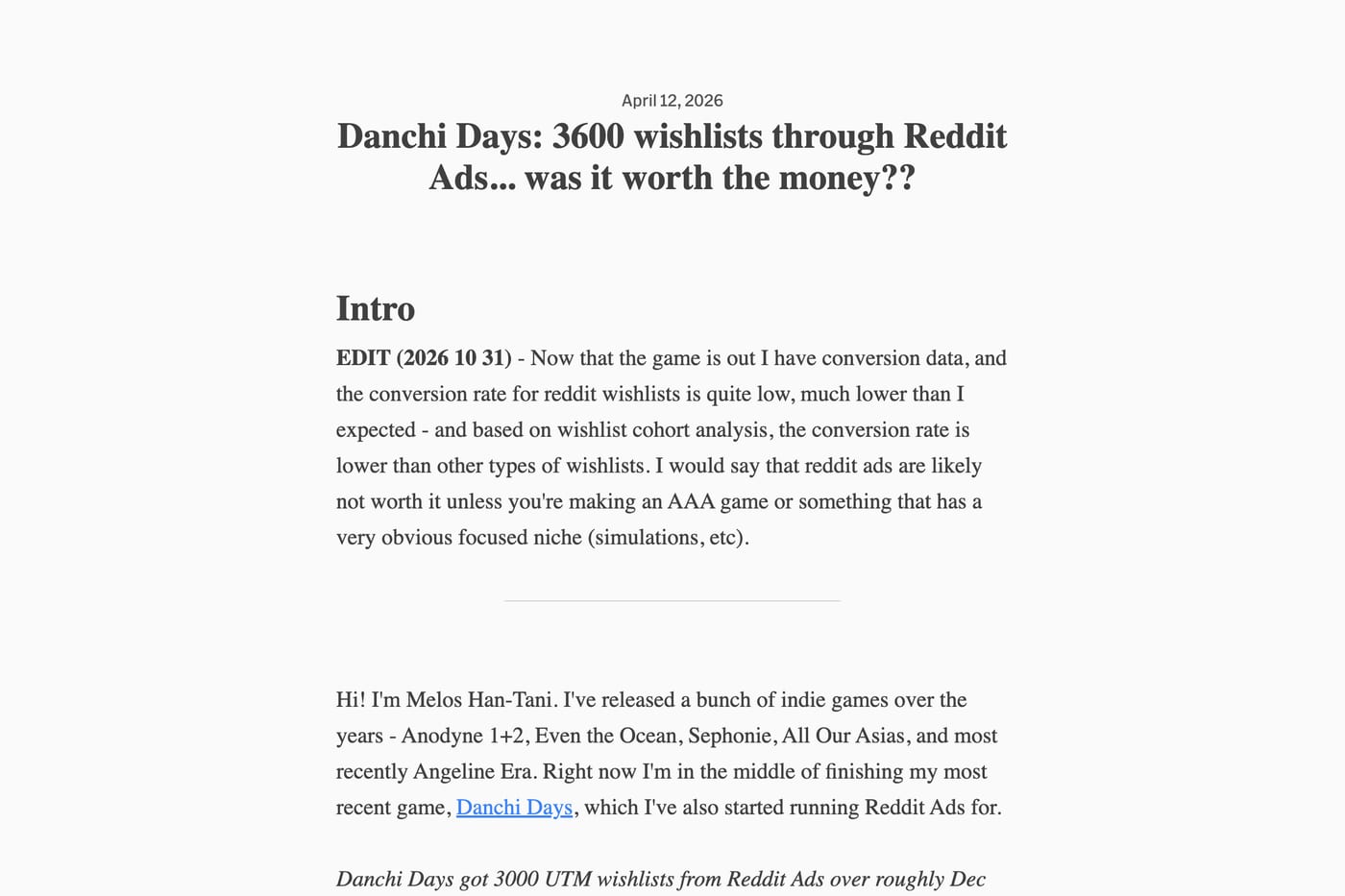
| Danchi Days (Melos Han-Tani), Dec 2025 to Apr 2026 | Reddit ads, $7,000 over 108 days | About 3,000 | 1.2x to 1.3x, based on a baseline of about 10 organic wishlists a day. Estimated 3,600 to 3,900 total, $1.79 to $1.94 per wishlist |
| Dead Weight (Klukva Games), 2025 | X ads | Nearly 14,000 | 1.7x, from comparing UTM peaks against total wishlist jumps. Estimated about 25,000 from X |
| Unnamed indie title (Green Man Gaming), post from Feb 2026 | YouTube plus Reddit | Not stated | Lift during a quiet period. UTM caught 24% |
A practical method you can repeat:
- Measure your baseline. Look at daily wishlist additions in the week before the campaign, with no other big beats.
- Run the campaign in a quiet window. No festival, no big update, no press push in the same days, or the lift is polluted.
- Compare total lift to UTM wishlists. Total wishlists during the campaign minus baseline, divided by UTM wishlists, gives your multiplier for that channel.
- Reuse it carefully. A multiplier from Reddit ads on mobile does not apply to a newsletter read on desktop. Measure per channel.
To see your daily totals, use the wishlist report covered in our guide on how to see Steam wishlists.
Example: Melos Han-Tani noted in the Danchi Days write-up that wishlists from the Reddit campaign converted to sales at launch much worse than expected. That is a reminder that cheap UTM wishlists are not the end of the story. If your wishlist conversion rate from one channel is poor, a low CPW can still be a bad deal.
Where UTM data is misleading in the other direction
UTM can also make a channel look better than it is, when the visitors are already on Steam and already signed in.
Example: In 2024, Butterscotch Shenanigans linked to Crashlands 2 from the original Crashlands store page through a store widget, and from inside the first game. Quoted by Chris Zukowski, they said this link accounted for about 40% of their UTM-tracked traffic and 75% of UTM-tracked wishlists. They also pointed out why: those visitors were already on Steam, so they were over-represented in UTM compared with links clicked inside social apps. The same post covers Valve's 2024 rule change that removed that kind of cross-link from store pages.

The lesson: do not compare a link inside the Steam ecosystem with a TikTok link on raw UTM conversion rate. The tracking rate is different, so the comparison is unfair.
Example: The solo developer of Match Morphosis wrote about spending $925 on Reddit ads in late 2025 for roughly 600 tracked wishlists, about $1.50 each, and found that 93% of the traffic came from mobile. He also pointed out the other big limit: Steam has no conversion callback, so ad platforms cannot optimize toward wishlists. You optimize toward clicks and use UTM to check which clicks were worth it.

Combining UTM with the Traffic Breakdown
Steam has a second report that you should read next to UTM: Store & Steam Platform Traffic Breakdown, also under Marketing & Visibility (Steamworks docs). It shows impressions and visits from surfaces inside Steam, like recommendations, discount sections and friend activity, plus external traffic.
The two reports count different things:
| UTM Analytics | Traffic Breakdown | |
|---|---|---|
| Covers | Only tagged links to your app or sale page | All store page traffic, inside and outside Steam |
| Shows conversions | Yes: wishlists, purchases, activations | No, impressions and visits only |
| Requires login for conversions | Yes | No |
| Cookie opt-outs | Excluded from tracking | Excluded since March 23, 2021 |
Valve says the Traffic Breakdown usually reports more visits than UTM, because the reports track different traffic and react differently to cookie preferences. UTM can show more visits only when a lot of your traffic comes from people who opted out of Valve's analytics cookies.
How to use them together:
- Check that your campaign moved total visits. If UTM shows 5,000 visits but total external traffic in the breakdown did not move, something is off with your tags or the clicks are low quality.
- Watch for the halo inside Steam. Ad viewers who later search Steam show up as search or direct traffic in the breakdown, not in UTM. A rise in those rows during a campaign, with nothing else running, is a sign the campaign worked better than UTM says.
- Watch what Steam does next. If your external traffic converts, Steam may start showing your game more. Our guide on how the Steam algorithm works covers what Valve says about this. Rising impressions in the breakdown after a campaign is the signal to look for.
Example: The Everfront Day 1 postmortem is a clean case of reading both. Wilhelm Tranheden posted his Coming Soon page to several subreddits with separate tags. In the first 24 hours the page got 1,014 visits and about 450 wishlists in total, while UTM tracked 766 visits and 192 wishlists. A single r/godot post drove 113 of the tracked wishlists from 365 visits, around 30% conversion, while bigger general subs converted worse. Without per-subreddit tags, he would have known only that "Reddit worked."
A setup checklist
- Create a shared sheet with your naming rules and every live link.
- Tag every permanent placement: website, press kit, bio links, Discord, YouTube description template, newsletter footer.
- Give every paid ad group and every creator their own
utm_content. - Run each link through "Test a UTM Link" before it goes live.
- Record your daily wishlist baseline before each campaign.
- Read conversions only after 4 days.
- Each month, export the CSV and compare UTM wishlists against total wishlist lift and the Traffic Breakdown.
If you work with creators, a per-creator tag in the link they put in their description or pinned comment is the simplest way to compare them, with the caveat that most short-form viewers tap from inside an app and many will not be tracked. Our post on turning creator views into Steam wishlists covers what to expect. For paid channels, see our guide to paid ads for indie games.
FAQ
How do I add UTM tracking to my Steam page?
Add ?utm_source=yoursource&utm_campaign=yourcampaign to your store link, for example store.steampowered.com/app/YOUR_APP_ID?utm_source=reddit&utm_campaign=demo_launch. No setup in Steamworks is needed. Results show up under Marketing & Visibility, UTM Analytics.
How long is the Steam UTM attribution window?
72 hours from the click. Wishlists, purchases and activations within that time count, and conversions are finalized 4 days after the visit.
Why does my UTM report show visits but almost no wishlists?
Usually because most visitors were not logged in to Steam in the browser they used, which is normal for links opened inside social apps. Only tracked (logged-in) visits can convert, so compare against your total wishlist lift before calling a channel dead.
Why is my UTM campaign missing from the breakdown table?
Steam hides UTM combinations that do not meet a minimum visit threshold, and Valve does not publish the number. Merge small variants into fewer tags or wait for more traffic.
Does Steam UTM tracking work on mobile?
Yes. Valve supports the mobile app and mobile web, and a click on a phone followed by a purchase on PC counts if the user is signed in. It fails when the link opens in a social app's in-app browser where the user is not signed in.
Can I use Steam UTM links for an affiliate program?
Valve advises against it. Steam has no affiliate program, the report cannot tie a specific purchase to a specific person, and refunds after 4 days are not removed, which makes payouts easy to abuse.
Can I track links to my developer page or bundle?
No. Only app pages and sale pages report. Since April 2025, tags on links to a sale page pass through to each game on that page.
Sources: Steamworks UTM Analytics; Steamworks Store and Platform Traffic Reporting; GameDiscoverCo on the UTM launch; How To Market A Game: Steam UTM feature; How To Market A Game: Crashlands 2 cross-linking; Green Man Gaming attribution case; Danchi Days Reddit ads; Everfront postmortem; Game World Observer on This Grand Life 2; WN Hub on Dead Weight; checked November 2026.
Get a wishlist forecast for your game
Send us your Steam page. We estimate views, creators and cost per wishlist before you spend anything.
Keep reading
How Many Copies Do Indie Games Sell? Real Steam Numbers by Tier
Most Steam indie games sell under 1,000 copies. Real numbers by tier…
Game Marketing Hook: How to Find, Test and Show Yours
What a game marketing hook is, how to test one cheaply with…
How to Name Your Game: Searchable, Memorable and Legally Safe
How to name your game: pass the Steam, Google and trademark checks…