Email Marketing for Indie Games: Build a List Steam Can't Take Away
Why indie games need a mailing list even with Steam wishlists: how to collect emails, tool costs, what to send, GDPR basics and real list results.
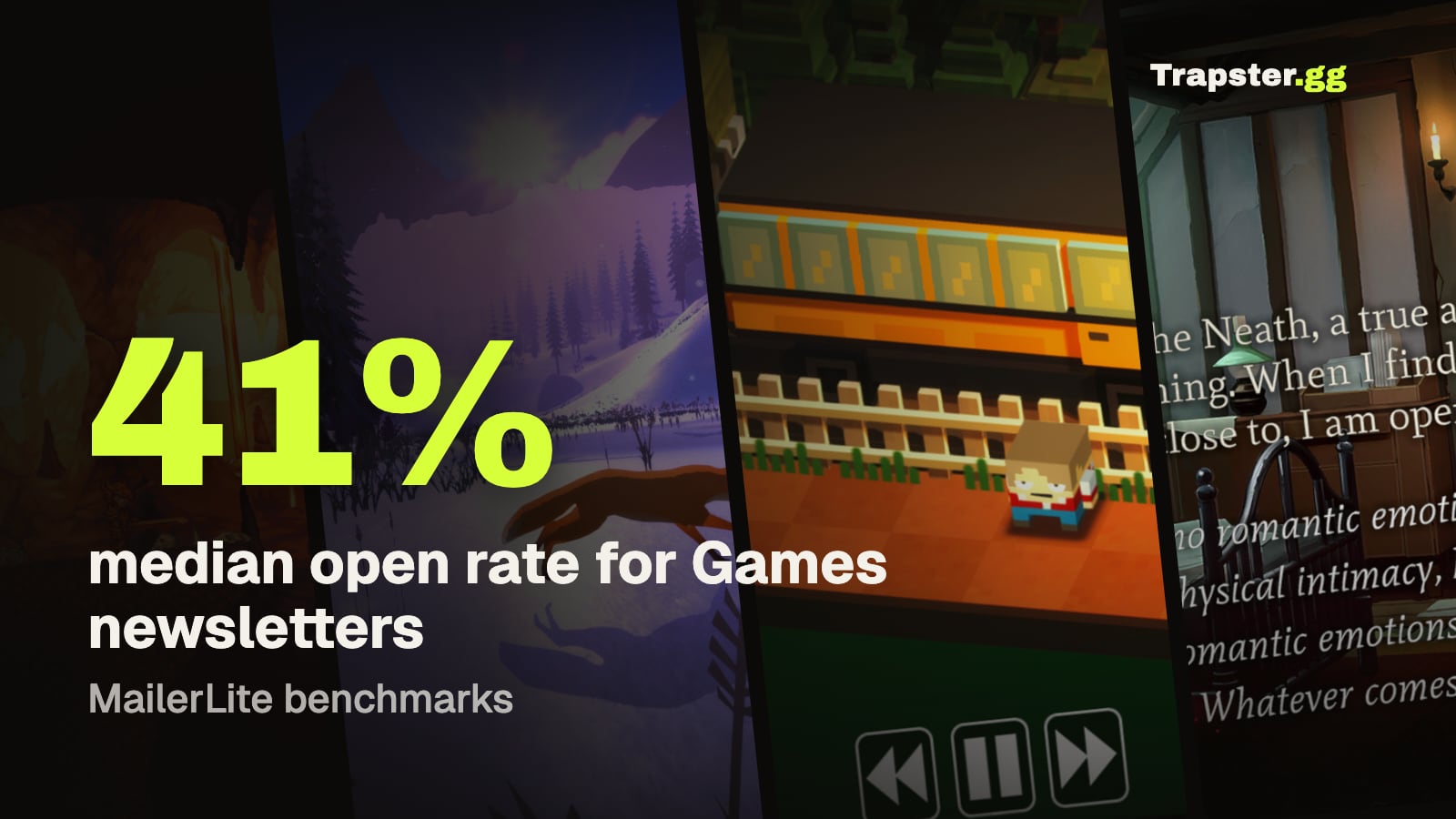
Short answer: Email marketing for indie games means building your own list of players who asked to hear from you, so you can reach them on your schedule instead of Steam's. Steam already emails wishlisters when your game launches and when it is discounted, but Valve controls the timing and the wording (Steamworks wishlist docs). A small list that you own covers the gaps: demo drops, Kickstarter launches, playtests, your next game. Free plans from tools like MailerLite and Kit are enough to start, and the median open rate for Games newsletters in MailerLite's 2025 benchmark data is 41.35%.
Why you need a mailing list when Steam already emails wishlisters
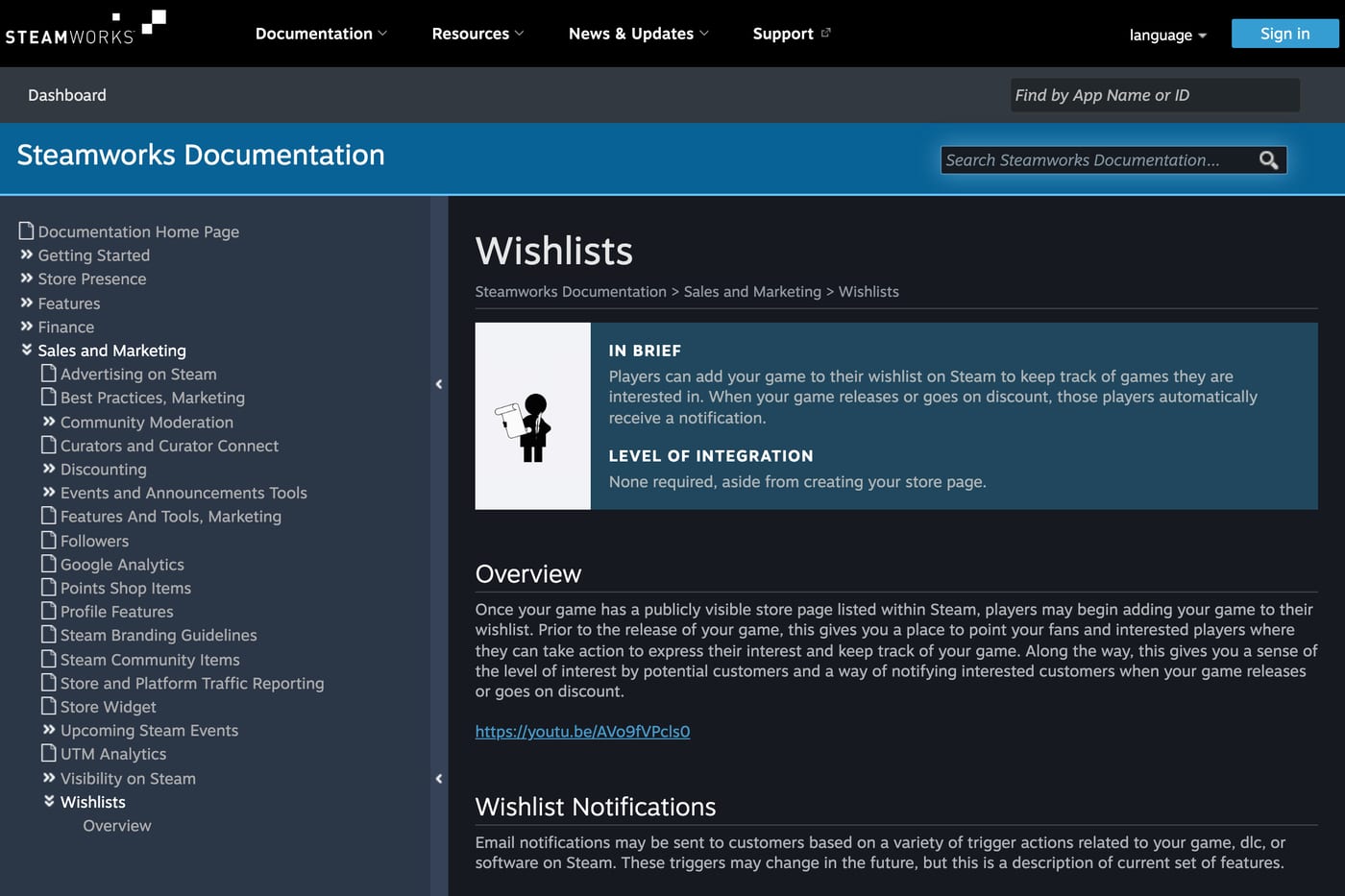
Wishlists are the main number most studios track, and they should be. But a wishlist is a permission Valve holds, not you. Here is what Valve's own documentation says Steam does with it (Steamworks: Wishlists):
| What happens | What Steam sends | The catch |
|---|---|---|
| Your game releases (or enters Early Access) | An email and/or mobile push to wishlisters | You do not write it or choose when it lands |
| Full release after Early Access | Another email to people who have it wishlisted at that time | Only one per transition |
| Your game gets a discount | A notification email or push | The discount must run longer than 8 hours |
| You release a demo | You can notify wishlisters | Valve says you can do this once |
| Any of the above | Users notified about your app in the last 2 weeks are on cooldown, and they must have verified their email |
That system works most of the time. When it fails, you find out late. Planet Centauri, a 2D sandbox game with nearly 140,000 wishlists, sold just 581 copies in the first five days after its 1.0 release. Months later the developers learned from Valve that the launch emails had hit a rare error, one Valve said had affected fewer than 100 games in a decade, and Valve offered a Daily Deal slot as compensation (Gamepressure, September 2025). A studio with its own list would at least have had a second channel on launch day.
The other reasons are simpler:
- Steam only emails about one game. Your list follows you to your next project, your DLC and your console port. Mortal Glory's developer barely used his list, yet picked up about 100 new subscribers just by mentioning upcoming DLC (How To Market A Game, 2021 postmortem summary).
- Steam cannot announce things that happen off Steam. Kickstarter launches, a playtest signup form or a festival booth all need a channel you control.
- You see the numbers. Steamworks shows notifications sent and resulting traffic, but your email tool shows opens, clicks and unsubscribes per message.
Email does not replace wishlists. Chris Zukowski put it bluntly back in 2017: "Email will never help new players discover you" (How To Market A Game). Your list turns people who already found you into people who show up on the day you need them. Every email should still push toward the Steam page.
Real examples: list size vs. results
These are public numbers from developers and journalists. Most are single-studio reports, so read them as data points, not benchmarks.
| Game / studio | What they did with email | Public result |
|---|---|---|
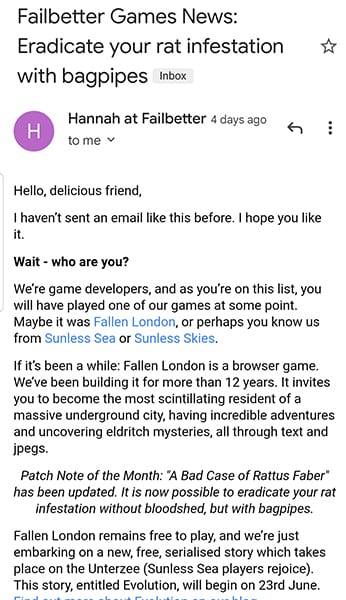
| Mask of the Rose / Failbetter Games (2022) | One mostly text email to the Fallen London list, which Zukowski describes as hundreds of thousands of somewhat engaged people, asking for wishlists | 26% open rate, 2% click rate, 0.6% unsubscribes, about 1,200 wishlists from that email (How To Market A Game) |
| The First Tree / David Wehle (2017) | Built a list from GIFs posted on Imgur and Reddit, then sent one launch email | About 4,400 subscribers and about 12,000 Steam wishlists; one Reddit GIF alone brought about 1,000 signups (Game Developer) |
| Will Glow the Wisp / Nikolas Crisci (2021) | Gave his older game away free in exchange for a newsletter signup | Grew from about 500 to 39,544 subscribers in a few days. He wrote that he regretted going for subscribers instead of wishlists (Game Developer) |
| The Iron Oath / Curious Panda Games (2017) | Had about 300 newsletter subscribers when the Kickstarter started, then sent a 48-hour reminder | Raised $94,524 from 3,835 backers; the team called the 48-hour reminder "huge" (Game Developer) |
| Of Sense and Soul (2023) | Newsletter of roughly 80 active subscribers with a wallpaper as a signup reward | 49% open rate; Kickstarter funded at 103% from 291 backers (developer postmortem) |
| Starcom: Nexus | Set up a list late, after a previous game flopped | A few hundred players joined, which the developer took as a sign there was demand for a bigger game; Starcom: Nexus later sold 29,000 copies within about six months of full release (Game Developer) |
| Planet Centauri (2024 to 2025) | Relied on Steam's launch email, which never sent | 581 copies in five days despite nearly 140,000 wishlists (Gamepressure) |

Two patterns stand out. Small lists convert well per person but rarely move a launch alone: 80 or 300 engaged subscribers helped a Kickstarter start strong, not a Steam launch. And a list built from a freebie grows fast but is full of people who wanted the freebie, which is why Crisci said he would have asked for wishlists instead.
How to collect emails
Very few people sign up for "news and updates." Zukowski made this point in 2017 and it still holds: give people a specific reason (How To Market A Game). Good reasons for a game studio are playtest or beta access, a soundtrack, a wallpaper, concept art, or a heads-up before a Kickstarter.
- Your website. Put one signup form above the fold with a concrete offer next to the Steam wishlist button. If you do not have a site yet, see our indie game website guide. Example: Failbetter grows its list through Fallen London account signups plus a direct signup form on its site (How To Market A Game).
- Inside your game or demo. A signup prompt on the main menu or end screen of a demo catches people at peak interest. Example: Blue Wizard ran a "Monthly Murderer Club" newsletter for Slayaway Camp that sent an unlock code for a new killer, available only to subscribers (How To Market A Game, 2017). For more on demos, read how to market a Steam demo.
- Discord. Pin a signup link in your announcements channel and offer playtest keys to subscribers. Discord is great for your most active fans, but plenty of players join a server, mute it and never return. Email reaches them anyway. Our Discord guide for game developers covers server setup.
- Kickstarter. Backers are not automatically newsletter subscribers. Kickstarter's own help center says you may only use backer information to communicate about the project and fulfil rewards, and that adding backers to an outside newsletter requires their consent, for example via a yes/no question in the backer survey or an update with a signup link (Kickstarter help). More in our Kickstarter for games guide.
- Events and festivals. A tablet with a signup form at a booth works, as long as the form shows the same consent wording as your website.
On every form, put the wishlist ask next to the email ask. Zukowski's advice from the Failbetter case is to push wishlists first, then quickly ask wishlisters to join the list.
Tools and what they cost
Prices below are from each vendor's pricing page as checked in November 2026. They change often and some vary by region, so confirm before you commit.
| Tool | Free plan | First paid step | Notes |
|---|---|---|---|
| Kit (formerly ConvertKit) | Up to 10,000 subscribers, unlimited broadcasts, forms and tagging | Creator plan listed at $33/month for 1,000 subscribers, billed yearly | Free plan has no automated sequences, so no welcome automation |
| MailerLite | 250 subscribers, 2,500 emails/month | Comfort from $12/month, Power from $25/month | Annual billing saves 10% |
| Mailchimp | 250 contacts, 500 sends/month (max 250 a day) | Essentials and Standard, priced by contact count | Price shown depends on region and promotion |
| Sendy | No free plan | $69 one-time license, sending through Amazon SES at $1.60 per 10,000 emails (Sendy's figure) | You host it yourself; Failbetter switched to it from Mailchimp |
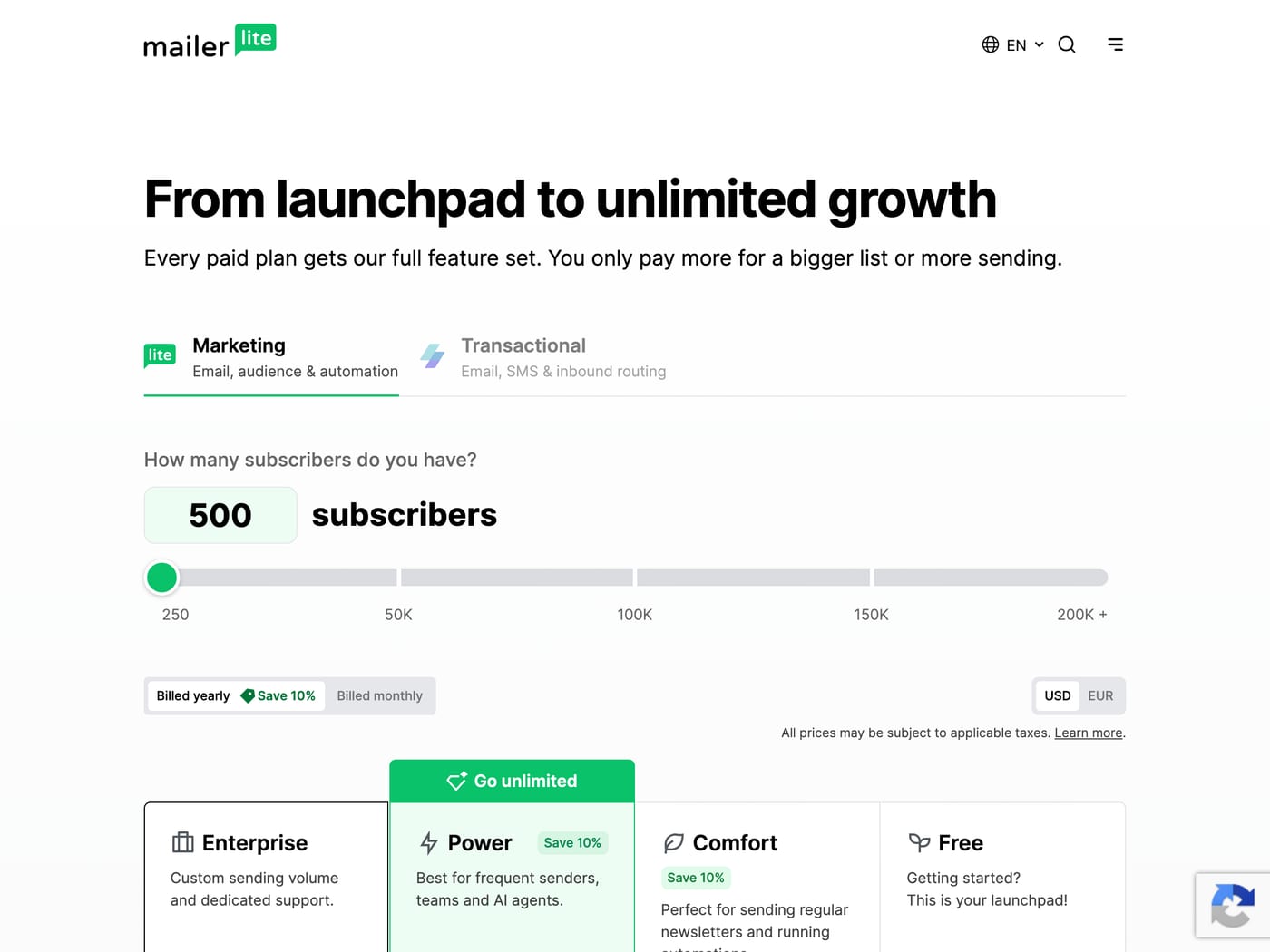
Free tiers have moved a lot. In 2021 Crisci's free Mailchimp account capped him at 2,000 contacts, and when his list jumped to almost 40,000 he had to prepay over 100 euros to keep sending (Game Developer). Today Mailchimp's free plan is 250 contacts. If a giveaway might spike your list, pick a tool whose overage pricing you have read in advance.
What actually matters for a game studio: one master list with tags (by game, by signup source, by platform), a signup form you can embed on your site and in your game, and a basic welcome automation. Zukowski recommends one list with segments rather than a separate list per game, because many tools bill per subscriber per list (How To Market A Game).
What to send and how often
The rule of thumb from How To Market A Game is "give-give-give-ask": for every email asking people to buy or wishlist, send three that give them something (source). The same post suggests sending at least once every two weeks to keep a list warm. For a small team, once a month is a realistic floor. Going quiet for a year and then emailing "we launched!" is how you end up in spam folders.
Emails that work for games:
- A welcome email that says who you are, what the game is, and gives one link (the Steam page).
- Development updates written for players, not investors: a new enemy, a cut feature and why, a GIF.
- Gifts: wallpapers, soundtrack tracks, early demo keys.
- The asks: wishlist, demo is live, Kickstarter is live, game is out, sale is on.
Keep the format plain. Failbetter's email that earned 1,200 wishlists was mostly text with one image, written in the second person, because "the intended audience of an email is one person," as Hannah Flynn told Zukowski (How To Market A Game). Write subject lines that state the news. "Studio Newsletter #12" tells nobody anything.
A launch sequence you can copy
Zukowski's launch sequence is four emails (source):
- One week before launch: the launch discount and how long it runs, a store page link, a wishlist ask.
- Right after the game goes live: it is out, here is the link.
- On the last day of the launch discount: the discount ends today.
- A few hours before the discount ends: a final reminder.
Your own email lands alongside Steam's release email, so you are not competing with Valve. You are giving the same people a second, more personal nudge and a chance to reach the subscribers who never wishlisted at all. For the rest of launch week, see our guide on turning creator views into Steam wishlists if you are also running short-form creator campaigns that week.
GDPR, CAN-SPAM and consent basics
This is not legal advice, but these are the rules most indie studios run into.
EU players (GDPR). The European Commission says consent must be freely given, specific, informed, and given through an affirmative act such as "an electronic tick-box that the individual has to explicitly check online." It must be "as easy to withdraw as to give consent," and it is up to you to prove the person consented (European Commission). In practice:
- No pre-ticked boxes. The person has to tick or click themselves.
- Say what you will send ("updates about our games, including launch and sale announcements") right next to the form.
- Keep the record your email tool stores (time, form, IP). Most tools do this by default.
- Put an unsubscribe link in every email and honour it right away.
- Do not import emails you collected for something else, like Kickstarter backers, support tickets or contest entries, without asking.
US players (CAN-SPAM). The FTC's guide requires a valid physical postal address in every commercial email (a registered PO box or private mailbox counts), a clear way to opt out, opt-outs honoured within 10 business days, and no deceptive subject lines. Each violating email can cost up to $53,088 (FTC).
The simplest approach for a small studio: run one opt-in standard for everyone, worldwide. It meets the stricter EU rule and you never need to sort subscribers by country.
Open and click benchmarks (with sources)
Treat email benchmarks with care. Apple's Mail Privacy Protection makes open rates less reliable, a caveat Mailchimp itself notes on its benchmark page. Clicks are the more honest number.
| Source | Data | Open rate | Click rate | Unsubscribe |
|---|---|---|---|---|
| MailerLite, "Games" category | Medians, about 3.6 million campaigns, Dec 2024 to Nov 2025 | 41.35% | 2.11% (9.71% click-to-open) | 0.25% |
| MailerLite, all industries | Same dataset | 43.46% | 2.09% | 0.22% |
| Mailchimp, all users | Campaigns to 1,000+ subscribers, last updated Dec 2023 | 35.63% | 2.62% | 0.22% |
| Failbetter, one email (source) | Single studio, single send | 26% | 2% | 0.6% |
Mailchimp does not publish a games category. For games, MailerLite's numbers are the closest public reference. If your click rate sits well under 1% for several sends in a row, the problem is usually the list (old, freebie-driven, never warmed up), not the subject line.
A simple plan for your first 90 days
- Week 1: Pick a tool with a free plan, create one list, add a signup form with consent text to your website and Steam page links.
- Week 2: Write a welcome email with one link to your Steam page. Offer a wallpaper or a soundtrack track as the signup reward.
- Weeks 3 to 4: Add the signup prompt to your demo's menu and pin it in Discord.
- Monthly: Send one update. Three gives for every ask.
- Before any big moment (Next Fest, Kickstarter, launch): send the date in advance, then the "it's live" email on the day.
FAQ
Is email marketing worth it for indie games?
Yes, as a complement to wishlists, not a replacement. Steam's emails are limited to release, discount and one demo notification, and you do not control them (Steamworks). Your own list reaches the same fans whenever you need them, including for future games.
How many email subscribers does an indie game need?
There is no published threshold. The examples above range from about 80 subscribers helping a small Kickstarter fund to about 4,400 subscribers next to about 12,000 wishlists. Engagement matters more than size: a list built from freebies converts worse than one built from your demo.
What is a good open rate for a game newsletter?
MailerLite's median for the Games category is 41.35% opens and 2.11% clicks, based on campaigns from December 2024 to November 2025 (MailerLite). Apple's privacy features make open rates less reliable, so watch clicks too.
Which email tool is best for game developers?
For most small studios, a free plan is enough to start. Kit's free plan covers up to 10,000 subscribers but has no automated sequences, MailerLite's covers 250 (Kit, MailerLite). Pick one with tags, embeddable forms and a welcome automation.
Can I add my Kickstarter backers to my newsletter?
Only with their consent. Kickstarter's help center says to ask with a yes/no question in your backer survey or post an update with a signup link (Kickstarter).
How often should a game studio send newsletters?
How To Market A Game suggests at least every two weeks, with three value emails for every ask (source). Once a month is a workable minimum for a small team.
Does Steam tell me how many people opened the wishlist email?
No. Steamworks reports email notifications sent, the store traffic they drive and conversion rates, but its documentation does not mention opens (Steamworks). Your own email tool is the only place you will see open and click rates.
Sources: Steamworks: Wishlists; How To Market A Game: Email Marketing 101; How To Market A Game: Failbetter case; Game Developer: The First Tree; Game Developer: 40,000 newsletter subscribers; Game Developer: The Iron Oath; Gamepressure: Planet Centauri; MailerLite benchmarks; Mailchimp benchmarks; Kickstarter help; European Commission; FTC CAN-SPAM guide; checked November 2026.
Get a wishlist forecast for your game
Send us your Steam page. We estimate views, creators and cost per wishlist before you spend anything.
Keep reading
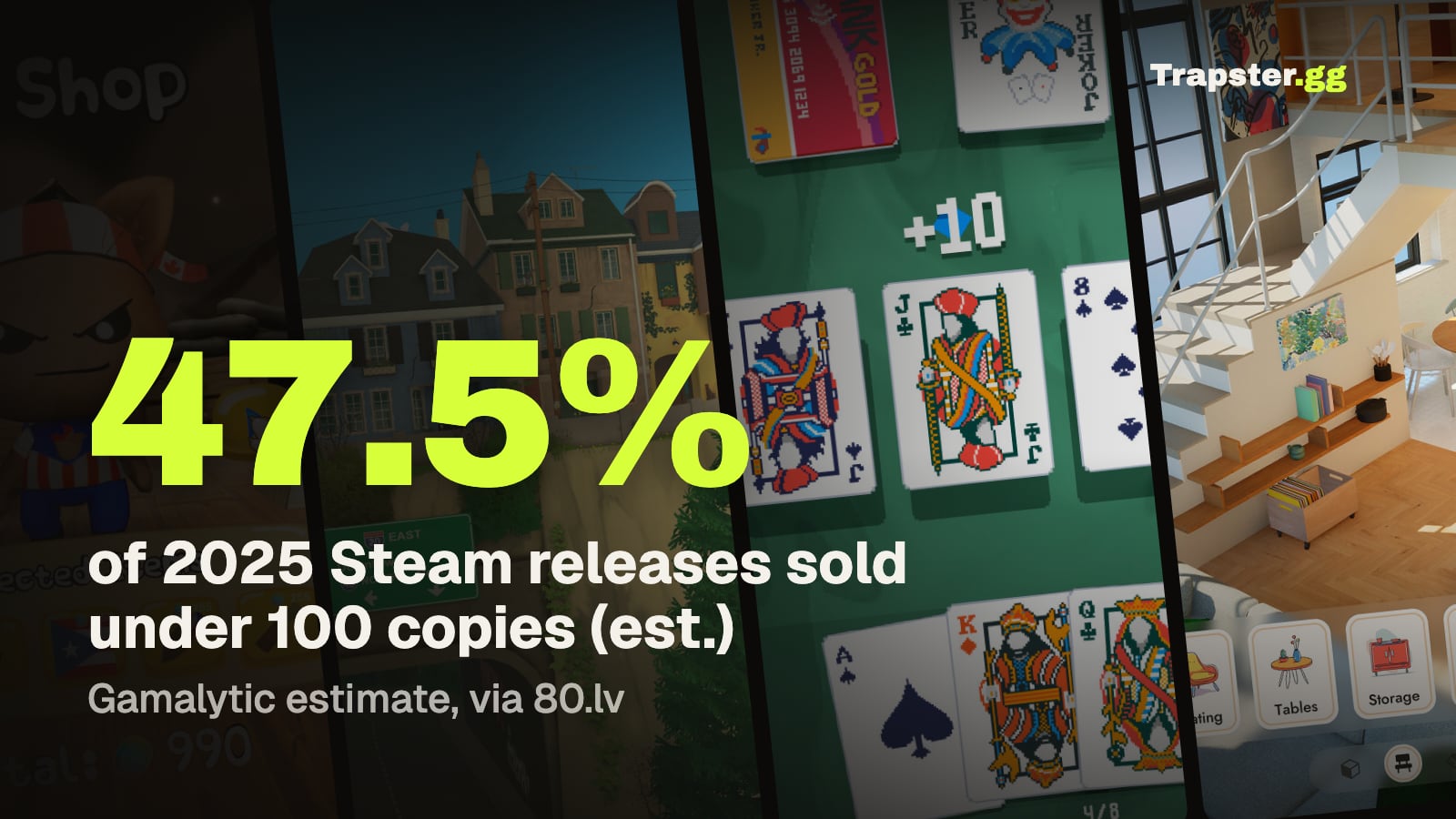
How Many Copies Do Indie Games Sell? Real Steam Numbers by Tier
Most Steam indie games sell under 1,000 copies. Real numbers by tier…
Game Marketing Hook: How to Find, Test and Show Yours
What a game marketing hook is, how to test one cheaply with…
How to Name Your Game: Searchable, Memorable and Legally Safe
How to name your game: pass the Steam, Google and trademark checks…