Game Age Ratings for Indie Devs: IARC, Steam and Consoles
How to get a game rated: what IARC is, its cost and stores, Steam's Content Survey and German rules, and what consoles require for ESRB, PEGI and CERO.
Short answer: For a digital-only indie game, you get most of your age ratings for free by filling in one questionnaire. On consoles, the Epic Games Store and Google Play, that questionnaire is IARC, which issues ESRB, PEGI, USK, ClassInd, GRAC and other regional ratings at once, and the IARC FAQ says it is "free of cost to developers at this time." Steam is not an IARC storefront. On Steam you complete Valve's Content Survey, which generates ratings for several regional boards, and Valve requires a valid rating to show your game in Germany and Indonesia. Direct ratings from a board only become necessary for physical copies or cases IARC does not cover, like some adult-rated games in Japan and Korea.
The rating boards you will run into
Every major market has its own board and its own age bands. For a digital game you rarely apply to them one by one, but store pages show their labels and some of them can pull your game from a region.
| Region | Board | Age labels | Legal weight | Digital route |
|---|---|---|---|---|
| US and Canada | ESRB | E, E10+, T, M (17+), AO (18+) | Voluntary, but console makers and many stores require it | IARC |
| Europe and UK | PEGI | 3, 7, 12, 16, 18 | Guidance for consumers | IARC |
| Germany | USK | 0, 6, 12, 16, 18 | Required by law to offer games in Germany | IARC, or Valve's own process on Steam |
| Brazil | ClassInd | L, 10, 12, 14, 16, 18 | Required, set by the Ministry of Justice | IARC self-classification |
| South Korea | GRAC | All ages up to adults only | Required by the Game Industry Act | IARC, except games rated 19 (adults only) |
| Japan | CERO | A, B (12), C (15), D (17), Z (18) | Z is the only legally restricted band | IARC on Nintendo and PlayStation for some digital-only games |
| Indonesia | IGRS | 3+, 7+, 13+, 15+, 18+ | Required by regulators, per Valve | IARC, or Valve's own process on Steam |
IARC lists nine participating rating authorities, adding Australia's Classification Board, Taiwan's DGSC and Saudi Arabia's Gmedia to the boards above. CERO is not one of them. The CERO bands come from Game Developer's report on the system; the ClassInd bands from article 11 of Brazil's Portaria 502/2021.
What IARC is and which stores use it
IARC (International Age Rating Coalition) is a single online questionnaire run jointly by the rating boards. Per IARC's own process description, you answer questions about your content once, and the system assigns a regional age rating, content descriptors and "interactive elements" such as in-game purchases for every participating region. Each storefront then shows the label its local buyers recognize.
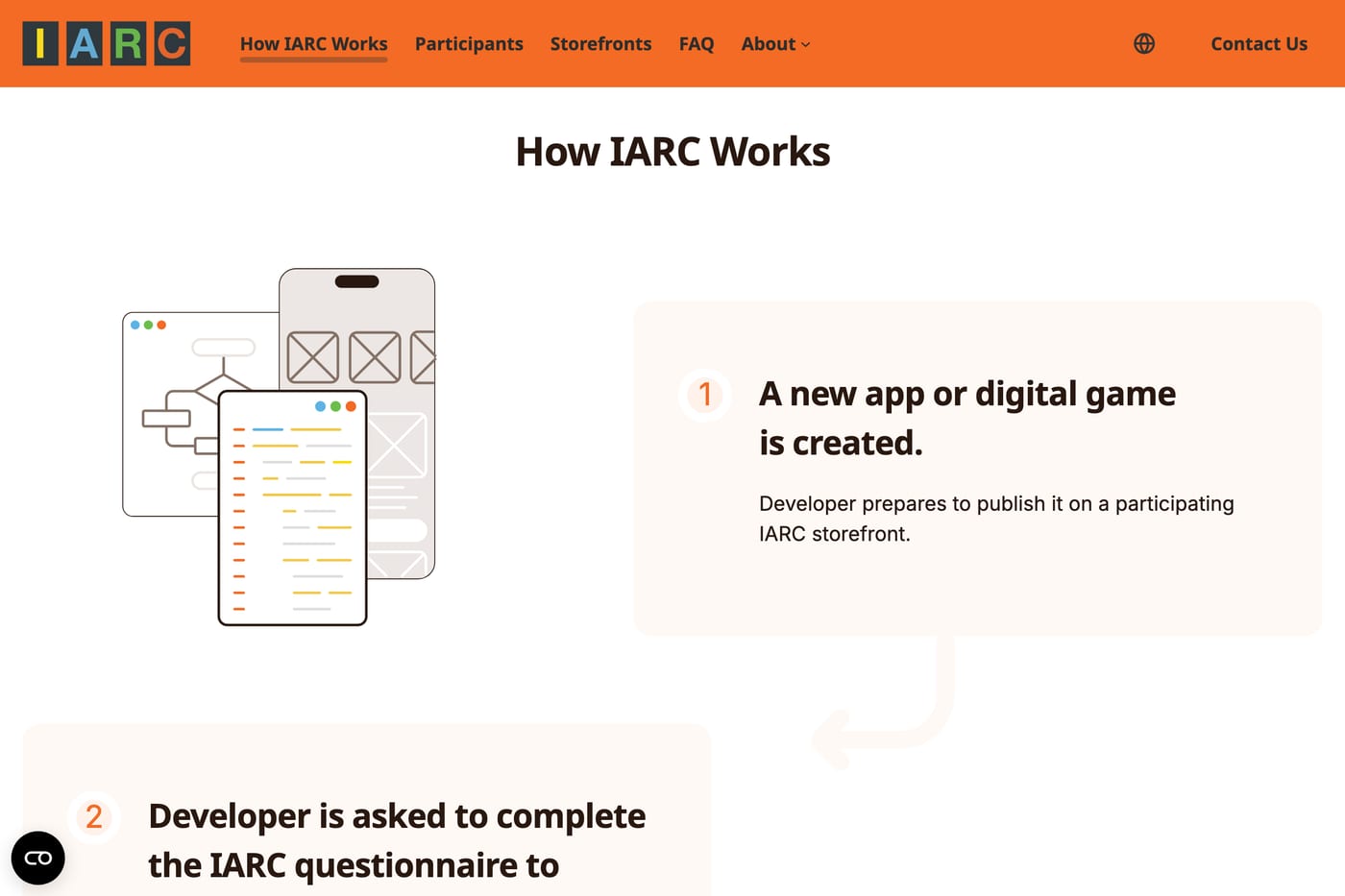
You get a certificate ID at the end. If you later release on another IARC storefront, you can usually reuse that ID instead of filling in the questionnaire again. Microsoft's Partner Center, for example, has an import option where you paste an existing IARC rating ID.
IARC's storefront page lists Nintendo, Sony PlayStation, Microsoft, Epic Games, Google Play, Meta Horizon, Amazon Luna, One Store, Pico, YouTube Playables, Facebook Gaming and Fortnite. Its milestones page dates the rollouts: Nintendo eShop in 2015, the Microsoft Store for Windows and Xbox in 2016, PlayStation Store in 2018 and the Epic Games Store in 2023.
IARC charges storefronts a license fee and developers nothing, per the FAQ. In April 2025 the German state youth authorities formally recognized IARC ratings, so USK labels issued through IARC count as official, Heise reported.
How to get a game rated, step by step
- List your platforms and formats. Digital-only on Steam, digital on consoles and a boxed release each follow a different path. Decide this before you budget for ratings.
- Write down every piece of content honestly. Go through violence, blood, sexual content, nudity, language, drugs, alcohol, gambling-style mechanics, user chat and purchases. Include text: in-game books, item descriptions and dialogue all count.
- Fill in Steam's Content Survey if you sell on Steam. It is required before you can submit your store page and build for review (more on this below).
- Fill in the IARC questionnaire on the first IARC store you release on, usually during console or Epic submission. Save the certificate ID.
- Reuse the certificate on the next IARC storefront, unless your content has changed.
- Apply directly to a board only for physical releases or for cases IARC does not cover. USK, for example, publishes its committee fees: 1,500 EUR for the regular 20 working day procedure, excluding VAT.
- Redo the questionnaire after content updates. A patch that adds blood, chat or loot boxes can change your rating.
What Steam requires
Steam runs its own system instead of IARC. PEGI's head of operations told Gamereactor that Steam "doesn't have any system or mandatory system in place" for PEGI, though developers can display a PEGI rating they already hold.
The Content Survey
Valve's Content Survey has three parts, and you must complete all of them before you submit for review:
- General Content. Your answers generate ratings for several regional rating boards, which appear on your store page at release. If you already hold official ratings, you can enter them in your game's Ratings section.
- Mature Content. You describe any mature content players may see. Valve uses this to decide how your game appears to each customer based on their content preferences. The doc is strict on one point: "You must disclose all the adult content you've uploaded in your builds," even if players cannot reach it.
- Generative AI. You disclose AI-generated content that ships in the game, and for live-generated AI you describe your guardrails.
Valve also notes that completing the survey does not make any content allowed, and some answers cannot be changed after approval without contacting Steam Support. Separately, the onboarding rules exclude content that may violate the standards of Steam's payment processors, "in particular, certain kinds of adult only content."
The mature content answers also matter for marketing. If you plan to send traffic from creator videos to your page, a mature content flag decides which logged-in Steam users can see the page they land on.
Germany
Valve's Germany page says that since November 15, 2024, Steam no longer displays games to customers in Germany if they lack a valid age rating. Players who already own the game keep access. You have two options: a USK rating, or Valve's own rating, which it builds from your Content Survey, customer feedback and its content review team. Valve cannot issue that rating if you have not filled in the survey.
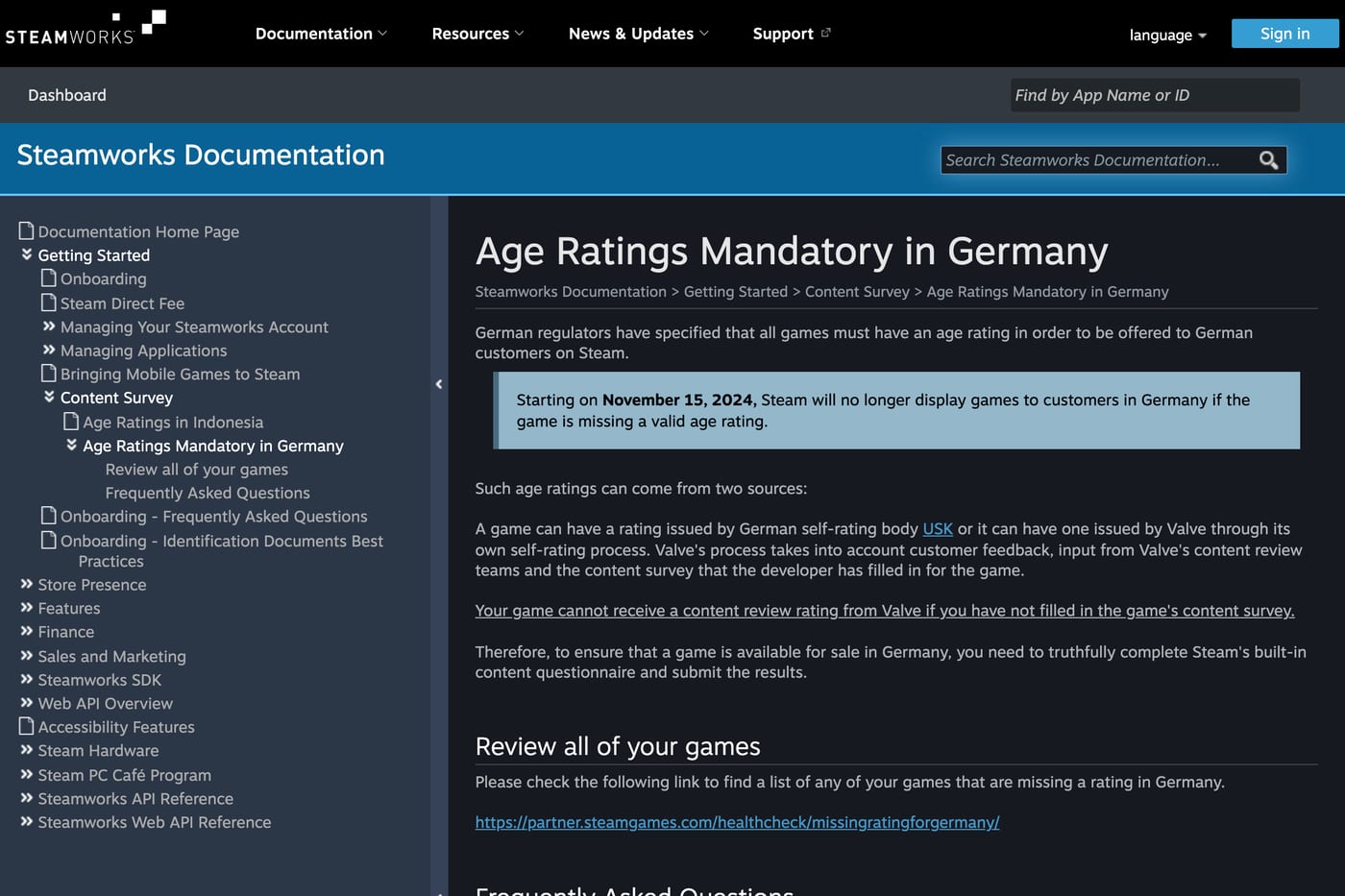
Example: in a spot check before the deadline, Heise found that the games missing a rating on the German store were mainly indie titles, naming Return of the Obra Dinn, Papers, Please, Undertale and Slay the Spire. If you have an older game in your catalog, assume it is in the same position until you check.
Read the USK rule carefully. Only enter a USK rating if USK actually reviewed your game, and "you must not submit a USK rating on Steam if it has been generated through the IARC process on a third-party store." In other words, the certificate you got on Switch or Xbox does not carry over to Steam. Some content cannot be sold in Germany at all, and you still have to disclose it in the survey.
Indonesia
The Indonesia page works the same way: a rating from IGRS or from Valve, the same ban on IARC-generated ratings from other stores, and the same rule that owners keep access. Valve has not published a fixed date. It says Steam "may no longer be able to display games" without a rating "in the near future." Valve's Indonesia page also points to a health check in Steamworks that lists which of your games are missing required ratings.
Example: in early April 2026 Steam started showing IGRS labels to Indonesian players, and some looked wrong, with adult games marked 3+ and family games marked 18+. Indonesia's ministry Komdigi said the labels came from publisher self-declarations and "are not the results of official IGRS classifications," Antara reported. The rules here are still settling, so answer the survey carefully: your answers are what Indonesian players see.
Korea and Brazil
Steamworks has no dedicated rating page for Korea or Brazil, so do not expect Steam to handle these for you the way it does for Germany.
- Korea. The Game Industry Act requires anyone distributing a game to get a rating from GRAC, a related body or a designated self-rating operator, with fines of up to KRW 10,000,000 for some breaches, according to a Legal500 summary of the 2021 amendment. Platforms like Meta are authorized self-rating operators, so their IARC certificate doubles as a GRAC rating. For games rated 19, Korea's adults-only band, GRAC does not follow IARC results and you apply separately, per One Store's developer guide. Example: Luck Be A Landlord's developer paid GRAC for a rating, got 12+ in January 2024 and returned to Google Play in Korea, then GRAC re-rated it 19+ in May 2024 and Apple's Korean App Store dropped it. His objection was ignored, and he wrote that Korea had produced over 20% of the game's mobile revenue, per his own blog.
- Brazil. Article 45 of Portaria 502/2021 exempts digital-only games from applying to ClassInd in advance if they are self-classified through IARC or another method the Ministry of Justice authorizes. Physical games go through prior review by the Ministry.

Australia
Steamworks has no Australia page either, but two indie cases show that Australian classification reaches Steam:
- Schedule I (TVGS), May 2025. The game was hidden from the Australian Steam store because it had never been submitted to the Classification Board. The developer had assumed only console and physical releases needed it: "It turns out all games in Australia have to receive a classification before they can be sold," Notebookcheck quoted him. He started the process, and The Indie Brew later reported the game back on sale with no content cut.
- RimWorld (Ludeon), 2022. The console version, submitted ahead of a possible physical release, was refused classification on February 28, 2022 over drug use, and the PC version was pulled from Steam in Australia as a result. After a review application by Double Eleven, the Classification Review Board unanimously rated it R18+ on April 20, 2022, finding that the drug mechanics discourage drug use, Press Start reported. A rating on one platform can take down your Steam version in the same country.
What consoles require
All three console stores use IARC for digital releases, so a digital-only indie can usually get every rating it needs through the questionnaire during submission. The details that catch people out:
- Physical editions need direct ratings. Microsoft's age ratings guide says "IARC ratings are valid only for digital distribution" and that games targeting physical distribution "must acquire ratings directly from the relevant rating authority." The ESRB's FAQ says boxed games are rated by at least three trained raters, while digital-only games go through IARC.
- You still fill in IARC on Xbox. Microsoft requires the IARC questionnaire for every product, even when you also hold a direct rating.
- Japan is special. Nintendo began accepting IARC ratings for download-only Switch games in Japan in 2020, with physical releases still needing CERO, Automaton reported. The Japanese PlayStation Store followed on March 9, 2022, but 18+ titles and games sold both boxed and digital still need CERO, per Automaton. On Xbox, free products including demos rated CERO Z or IARC 18+ cannot release in Japan at all, according to Microsoft.
- A rating change can delist you. Tiny Bookshop was pulled from the Switch eShop in every region for nearly two weeks in late 2025 after the ESRB rated its upcoming physical edition T while its digital IARC rating was E. The studio estimated about 10,000 lost sales, Aftermath reported. Balatro had a similar week in March 2024: PEGI moved it from 3 to 18 overnight for "prominent gambling imagery," and it was temporarily removed from the PlayStation, Switch and Xbox stores in several countries, Game Developer reported. In 2021, GameDiscoverCo described how a jump of two rating categories in one region could get a game delisted on Switch until it was rechecked.

For the rest of the console process, see our guide to publishing an indie game on consoles.
New rules for in-game purchases and gambling themes
If your game sells anything, check PEGI's 2026 update. Announced on March 12, 2026 and applied to games submitted from June 2026, it sets a default PEGI 16 for paid random items such as loot boxes, PEGI 12 for time-limited or quantity-limited offers, PEGI 7 for daily return rewards, PEGI 18 for tradable NFT mechanics, and PEGI 18 for online chat without blocking or reporting. VGC reports that existing titles will not be re-rated. A cute game with a gacha shop submitted after June 2026 now lands at 16 in Europe by default.
Gambling themes without real money are a separate trap. Balatro and Luck Be A Landlord, both roguelikes built on poker and slot machine imagery with no paid randomness, sat at PEGI 18 until the PEGI Complaints Board lowered both to 12 on appeal in February 2025, Insider Gaming reported. PEGI's rule at the time, as Gamereactor quoted it: "any teaching or glamorisation of simulated gambling automatically leads to a PEGI 18 rating."

Australia went further. Since September 22, 2024, games with paid loot boxes get at least M and games with simulated gambling get at least R18+, which is legally restricted to adults, per a Legal500 summary. Games classified before that date keep their rating unless they are significantly modified.
Mistakes that cost indie studios
- Shooting low on the questionnaire. Ratings can be checked after release; Brazil's Portaria 502, for one, says ClassInd monitors self-classified games by sampling. Lean slightly harsh: an overstated rating is a smaller problem than a delisting.
- Forgetting text. One word in one of 300 book descriptions moved Tiny Bookshop from E to T.
- Planning a boxed edition late. A physical run needs direct ratings that can differ from your digital ones, and the store may update your digital listing to match.
- Skipping the Steam survey on old games. Unrated games are invisible in Germany. Run the health check across your whole catalog.
- Assuming a Steam-only game needs no rating. Schedule I learned otherwise in Australia.
- Not appealing. Balatro, Luck Be A Landlord and RimWorld all got a lower or a legal rating on appeal.
If you are still setting up your Steam release, our Steam publishing guide and launch checklist cover where the Content Survey fits in the timeline.
FAQ
How much does an IARC rating cost?
Nothing for developers. The IARC FAQ says ratings are free to developers at this time, and storefronts pay the license fee.
Do I need an ESRB or PEGI rating to sell on Steam?
No. Steam generates regional ratings from your Content Survey, and you can add official ratings you already hold. In Germany and Indonesia your game needs either a real USK or IGRS rating or Valve's own rating.
Can I use my IARC rating on Steam?
Not for Germany or Indonesia. Valve's docs say you must not enter a USK or IGRS rating generated through IARC on a third-party store.
How do I get an IARC rating for my game?
You fill in the IARC questionnaire inside a participating store's submission flow, such as Nintendo, PlayStation, Xbox Partner Center, Epic or Google Play. You get a certificate ID you can reuse on other IARC stores.
How long does a game rating take?
IARC issues ratings as soon as you finish the questionnaire. Direct reviews take longer: USK lists 20 working days for its regular procedure, with paid express options.
Do I need a CERO rating to sell in Japan?
For physical releases on console, yes. For download-only games, Nintendo and PlayStation accept IARC in Japan, but PlayStation still requires CERO for 18+ titles.
What happens if my rating changes after launch?
The store updates your rating, and on some platforms a large jump can delist the game until it is rechecked. Keep your questionnaire answers accurate after every content patch.
Sources: IARC: how it works, IARC FAQ, IARC participants, IARC storefronts, IARC milestones, Steamworks Content Survey, Steamworks: Germany, Steamworks: Indonesia, Steamworks onboarding, Xbox age ratings, ESRB FAQ, USK cost overview, Portaria 502/2021, VGC on PEGI 2026, Aftermath on Tiny Bookshop, GameDiscoverCo on ratings, Game Developer on Balatro, Insider Gaming on PEGI appeals, Luck Be A Landlord dev blog, Press Start on RimWorld, Notebookcheck on Schedule I, Heise on Steam Germany, Antara on IGRS, Legal500 on Australia's gambling rules; checked November 2026.
Get a wishlist forecast for your game
Send us your Steam page. We estimate views, creators and cost per wishlist before you spend anything.
Keep reading
How Many Copies Do Indie Games Sell? Real Steam Numbers by Tier
Most Steam indie games sell under 1,000 copies. Real numbers by tier…
Game Marketing Hook: How to Find, Test and Show Yours
What a game marketing hook is, how to test one cheaply with…
How to Name Your Game: Searchable, Memorable and Legally Safe
How to name your game: pass the Steam, Google and trademark checks…