How Much Do Indie Games Make on Steam? Gross to Net Math
How much indie games make on Steam: the gross to net math (Valve cut, refunds, VAT, publishers) and the Boxleiter review method, with real postmortems.
Short answer: Far less than copies sold times the store price. Simon Carless of GameDiscoverCo puts what a developer actually receives after Steam's cut, refunds, VAT and discounting at 30% to 50% of that headline figure, and a publisher deal or income tax takes more on top. To estimate another game's revenue, people use the Boxleiter method: multiply its Steam review count by a sales per review ratio, which GameDiscoverCo measured at an average of 63 and a median of 58 across 237 games, with newer releases lower. Real postmortems show how wide the outcomes are: one developer's $9.99 rage platformer cleared about $41,000 after Steam's cut, while another studio's $560,000 in gross sales over five years became $73,000 per co-founder.
Why "copies times price" overstates revenue
Most revenue estimates you see online start with one number: units sold multiplied by the US list price. That number is wrong in two directions at once. The units figure is usually an estimate from reviews, and the price is a price few buyers paid.
Carless says it directly in his NB number analysis: please do not take an estimated unit count and multiply it "by its regular Steam USD store price and think that's the money received." Buyers in many countries pay a lower regional price, a large share of copies sell during discounts, some buyers refund, and in VAT countries part of every sale is tax that Valve collects and remits. Only after all of that does Valve take its revenue share.
Here is what the gap looks like in published numbers. How To Market A Game published Peglin's first week figures: 80,204 units and $1,049,413 before Steam's cut. That works out to about $13.08 of gross revenue per copy, against a launch price the post gives as $17.99 after a 10% discount. And that is launch week, when discounting is lightest.

The gross to net waterfall
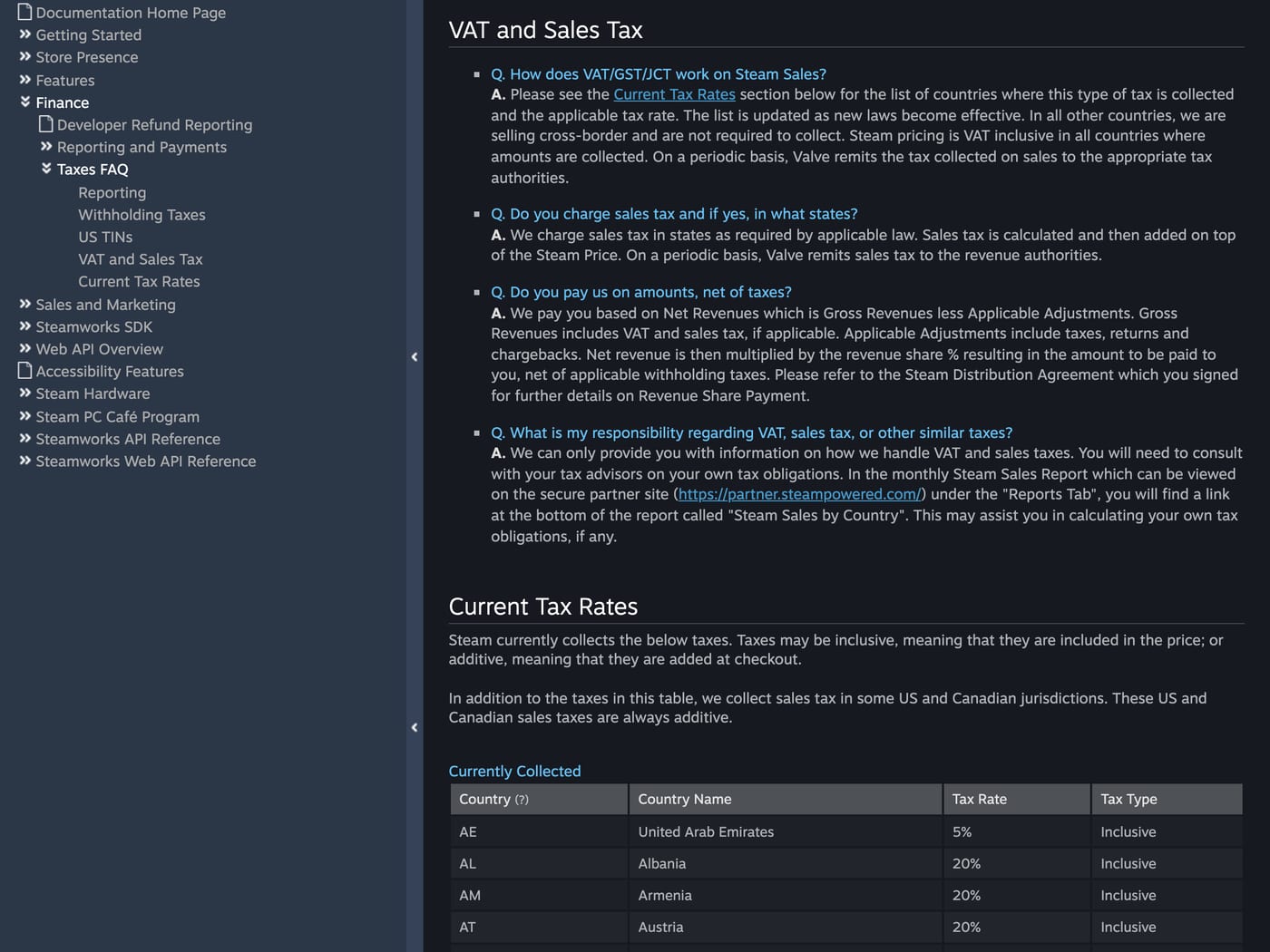
Steamworks shows you two kinds of revenue. The live sales portal shows gross figures that, in Valve's words, "do not include any deductions (refunds, chargebacks, taxes, etc)". The monthly report subtracts those adjustments and "reflects the actual amount you will be paid." Valve's payments FAQ describes the order: gross revenue less applicable adjustments gives net revenue, and net revenue times your revenue share percentage is your payment.
So the money passes through these layers, roughly in this order:
| Layer | What it takes | Source |
|---|---|---|
| Regional pricing and discounts | Lowers the average price per copy below the US list price | Steamworks pricing docs |
| VAT and sales tax | Steam prices are VAT inclusive where Valve collects it; US sales tax is added on top | Steamworks Tax FAQ |
| Refunds and chargebacks | Deducted from gross; buyers can refund within 14 days and under 2 hours played | Steam refund policy |
| Valve's revenue share | 30%, then 25% on revenue beyond $10 million and 20% beyond $50 million | Game Developer, 2018 |
| US withholding tax | 0% to 30% on the US share of your payment, set by your tax interview | Steamworks Tax FAQ |
| Publisher share | Whatever your contract says, often after the publisher recoups its investment | GameDiscoverCo |
| Your own taxes and team split | Corporate or income tax where you live, then founders or contractors | Your accountant |
Regional pricing and discounts
Steam lets you set a price per currency, and it suggests converted prices relative to your USD price in the Propose Pricing tool. The pricing docs say plainly that "pricing decisions on Steam are entirely in the hands of you the developer." Valve's suggested regional prices are lower than the USD price in many markets, and many developers accept them. We cover the tradeoffs in our guide to Steam regional pricing.
Discounts then pull the average down further over the life of the game. GameDiscoverCo's review research adds a second effect: heavily discounted games collect fewer reviews per copy, because impulse buys often go unplayed. That matters when you estimate from reviews, which we get to below.
VAT and sales tax
Valve's Tax FAQ says "Steam pricing is VAT inclusive in all countries where amounts are collected." If a buyer in Germany pays €19.99, part of that is German VAT that Valve remits to the tax authority. It is never your revenue. US and Canadian sales taxes work the other way: they are added on top of the displayed price. Taxes are one of the applicable adjustments Valve removes before calculating your share.
Refunds
Steam refunds a game "within two weeks of purchase and with less than two hours of playtime", and Valve may review requests outside those rules. Refund rates vary a lot by genre and length. Two single developer reports:
- Only Way is Down, a $9.99 rage platformer, had 1,712 copies returned, 16.5% of all purchases, about ten months after its April 1, 2025 launch, per the developer's own postmortem.
- Northend Games co-founder Omer Develioğlu said refunds cost $134,000 of $560,000 gross, a 22% rate, as reported by Tom's Hardware. He said China made up 53.3% of his sales and that Chinese buyers refund disproportionately.
Short games and games that show their whole hook in the first hour are the ones most exposed. Our guide to Steam refunds for developers covers what you can see in your reports and what you can do about it.
Valve's revenue share
Valve takes 30% of net revenue for almost every indie game. The tiers announced in late 2018 lower the take to 25% on revenue beyond $10 million and 20% beyond $50 million, which very few indie games reach. Valve pays monthly, about 30 days after the sales month, once you clear a $100 minimum. The details, including the $100 app fee, are in our breakdown of Steam fees for developers.
US withholding tax
If you are outside the US, Valve may withhold tax on the US portion of your payment. The Tax FAQ says the rate "may range from 0% to 30%," with the full 30% applied when your country has no tax treaty with the US. Your rate appears at the end of the Steamworks tax interview. Develioğlu, who lives in Thailand, reported a 5% rate on that portion.
Publisher share
If you signed with a publisher, the split applies to what Valve pays out, and usually only after the publisher earns back its advance and costs. In a 2020 review of contracts, Carless summarized Raw Fury's published terms as funding plus 15% recouped at a 100% publisher recoup rate, followed by a 50% royalty, which he called "a bit more than average" for the developer. The same piece quotes Jan Willem Nijman saying the fair standard for advances up to around $100,000 is 70/30 in the developer's favor. Recoupment is why a game can sell well and still pay its developer very little in year one. If you are still deciding, read publisher vs self-publishing before you model revenue.
A full waterfall from a real studio
Northend Games published the clearest public waterfall we have found in 2026. These are Develioğlu's own figures for two games, Northend Tower Defense and Deepstone Rift (Early Access), over five years, as reported by Tom's Hardware in October 2026. This is a single developer's account, not audited data.
| Step | Amount | Running total |
|---|---|---|
| Gross sales, 135,000 units | $560,000 | |
| Refunds (22% rate, high in China) | minus $134,000 | $426,000 |
| Steam's 30% | minus $127,000 | about $297,000 |
| US withholding at 5% | about minus $9,700 | $287,300 |
| Asian publisher (PR and distribution in China, Japan, Korea) | minus $115,000 | $172,000 |
| Thai tax at 15% | minus $26,000 | $146,000 |
| Split between two co-founders | $73,000 each |
That is about 26% of gross before the founder split, and roughly $15,000 a year per founder. Tom's Hardware also modeled the same games with no publisher, a smaller Asian share and a lower refund rate, and found the net came out nearly the same. Tom's Hardware also notes that China becoming the biggest market could mean the publisher did a good job.

An older and smaller example points the same way. Armaan Sandhu reported that Rainswept, priced at $11.99, made $12,248 gross and $6,422 net across Steam and GOG in its first three months, and he plans with net at about 55% of gross. Note that his "gross" already sits below copies times list price.
How to estimate a game's revenue from its Steam reviews
Valve does not publish sales. Reviews are public, so the industry uses them as a proxy. For typical unit numbers at different review counts, see our guide to how many copies indie games sell.
Where the Boxleiter method comes from
Jake Birkett of Grey Alien Games wrote it up in 2015 and credited the idea to Mike Boxleiter, via Ryan Clark. Working from data on popular 2014 Steam games, he suggested using 30 to 100 owners per review as an approximate guide. He also warned that the sample was hits only and that bundles and sales could cut revenue a lot.
The updated multipliers
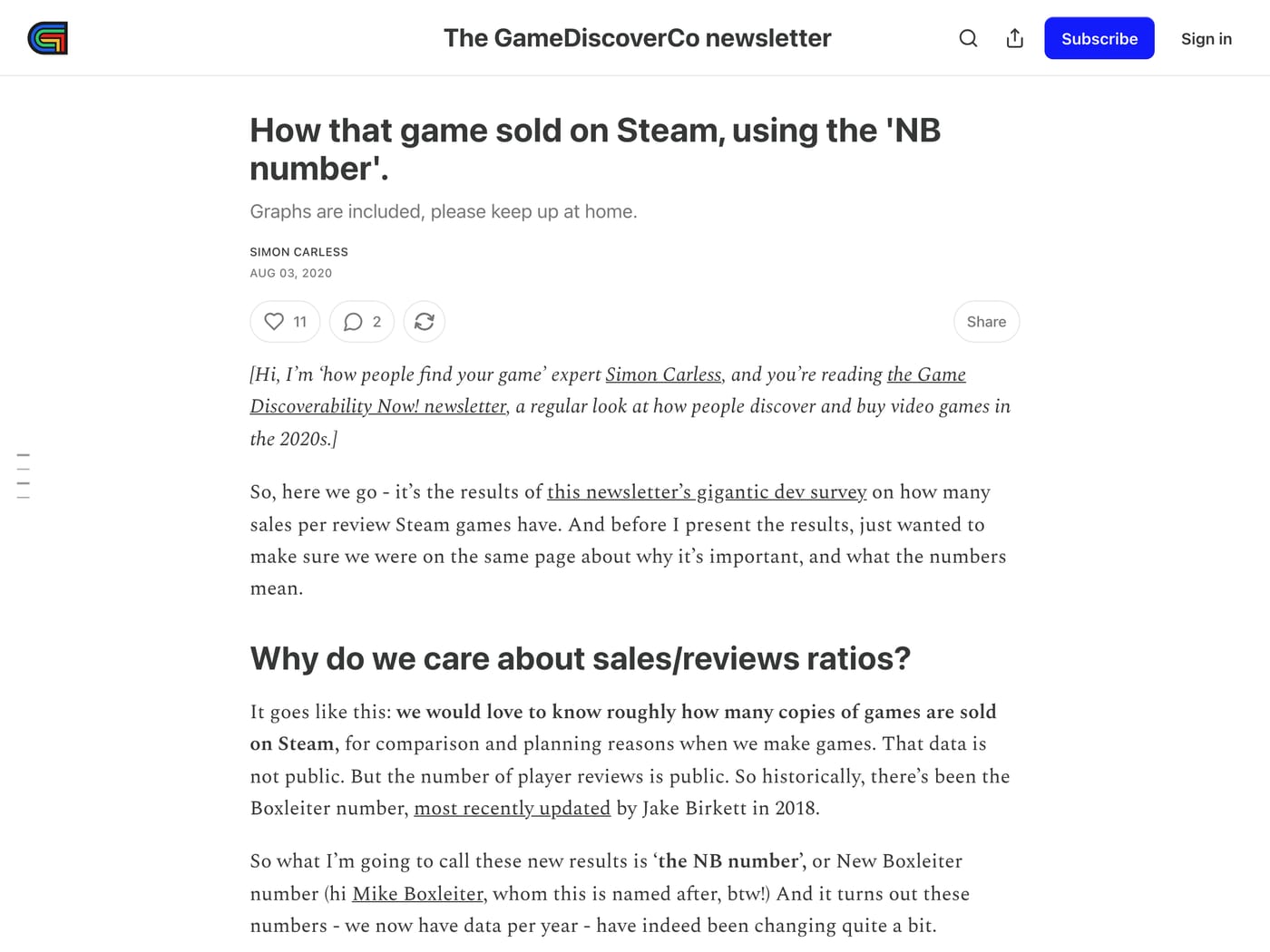
GameDiscoverCo refreshed it in 2020 with real sales data that developers submitted, and named it the NB number (New Boxleiter):
- Across 237 non outlier games: an average of 63 sales per review and a median of 58. The middle 80% sat roughly between 25 and 100.
- Games launched before 2017: average 81, median 74.
- Games launched in 2019: average 57, median 51.
- Games launched in 2020: average 41, median 38, mostly between 20 and 60.
The drop is largely the review prompt Steam added in late October 2019. Valve's docs confirm that after playing for a while, users are prompted to leave a review inside the client, so newer games collect more reviews per buyer.
A 2023 GameDiscoverCo piece built on Gamalytic's research added more texture: games with under 100 reviews had a 36x ratio, versus 52.8x for games with 1,000 to 10,000 reviews. The same research found more reviews per copy for games with long average playtime, and for games at both ends of the score scale (Overwhelmingly Positive and Mostly Negative or worse). Heavy discounting lowers reviews per copy.
Real ratios from games that published both numbers
| Game | Reviews | Units | Ratio | Window |
|---|---|---|---|---|
| Peglin | 1,071 | 80,204 | about 74 | First week, 2022 |
| Only Way is Down | 113 | 8,656 net of returns | about 77 | About 10 months, 2025 to 2026 |
| Tape to Tape | about 830 | 34,020 | 41 | First 8 days, 2023 |
| Clone Drone in the Danger Zone | not stated | not stated | 30 lifetime, 14 in 2020 | Lifetime to 2020 |
| Forge Industry | 15 | 104 | about 8 | First week, 2023 |
Tape to Tape's review count is derived from the 41x ratio that How To Market A Game reported. Clone Drone's developer saw his ratio fall from 67 for 2017 to 2019 sales to 14 for 2020 alone, and Carless flags it as a likely outlier because repeat players drove many unreviewed purchases.
The spread in that table is the main lesson. Ratios run from under 10 to nearly 80 for games launched within three years of each other. A rage game that viewers buy after watching a creator suffer, a long systems game with a devoted audience, and a game with fifteen reviews all behave differently.
The caveats that matter most
- Keys. Valve counts "only purchases (not key activation)" in the review score. Reviews from keys can still appear, but a game with large bundle or key sales can have a very different ratio.
- Free copies. Press and creator copies can produce reviews with no sale behind them, which pushes small games toward a lower ratio.
- Age. Older games with years of deep discounts look different from launch week.
- Small numbers. At under 100 reviews, one extra review moves the estimate by dozens of units. Treat it as a range, not a figure.
- Units are not revenue. Even a perfect unit estimate still needs the whole waterfall above.
Step by step: estimate a game's revenue
Here is a simple process for estimating what a comparable game earned.
- Take the total review count from the game's Steam store page, all languages.
- Pick a ratio range, not one number. For games launched since 2020, 30 to 60 is a sensible working range based on the GameDiscoverCo data. Go lower for small games under 100 reviews or long discounted back catalogs. Go higher for short or casual games and strong launch weeks.
- Get a unit range. Reviews times the low and high ratio.
- Multiply by the list price to get a headline gross range.
- Apply 30% to 50% to get what a self-published developer likely received, per Carless's estimate. If the game has a publisher, apply its split on top, if you know it.
- Sanity check against public postmortems in the same genre and price band.
Example: a $14.99 game with 500 reviews. At 30 to 60 sales per review that is 15,000 to 30,000 copies, or $225,000 to $450,000 at list price. At 30% to 50% of that, the developer probably received roughly $67,000 to $225,000 from Steam before any publisher share or income tax. That range is honest. A single number would hide how little you know.
Now test the method on the examples above. For Peglin, 1,071 reviews times 30 to 60 gives 32,000 to 64,000 copies, but the real first week was 80,204. For Only Way is Down, 113 reviews gives 3,400 to 6,800, against a real 8,656. In both cases the method undershot. Short sessions, launch spikes and creator coverage pushed the ratio above the typical range. For Forge Industry it would have overshot badly. Use the method to find the order of magnitude, then adjust using what you know about the genre and how the game was marketed.
What this means for your own plan
If you are budgeting your own game, model in net from day one. Take your realistic unit range, multiply by an average price well below list, then take off refunds, Valve's 30%, any withholding, and any publisher split. If the plan only works at copies times list price, it does not work.
Two published figures help with timing. Jake Birkett's 2018 survey of about 30 developers found that first year revenue was a median of 4.5 times week one revenue, with most between 2x and 10x. And Valve pays about 30 days after each sales month, so launch month cash arrives at the end of the following month.
The gap between gross and net is the reason marketing spend has to be judged against what you keep, not against headline sales. If you run creator campaigns, track creator views to Steam wishlists and price the result against net revenue per copy, not the store price.
FAQ
How much does the average indie game make on Steam?
There is no reliable public average, because Valve does not publish sales and the distribution is extremely skewed. Use the review based method above for comparable games, and remember that a developer typically keeps 30% to 50% of copies times list price, per GameDiscoverCo.
What is the Boxleiter method?
It estimates a Steam game's unit sales by multiplying its review count by a sales per review ratio. It was written up by Jake Birkett in 2015 and updated by GameDiscoverCo as the NB number.
What multiplier should I use for Steam reviews in 2026?
For games released since 2020, 30 to 60 is a reasonable working range. GameDiscoverCo found a median of 38 for 2020 launches, 36x for games under 100 reviews and 52.8x for games with 1,000 to 10,000 reviews.
Does Steam's 30% come out before or after VAT?
After. Valve's Tax FAQ says Steam prices include VAT where Valve collects it, and taxes, returns and chargebacks are removed before the revenue share is applied.
How much does Steam take from indie developers?
30% of net revenue until a game passes $10 million, then 25% up to $50 million and 20% beyond that. See our full guide to Steam fees for developers.
How accurate are Steam revenue calculators?
They run the same review multiplier, usually with one fixed ratio, so treat their output as a rough range. Real games in this article landed anywhere from about 8 to 77 sales per review.
Sources: GameDiscoverCo, NB number; GameDiscoverCo, review count research; GameDiscoverCo, publishing contracts; Grey Alien Games, Boxleiter method; Steamworks payments and reporting; Steamworks Tax FAQ; Steamworks user reviews; Steam refund policy; How To Market A Game, Peglin; Only Way is Down postmortem; Tom's Hardware, Northend Games; checked November 2026.
Get a wishlist forecast for your game
Send us your Steam page. We estimate views, creators and cost per wishlist before you spend anything.
Keep reading
How Many Copies Do Indie Games Sell? Real Steam Numbers by Tier
Most Steam indie games sell under 1,000 copies. Real numbers by tier…
Game Marketing Hook: How to Find, Test and Show Yours
What a game marketing hook is, how to test one cheaply with…
How to Name Your Game: Searchable, Memorable and Legally Safe
How to name your game: pass the Steam, Google and trademark checks…