Selling Your Game in China on Steam: Players, Pricing, Platforms
How to sell to Chinese players on global Steam: language share, Simplified Chinese payoff, CNY pricing, Bilibili and Douyin, and language review scores.
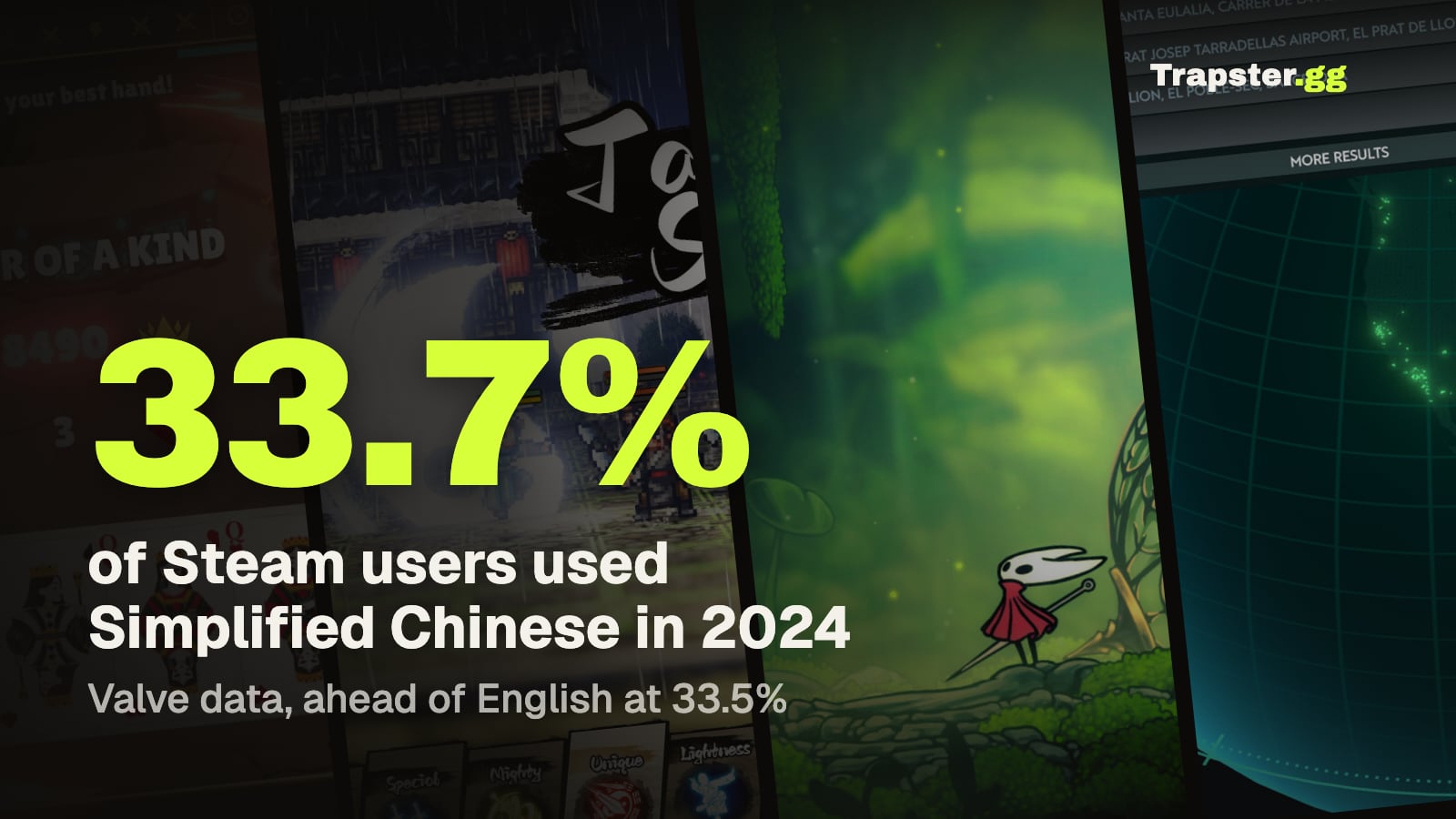
Short answer: You can sell an indie game to Chinese players on the normal, global Steam store today, with no Chinese publisher and no license, and most Chinese PC players buy there: a Niko Partners survey reported by Game World Observer found 79% of Chinese PC gamers use Steam for premium games, mostly the international version. Valve's own data showed Simplified Chinese as the primary language for 33.7% of Steam users in 2024, slightly ahead of English. What decides whether those players buy is a proper Simplified Chinese translation, a yuan price that feels local, and a presence on Chinese video platforms like Bilibili and Douyin. The separate Steam China storefront only carries government-approved games, and most indies never need it.
How many Chinese players are on Steam
There are two public numbers worth knowing, and they measure different things.
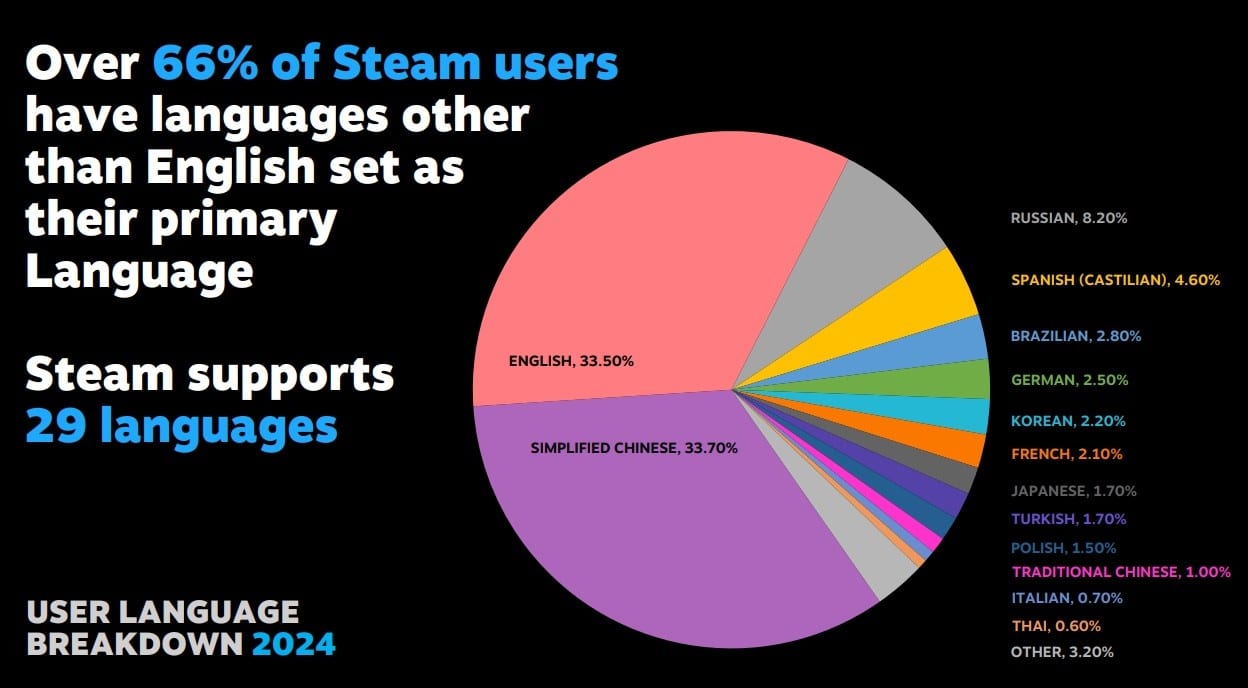
The first is Valve's own language breakdown for 2024, shown at GDC 2025 and published by GameDiscoverCo: Simplified Chinese 33.7%, English 33.5%, Russian 8.2%, everything else far behind. That is the share of users with each language set as their primary Steam language across the year.
The second is the monthly Steam Hardware and Software Survey. It is opt-in and swings a lot. In the October 2026 survey, Simplified Chinese was 21.98% of respondents, down 9.41 points from the month before, with English at 39.04%. A swing of nine points in one month is sampling, not millions of players leaving. Use the survey for direction and Valve's yearly figure for scale.
Whichever number you use, the conclusion is the same: Chinese speakers are one of the two largest language groups on Steam. The practical question is how much of that audience your game can reach.
Steam China vs global Steam
A lot of developers assume selling in China means going through Steam China. It does not.
| Global Steam | Steam China (蒸汽平台) | |
|---|---|---|
| Who runs it | Valve | Perfect World, in partnership with Valve |
| What you need | A normal Steamworks release | Chinese government approval and an ISBN shown on the store page |
| How you get on | Self-publish | Through a Chinese publisher; Valve says it works with "a select group of partners" |
| Catalog | Your game is there by default | Launched in February 2021 with 41 titles |
| Who buys there | Most Chinese PC players buying premium games | Players buying licensed titles locally |
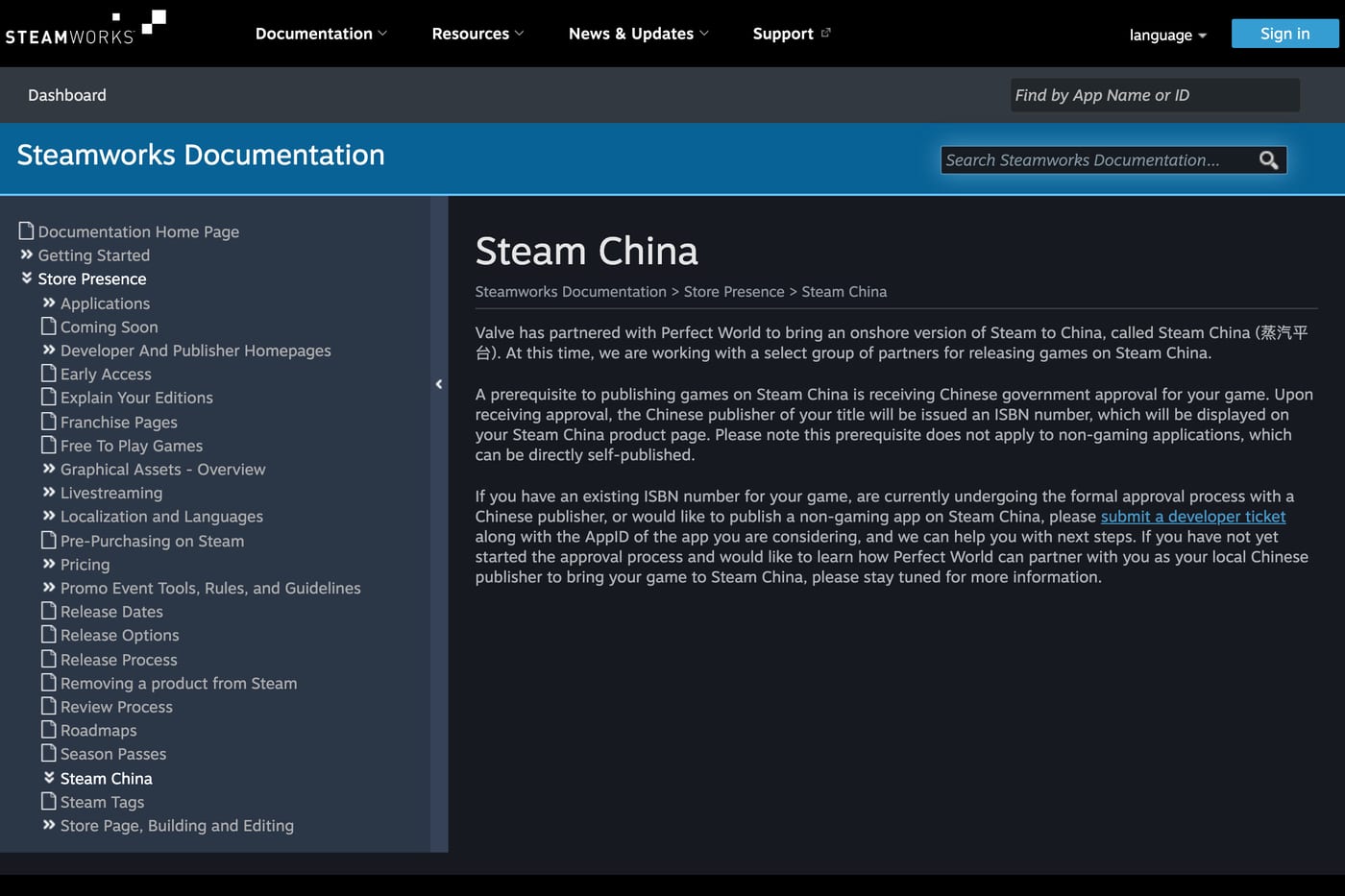
Valve's Steam China documentation is short: games must first receive Chinese government approval, the approved publisher receives an ISBN, and if you have not started that process, Valve says to "stay tuned for more information." In October 2020 GameDiscoverCo quoted Adria Carrasco of Another Indie, who expected a license to cost around $5,000, with waiting queues of 9 to 14 months and multiple rejections. Treat that as one developer's view from years ago, but the point holds: licensing is a project, not a checkbox.
For a typical indie, the decision is simpler. Release on global Steam, make the game good in Simplified Chinese, and price it for yuan. Leave Steam China for later, if a Chinese publisher wants to license it.
What Simplified Chinese localization pays back
Steam shows Chinese players the store in their language, and a game without Chinese is easy to scroll past. GameDiscoverCo's Simon Carless put it bluntly in a December 2023 analysis: a team that skips Chinese translation may lose "way more than 68%" of its Chinese players, and he wondered whether it "may be 90% or more" for many games.
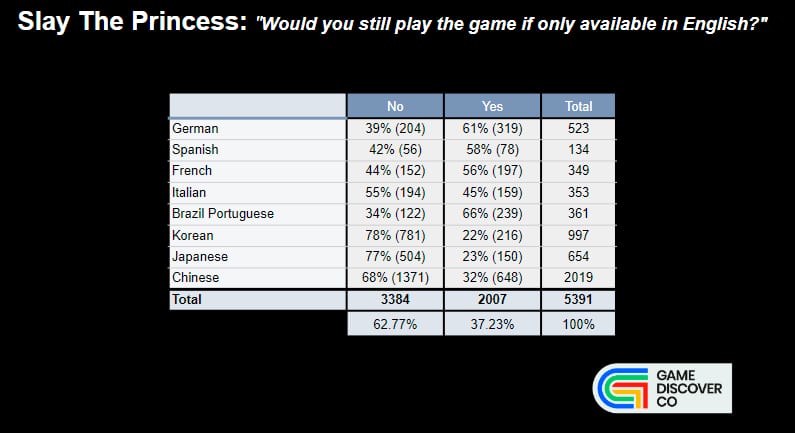
The 68% lines up with a player survey by the team behind Slay the Princess, shown in the same issue, in which only 32% of Chinese respondents said they would play a text-dense game in English. Brazil (66%) and Germany (61%) were far more willing.
Older data points the same way. In an anecdotal sample from a 2020 GameDiscoverCo issue, games with Chinese translations saw China at 10% to 22% of unit sales, about 16% on average, while text-heavy games without Chinese saw "more like 1-2%." The same piece warned that a 16% unit share might only be 9% to 12% of revenue, because yuan prices are lower.
A few practical rules from the people who have done it:
- Translate the store page first. It is the cheapest test and it is what Chinese players see before anything else. Lars Doucet's advice from the Defender's Quest case was simple: "Localize your store page!"
- Use human translators, then get native players to check it. Machine translation and rushed scripts get punished in reviews (see the Silksong case below).
- Simplified first, Traditional second. GameDiscoverCo's view is that Traditional Chinese "maybe isn't vital, if you have Simplified." On the October 2026 survey it was 1.30% of respondents.
- Keep names and terms consistent. Glossaries matter in Chinese because players notice when an item or character has two names.
For the mechanics of adding languages in Steamworks, see our guide to game localization on Steam.
Real examples: who sold to China and what happened
| Game | What they did | Public outcome |
|---|---|---|
| Against the Storm (Eremite Games, Hooded Horse) | Shipped in 17 languages including Simplified Chinese | China, Japan, Korea and Taiwan together were at least 32% of sales, "frontloaded to China" (GameDiscoverCo) |
| NEBULOUS: Fleet Command (Eridanus Industries) | Was English only in late 2023 | China was 2% of sales, the only Asian country in its top 10, in late 2023 (GameDiscoverCo). The store page now lists Simplified Chinese |
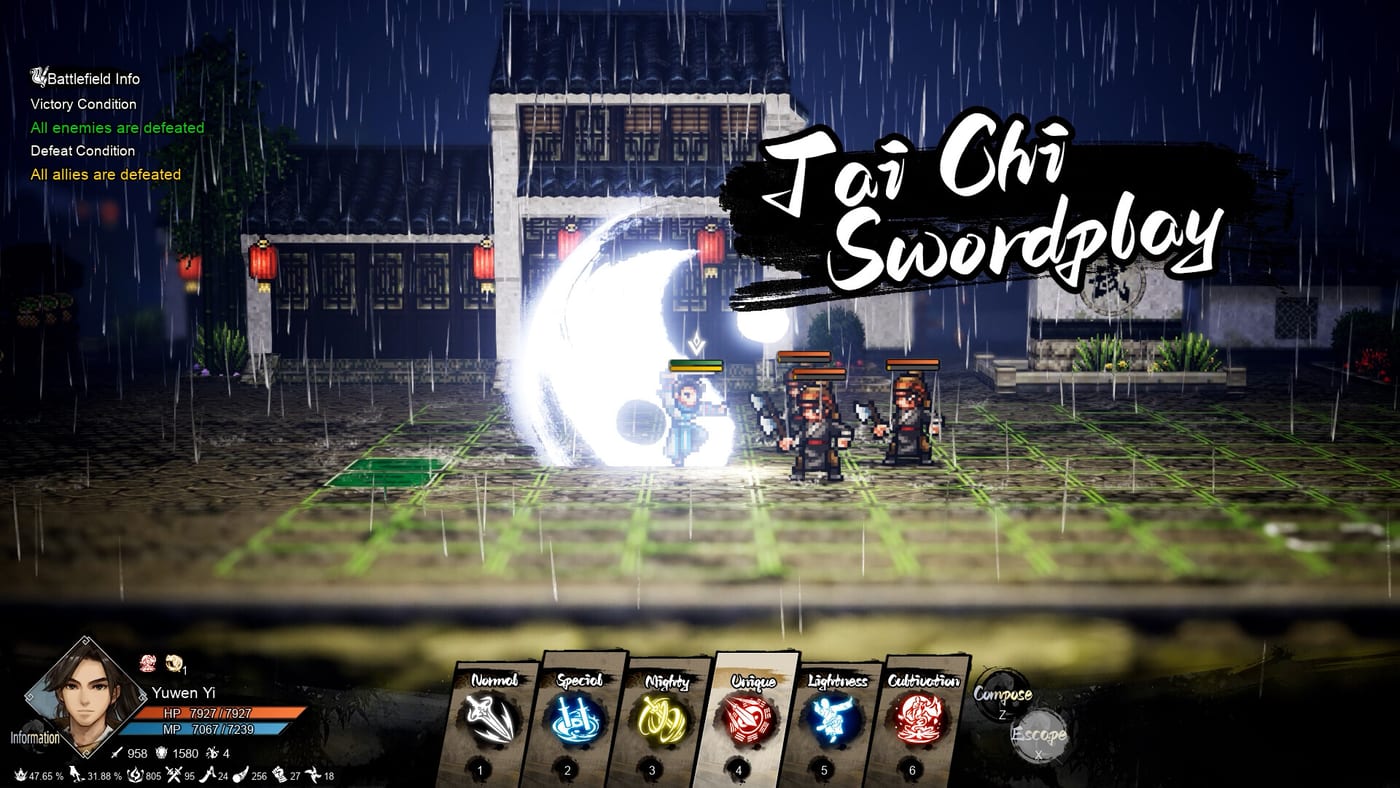
| Wandering Sword (The Swordman Studio, Spiral Up Games) | Wuxia pixel RPG, covered heavily by Bilibili and Douyin creators | 200,000 copies in its first month, per the publisher, with about 80% of Steam owners in China, per GameDiscoverCo data (GameDiscoverCo) |
| Back to the Dawn (Metal Head Games, Spiral Up Games) | Prison escape RPG; the publisher names Bilibili and Douyin as its main traffic sources | Almost 3,000 Very Positive reviews in Early Access by January 2024; GameDiscoverCo estimated about 75% of owners in China (GameDiscoverCo) |
| One Last Hand (Fire Brick Games, Istanbul) | Small paid Chinese streamer push on the demo, then organic pickup | About 12,000 net copies in two weeks, roughly 90% from China, per a Reddit poster claiming to be on the team (Notebookcheck) |
| Infection Free Zone (Jutsu Games, Games Operators) | Chinese outreach on Heybox and video sites before Early Access | 31% of wishlists from China in the second half of 2022, as reported by the agency Huqiao (DevGAMM talk) |
| Havendock (YYZ Studio) | Influencer outreach in China, Feb to May 2023 | 14,690 new wishlists, 6,000 of them via Heybox, agency-reported (same talk) |
| Above Snakes (Square Glade Games) | One month of Chinese creator outreach around launch | 52 videos and 300,000+ views in the first week, 27% of Steam reviews in Chinese, agency-reported (same talk) |
| Defender's Quest (Level Up Labs) | Added Simplified and Traditional Chinese, story still in English, then ran a 50% off weekly deal | China became its #1 sales region by units and gross revenue that week (Game Developer, 2017) |
Two patterns stand out. Games with themes that already resonate in China (wuxia or prison stories) can end up with most of their players there. And the Western indies in the table that did well in China did not get there by accident: they translated first, and most then put the game in front of Chinese creators or communities.

Example: One Last Hand. A team member's Reddit account, summarized by Notebookcheck, says a cheap Chinese streamer campaign on the demo produced a week with about 8,000 demo players and 1,000 new wishlists. Bigger streamers then covered it unpaid. Western creator outreach, paid campaigns and Reddit ads apparently did not produce the same organic second wave. Those are one developer's numbers, and the poster also reported a refund rate higher than they had hoped.
Pricing your game in yuan
Chinese yuan (CNY) is a live Steam currency, so you set a yuan price like any other. Valve's pricing documentation says you can accept its suggestions or set every currency yourself, that a missing price makes the game unavailable to buyers using that currency, and that raising a price in any currency triggers a 30 day cooldown on discounts. Get the yuan price right before launch.
Here is what real games charge right now, from the Steam store in the US and China (November 2026):
| Game | US price | China price |
|---|---|---|
| Hollow Knight: Silksong | $19.99 | ¥76 |
| Havendock | $19.99 | ¥68 |
| Back to the Dawn | $23.99 | ¥98 |
| Wandering Sword | $24.99 | ¥78 |
| Above Snakes | $24.99 | ¥85 |
| Infection Free Zone | $24.99 | ¥88 |
| Against the Storm | $29.99 | ¥99 |
| Stellar Blade | $59.99 | ¥268 |
The indies on that list charge between about 3.1 and 4.1 yuan for every dollar of US price, which at market exchange rates is roughly half the US price. Notice also how many end in 8. A price like ¥68 or ¥98 looks like a local price, while ¥71.99 looks like a currency conversion.
Bigger publishers price the same way. Alinea Analytics noted that Stellar Blade sold for ¥268 against $60 in the US, and that over half of its 1.5 million Steam copies came from China.
Two caveats before you lower anything:
- Refunds run higher. In GameDiscoverCo's 2025 refund survey, Chinese players were described as refunding at a higher rate, and one anonymous developer reported a 28% refund rate in China. Plan for it in revenue forecasts, and see our notes on Steam refunds.
- Lower price means lower revenue share than unit share. If China is 30% of your units, it will be a smaller slice of your revenue.
Our guide to Steam regional pricing covers the rest of the currency list.
Chinese platforms: where Chinese players find games
Your Western channels mostly do not reach mainland Chinese players. Even Discord is not widely accessible there, according to the China marketing firm Huqiao. These are the channels studios use instead:
| Platform | What it is | How game studios use it |
|---|---|---|
| Bilibili | Long and mid-length video, closest to YouTube | Creator playthroughs and reviews. Spiral Up Games named it and Douyin as its main traffic sources; the top Wandering Sword video there passed 700,000 views |
| Douyin | Short vertical video, the Chinese TikTok | Short gameplay moments and clips. Many Wandering Sword videos there were short, some up to 11 minutes |
| Xiaohongshu (RedNote) | Image and text posts plus video, lifestyle-leaning | Devlogs and behind-the-scenes posts. The platform runs an Indie Game Developers Alliance with about 3,500 developers (36Kr, July 2026) |
| Microblogging, closest to X | Announcements and giveaways. One team in the same 36Kr piece ran repost and giveaway campaigns on Weibo while posting trailers on Bilibili | |
| Heybox (小黑盒) | PC gaming community app linked to Steam | Wishlists and news. Agency case studies credit it with thousands of wishlists per game (Huqiao talk) |
| QQ groups | Group chat | The usual replacement for a Discord server for Chinese players |
What works on Xiaohongshu is different from a trailer drop. The 36Kr piece quotes a developer saying that a large traffic push with the wrong audience gave a conversion rate that was "basically zero," and a producer found that interactive posts, like daily life rants and character sharing, drew far more traffic than posts that only showed artwork.
For most small studios, the realistic play is not running six Chinese accounts. It is getting Chinese creators to cover the game. In the Huqiao cases, that meant offering Steam keys to creators found by searching Bilibili, in Chinese characters, for similar games. The same logic as finding creators in the West applies: match the creator's audience to your genre, and give them a build worth playing. Huqiao's checklist also lists a phone number as a requirement for a Bilibili account, and many Western teams work through a Chinese publisher or agency for the outreach itself.
Review culture and language-specific scores
Chinese players review in Chinese, and since August 18, 2025, that has changed what other players see.
Valve now calculates a separate review score per language for games with more than 2,000 public reviews and at least 200 written reviews in a language. Players see the score for their primary language by default. Valve names "translation issues, cultural references, poor network connections" as reasons different language groups can have "vastly different experiences" of the same game.
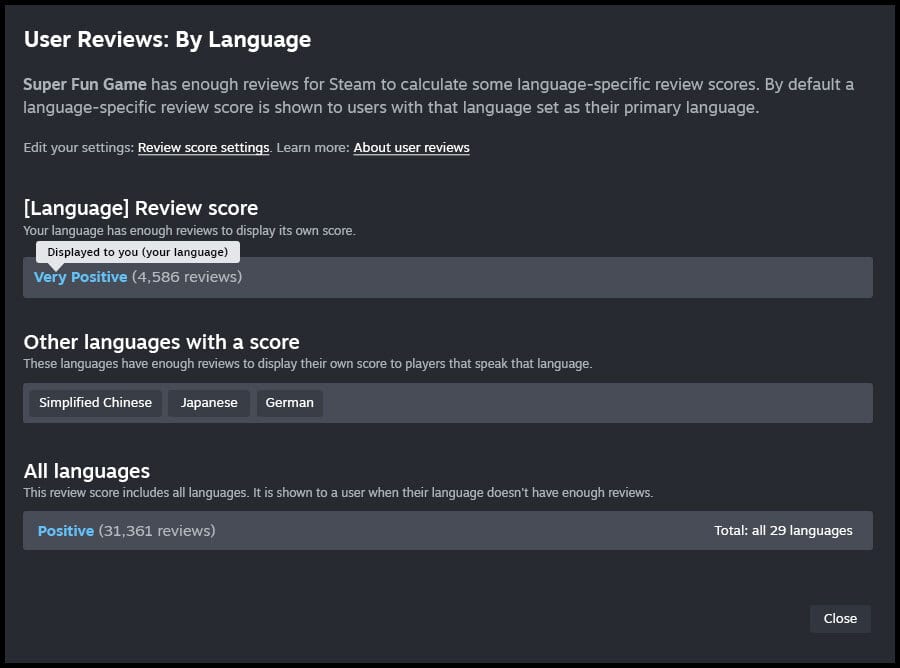
For you, this cuts both ways. A bad Chinese translation now drags down only the score Chinese players see, which is exactly the audience it hurts most. Our Steam review score guide covers the thresholds in more detail.
Example: Hollow Knight: Silksong. Team Cherry's sequel launched in September 2025 with a Simplified Chinese translation players called poor. By late September, TheGamer reported via OpenCritic that the "vast majority" of negative Steam reviews came from China, while English-only reviews sat at 91% positive. Team Cherry said its "first priority" was fixing the translation, and in patch 4 in October it made a fan translation by Team Cart Fix the official Simplified Chinese text.
Example: WUCHANG: Fallen Feathers. Alinea Analytics reported a positive share under 20% among Chinese reviews a few hours after launch in July 2025, against 55% or more in English, Russian and Brazilian reviews, mainly over PC performance. Alinea also noted Wo Long: Fallen Dynasty at 42% positive in Simplified Chinese against 70% or more in English.
Practical takeaways:
- Test performance on mid-range hardware and Chinese network conditions before launch, especially for multiplayer.
- Reply to Chinese reviews in Chinese, even briefly. Use a native speaker, not a translation tool.
- Ship a translation fix fast if players flag terms. Silksong shows players will accept a fix, including a community one.
- Check the "See language breakdown" link on your store page, so a problem in one language does not hide inside a good overall score.
A simple plan for selling your game to Chinese players
- Check fit. Look at games like yours on Steam and see how many Chinese reviews they have. If a large share of their reviews are in Chinese, China is likely a real market for you.
- Translate the store page and capsule text, then the game, with a native reviewer. Do it before your demo or Next Fest, because that is where Chinese creators will first meet the game.
- Set a yuan price by hand before launch, on local-looking price points.
- Get on Chinese video platforms. Send keys to Bilibili and Douyin creators who cover your genre, or work with a Chinese publisher or agency that already has those relationships. If you are already working with short-form creators in the West, the views to wishlists math is similar; only the platforms change.
- Open a QQ group or Heybox page so Chinese players have somewhere to talk to you.
- Watch reviews by language at launch, and fix translation or performance issues within days, not weeks.
FAQ
Can I sell my game in China on Steam without a license?
Yes. Global Steam is available to Chinese players and most of them buy premium PC games there. A license (ISBN) is only needed for the separate Steam China storefront.
What percentage of Steam users are Chinese?
Valve's data for 2024 showed Simplified Chinese as the primary language of 33.7% of Steam users. The monthly hardware survey varies a lot; in October 2026 it showed 21.98%.
Is Simplified Chinese localization worth it for an indie game?
For most games, yes. In a 2020 sample, GameDiscoverCo saw games with Chinese translations get 10% to 22% of unit sales from China, against 1% to 2% for text-heavy games without it.
How should I price my game in China on Steam?
Set the yuan price yourself. Comparable indies charge ¥68 to ¥99 for games that cost $19.99 to $29.99 in the US.
Do Chinese players refund more on Steam?
Developers report higher refund rates in China. One developer in GameDiscoverCo's 2025 survey reported 28%.
What is Steam China?
An onshore version of Steam run by Perfect World with Valve. It only sells government-approved games with an ISBN, and launched in 2021 with 41 titles.
Which Chinese platforms should I use to market a game?
Bilibili for longer creator videos, Douyin for short clips, Heybox for wishlists and PC players, and Xiaohongshu for cozy or visual games.
Sources: Valve: Updates to User Review Scores Based on Language; Steamworks: Steam China; Steamworks: Pricing; Steam Hardware and Software Survey; GameDiscoverCo: Steam's GDC graphs; GameDiscoverCo: localization data; GameDiscoverCo: PC game discovery in China; GameDiscoverCo: Steam refunds; Game World Observer on Niko Partners; Alinea Analytics; Notebookcheck on One Last Hand; checked November 2026.
Get a wishlist forecast for your game
Send us your Steam page. We estimate views, creators and cost per wishlist before you spend anything.
Keep reading
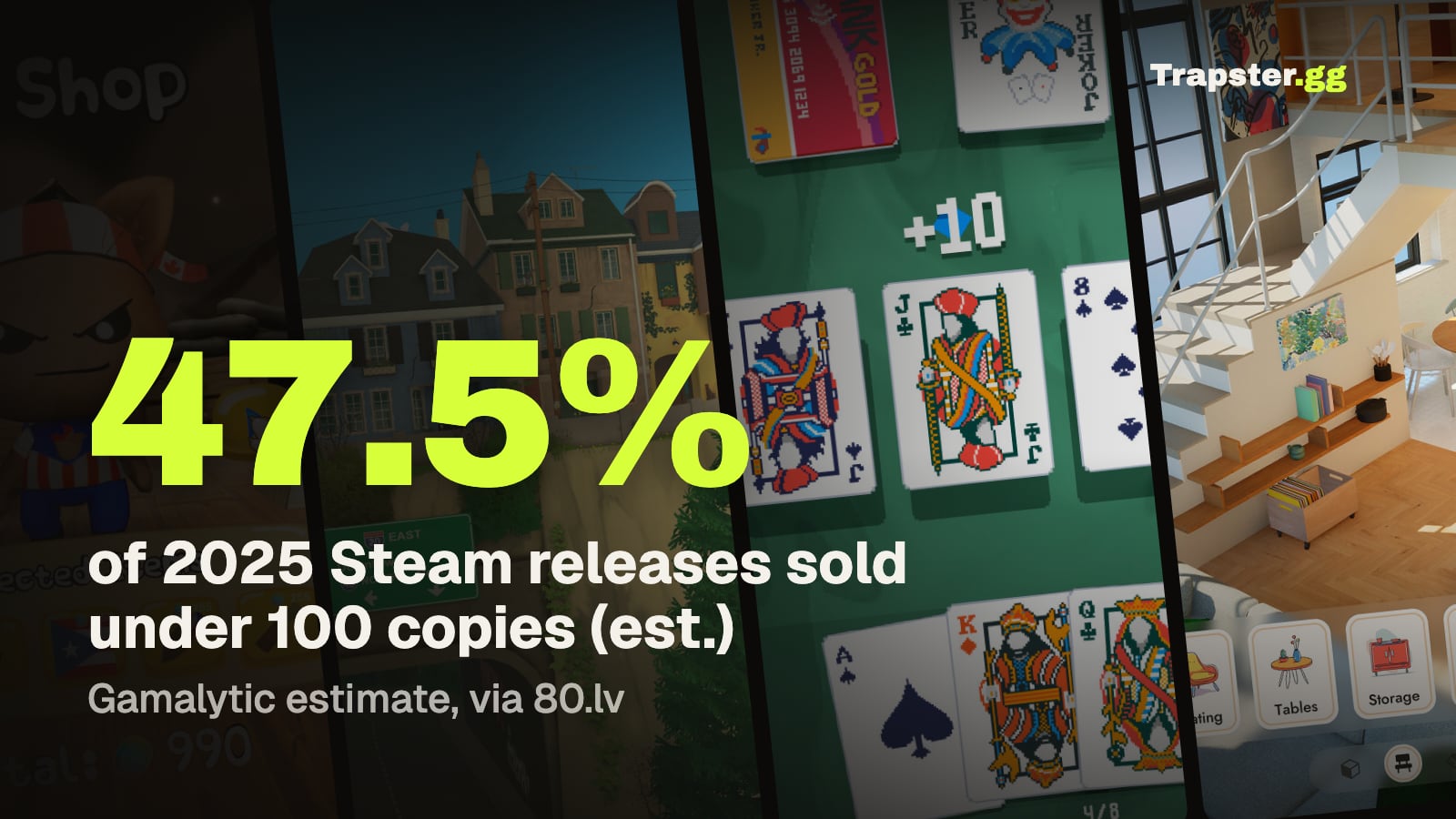
How Many Copies Do Indie Games Sell? Real Steam Numbers by Tier
Most Steam indie games sell under 1,000 copies. Real numbers by tier…
Game Marketing Hook: How to Find, Test and Show Yours
What a game marketing hook is, how to test one cheaply with…
How to Name Your Game: Searchable, Memorable and Legally Safe
How to name your game: pass the Steam, Google and trademark checks…