Steam Trading Cards for Developers: Eligibility, Assets and Revenue
How a game becomes eligible for Steam Trading Cards, every asset size you need, what card sales earn you, and when hit indies added their sets.
Short answer: You cannot apply for Steam Trading Cards. Steam turns on Profile Features (cards, badges, emoticons, backgrounds) automatically once your game passes a "confidence metric" that, per Valve's Profile Features docs, is "based on sales and player engagement figures" and ignores reviews, wishlists and total playtime. Steam checks this several times a day. Once you qualify, you upload a set of 5 to 15 cards, 5 badge levels plus a foil badge, 5 emoticons and 3 profile backgrounds through the Steam Community Items tool, Valve reviews them in about 2 to 3 days, and you release them. Your income comes from a small fee on every Community Market sale of your cards, which for most indie games works out to pennies per card.
How eligibility works in 2026
Before May 2017, every game could ship cards on day one. Valve changed that in its Changes to Trading Cards post (May 16, 2017) because "fake developers" were generating thousands of keys, handing them to bot accounts, and selling the cards those bots farmed. Valve's fix: cards don't drop "until the game has reached a confidence metric that makes it clear it's actually being bought and played by genuine users."
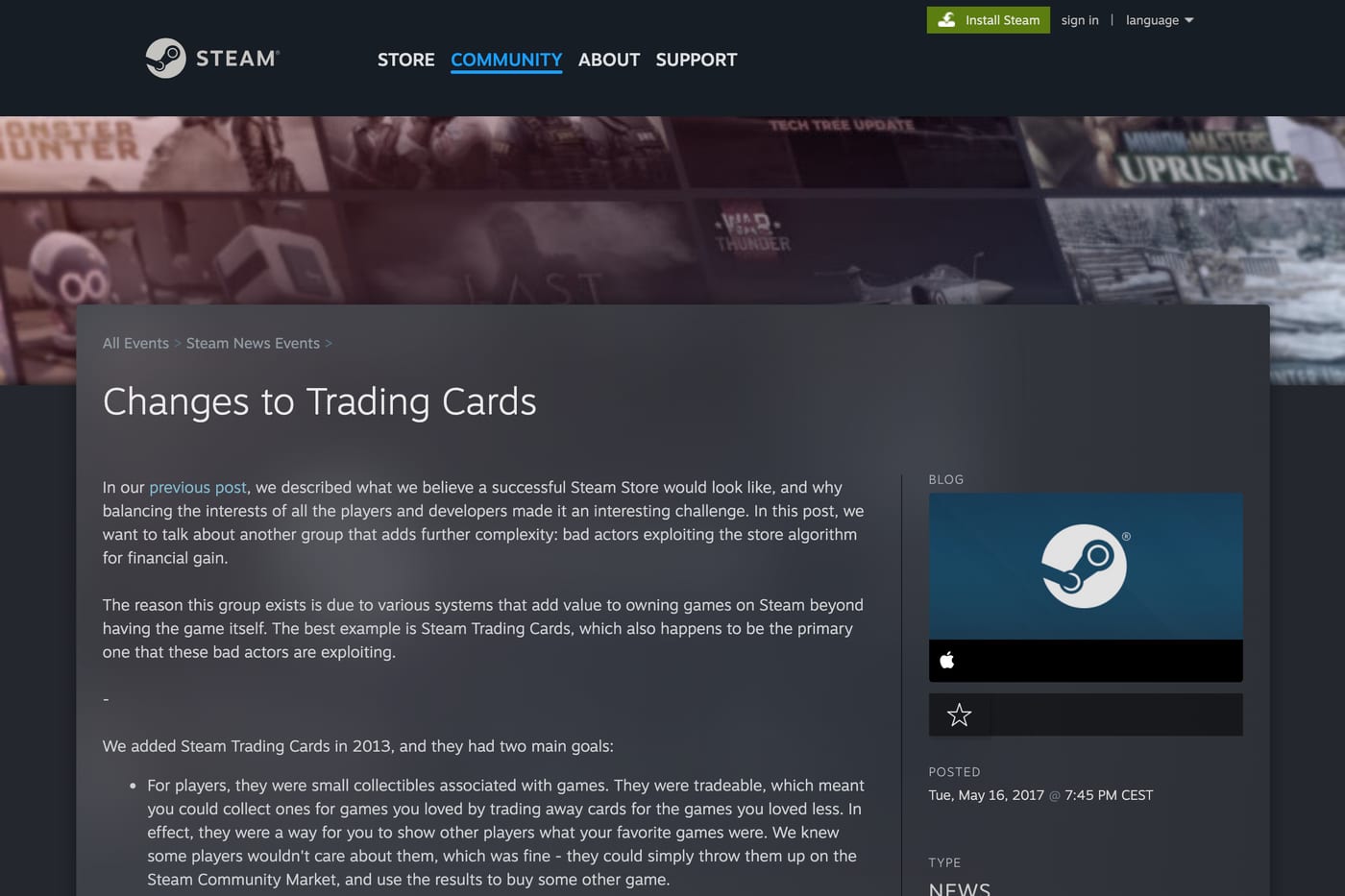
What the current Steamworks docs say about that metric:
- It is "based on sales and player engagement figures." It does not use user reviews, wishlists, total playtime or any judgment of quality (Profile Features).
- Steam checks automatically "several times per day." There is no form to fill in and no one to email.
- Not qualifying "does not impact how we promote your game on the store," and it does not mean Valve thinks your game is fake.
- When you do qualify, cards drop retroactively. Everyone who played before the switch gets drops for the playtime they already logged (Valve, 2017).
Valve has never published the threshold. One developer who went through it, Richard East, guessed it at "about 5,000 x $10 units sold" in a 2020 guide on Game Developer and estimated that roughly the top 10 to 20% of new titles reach it. Treat both as one developer's estimate, not a rule.
Two things that do not help you get there:
- Free to Keep giveaways. The Free to Keep docs say plainly: "Trading cards will not drop for customers who own the game through a Free to Keep package."
- Free-to-play without purchases. Free apps "may only have trading cards if the app has in-app purchases," and players get one drop per roughly $9 spent (Steam Community Items).
If you give away a lot of keys through bundles or key giveaways, remember the metric leans on sales. A game that moved many cheap keys may reach the bar later than a game that sold fewer copies at full price.
What else changes when you are "vetted"
The confidence metric gates more than cards. In June 2018 Valve posted More Changes Addressing Fake Games and tied extra limits to the same metric. Until your game qualifies:
- It is capped at 100 achievements.
- Its achievements don't count toward a player's global achievement count or the Achievement Showcase.
- It doesn't count toward a player's game library count or Game Collector showcase.
- It can't be used for Coupons.
The current achievements guide lists the limit as 5,000 achievements per app, or 100 "for apps that have not yet been vetted," and up to 40 achievement sets per app. Archived achievements count toward the limit. Since 2018 Steam also shows on your store page whether these limits apply, so completionist players can see it (Valve, 2018).
For most games this does not matter. If you planned 300 achievements for a big RPG, ship the first 100 and add the rest after you qualify.
Achievements basics alongside cards
Cards and achievements are separate systems. Card drops are tied only to playtime, not to achievements. Valve's Trading Cards FAQ explains it didn't want people to "use achievement-unlockers in games in order to get cards."
What you need for achievements, per the Steamworks achievements docs:
- Define them on the App Admin page of the partner site. Call
SetAchievementthenStoreStatsright away when one unlocks. - Icons: Valve recommends 256x256 PNG (64x64 minimum, square, JPG accepted). The editor can generate the grey "unachieved" version from your colour icon (guide).
- Names and icons must be all-ages appropriate.
- Before release you can't see unlocks in the Steam Community, so build a debug readout into the game. Clear test unlocks with
achievement_clear <appid> <name>in the Steam console. - Achievements "will not be shown until your app is somewhat visible to the community."
Ship achievements at launch. They work from day one, and the global unlock percentages tell you whether your hard challenges are too hard.
The full asset list and sizes
Everything goes through Edit Steamworks Settings, then Community, then Community Items. Specs from Valve's Steam Community Items page:
| Asset | How many | Size and format | Notes |
|---|---|---|---|
| Trading card, small | 5 to 15 | 206x184 PNG | Shown in inventory and Market. Steam adds the frame. |
| Trading card, large | Same as above | 1920x1080 JPG, under 350KB | The "zoomed in" art behind the small card |
| Game logo for cards | 1 | 206x44 transparent PNG | Must read on dark and light backgrounds |
| Card border colour | 1 | Hex code | Plus a title and short description per card |
| Badges | 5 levels + 1 foil | 80x80 transparent PNG | Shown on #1B1B1B backgrounds. Each needs a unique title. |
| Emoticons | 5 | 18x18 and 54x54 transparent PNG | The 18x18 version is what people see most |
| Profile backgrounds | 3 | 1920x1080 JPG, under 350KB | Fade sides and bottom to black |
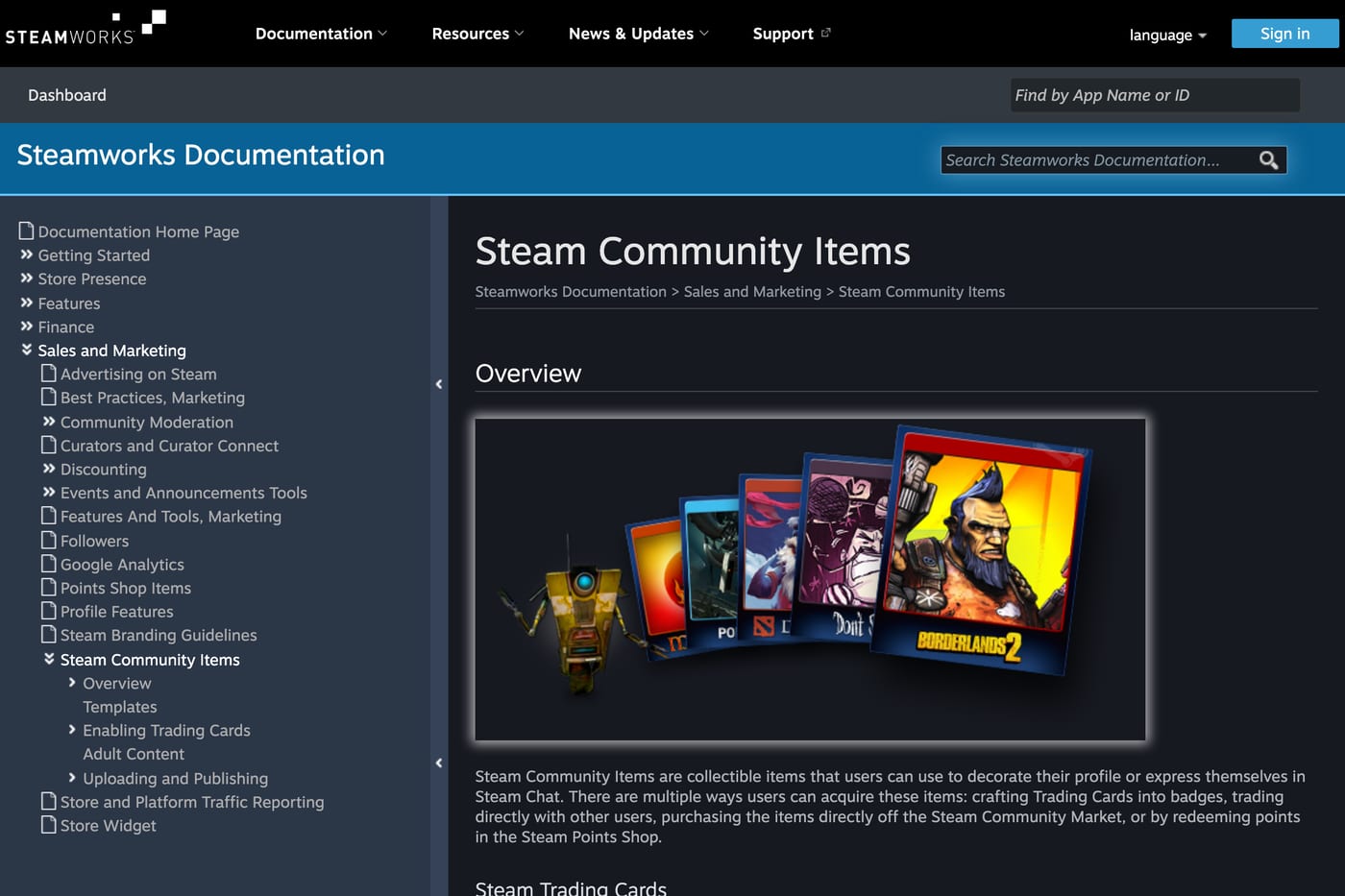
Rules that catch people out:
- Set size. Valve says sets are "usually 6-10 cards, less for shorter games." Players get drops for half the set from playtime and have to trade or buy the other half.
- Keep text out of the art. East reports that badges containing his game's title were rejected. Vampire Survivors' team wrote that "due to some rules we had to remove the text from the official cards" (announcement).
- Backgrounds. No screenshots, no logos, no bright imagery. They sit behind a player's profile, so they have to stay out of the way.
- All ages. Assets aren't age gated. No nudity, sexual content or realistic gore, whatever your game's rating.
- No edits after release. Once published, changes are "only permitted for errors."
- Foil cards and booster packs are automatic. Steam generates foils from your art and builds booster pack images from your store capsules, so make sure your capsule art is in good shape.
Valve provides PSD templates on the same page. Use them. They show exactly where Steam crops.
Points Shop items are a separate track
The basic emoticons and static backgrounds above can also be redeemed with Steam Points by owners with at least two hours of playtime. Animated items (avatar frames, animated avatars, animated backgrounds, mini-profile backgrounds, stickers and full Game Profiles) are a separate set with their own specs on the Points Shop Items page. Animated profile backgrounds, for example, are 1920x1080 MP4 and WebM files under 4MB with a baked-in fade to black.
How to ship your set, step by step
- Check eligibility. When you qualify, the Community Items section opens for your app. Nothing to request.
- Pick your card count. East recommends 5 or 6 because "the market value is split across them" and smaller sets are easier to complete. Bigger sets suit games with a large cast and a large audience. More on that below.
- Make the art. Reuse character art, key art and promo illustrations. Players recognise it, and every Market listing shows it to people browsing.
- Upload and set card drop settings. You set the minimum playtime before each drop in the badge's card drop settings.
- Submit for review. Mark the assets ready. Valve's estimate is 2 to 3 days. Feedback comes back through the same tool.
- Release. After approval, set the release state to "Released." There's no extra waiting period.
- Tell players. East notes he had to add "Steam Trading Cards" to his store page feature list by hand, so check yours. Then post an announcement. Bundling the news into a bigger update gives you a stronger post, see Steam events and announcements.
Real examples: when hit indies added cards
Being eligible early doesn't mean shipping cards early. Many successful indies added cards months after launch, usually alongside a major update. Release dates come from the Steam store, card dates from each game's own announcement. Card counts and prices are from the Community Market on November 17, 2026 (lowest listed price for a regular card).
| Game | Steam release | Cards added | Cards in set | Typical card price |
|---|---|---|---|---|
| Balatro | Feb 20, 2024 | Mar 1, 2024, with the Mac version | 15 | $0.04 to $0.05 |
| Vampire Survivors | Oct 20, 2022 (1.0) | Jul 11, 2023, with a co-op preview | 5 | $0.06 to $0.08 |
| Dave the Diver | Jun 28, 2023 | Oct 2023, in a content update | 10 | $0.05 to $0.06 |
| Brotato | Jun 23, 2023 | Oct 25, 2024, with co-op and its first DLC | 6 | $0.07 to $0.08 |
| PEAK | Jun 16, 2025 | Aug 28, 2025 | 15 | $0.03 to $0.05 |
| DREDGE | Mar 30, 2023 | Live | 5 | $0.10 to $0.12 |
| Cult of the Lamb | Aug 11, 2022 | Live | 14 | $0.05 to $0.08 |
| Hollow Knight: Silksong | Sep 4, 2025 | Live | 9 | $0.09 to $0.12 |
| Hades II | Sep 25, 2025 (1.0) | Live | 10 | $0.07 to $0.09 |
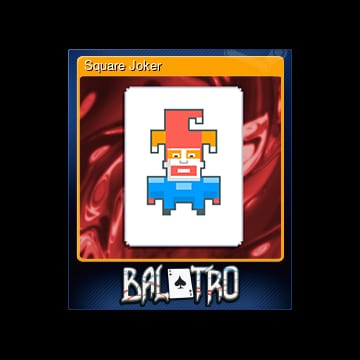
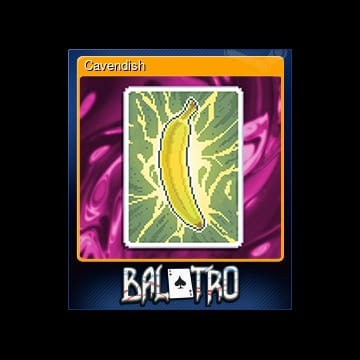
What these show:
- Balatro shipped cards ten days after launch, which tells you a strong launch can clear the metric very quickly. The team paired the news with the Mac port so it was one bigger announcement.
- Vampire Survivors shipped 5 cards, 6 badges (5 plus foil), 5 emoticons and 3 backgrounds, the exact minimum, with poncle joking that they hit the "generate Steam Trading card and other Steam things" button. The minimum is fine.
- Brotato waited 16 months and launched cards as one line in its co-op and Abyssal Terrors DLC post. Cards were a bonus, not the news.
- PEAK credited the freelance artist by name in its announcement. If you outsource the set, that's a nice touch and costs nothing.
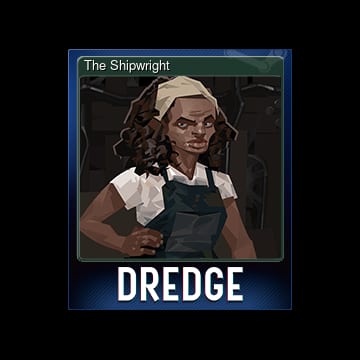
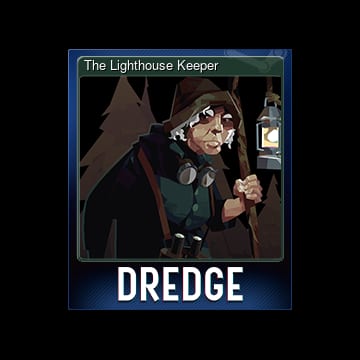
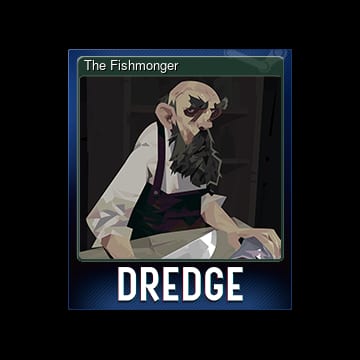
- DREDGE shares the smallest set on this list (5 cards, like Vampire Survivors) and has some of the highest card prices. Fewer cards means each one is scarcer, which fits East's advice.
And three big hits never added them. As of November 2026 the Steam store lists no Trading Cards for Lethal Company, Schedule I or Blue Prince. Cards are optional. A game that sells well without them gives up some profile presence and a bit of Market income, nothing more.

How the money works
Valve does not pay you per card drop. Your income is a fee on Community Market sales.
From Valve's Community Market FAQ:
- The Steam Transaction Fee "is currently 5% (with a minimum fee of $0.01)," paid by the buyer.
- Game-specific fees are "determined and collected by the game publisher." Valve lists its own games (Dota 2, Counter-Strike 2) at 10%.
For trading cards on non-Valve games, the commonly cited split comes from developers, not a Valve page. East's 2020 guide puts it at 10% to the developer, 5% to Steam and 85% to the seller, with a $0.01 minimum per party, so the cheapest possible card sells for $0.03.
Do the maths with the prices in the table. A card selling for $0.05 earns you the $0.01 minimum. You need tens of thousands of card sales to make a few hundred dollars. The only public breakdown we found is old but matches: Seaven Studio reported in 2014 that Steam Cards were 1.2% of total Steam revenue for Ethan: Meteor Hunter (one developer's figure).
So budget cards as a fan and profile feature, not income. Valve itself framed them in 2017 as "an easy way to add extra value to their game, and provide rewards to their biggest fans." For the bigger picture on what Steam takes, see Steam fees for developers.
Card farming, bots and Valve's anti-abuse changes
Card farming means idling games just to collect drops and sell them. Players do it with open-source tools such as ArchiSteamFarm, which describes itself as an application for "farming Steam cards from multiple accounts simultaneously." Idling by real owners is mostly harmless to you: they bought the game, and each account only gets half a set from drops.
The real abuse was on the developer side, and Valve's responses shaped today's rules:
- May 2017: the confidence metric. Valve's reasoning was partly about the algorithm. Card farming games produced "faux data," and "the algorithm runs the risk of thinking that one of these games is actually a popular game" (Valve). If you want to understand that side, read how the Steam algorithm works.
- September 2017: mass removals. Valve pulled nearly 200 games from Silicon Echo Studios, saying the developer "was mass-shipping nearly-identical products on Steam that were impacting the store's functionality" (PCGamesN).
- June 2018: more limits. The achievement cap, the Game Collector exclusion and the coupon ban described above (Steamworks).
- Ongoing: Market access rules. To use the Market, an account needs a purchase older than 7 days but less than a year old, plus Steam Guard enabled for 15 days (Market FAQ). Free to Keep licences get no drops.
For a legitimate developer the takeaway is simple. Don't design your key strategy around cards, don't expect cards on day one if your launch is small, and don't promise them to players before you qualify.
Should you bother?
Yes, if you qualify and have the art. It's a few days of work, mostly reusing assets you already have, and some of your most engaged players care about badges and Steam levels. Valve's own docs say missing profile features "mainly affects games whose only value is in profile features," so don't expect cards to sell copies.
The best way to use them is the way Balatro, Brotato and Dave the Diver did: hold the set for a major update or DLC and mention it in that announcement. If you're still pre-launch, put the energy into the things that decide whether you qualify at all, starting with a solid launch and more reviews.
FAQ
How do I get Steam Trading Cards for my game?
You can't request them. Steam enables Profile Features automatically when your game passes a confidence metric based on sales and player engagement, and checks several times a day. After that you upload the assets in Steamworks under Community Items.
How many sales do you need for Steam Trading Cards?
Valve doesn't publish a number. One developer estimated around 5,000 copies at $10 in 2020, but treat that as a guess. Reviews, wishlists and playtime are not part of the metric, according to Valve.
How much money do developers make from trading cards?
Usually very little. A developer gets a game-specific fee on each Market sale, commonly cited as 10% with a $0.01 minimum, and most indie cards sell for a few cents. Seaven Studio reported cards at 1.2% of its Steam revenue.
How many trading cards does a set need?
Between 5 and 15. Valve says sets are usually 6 to 10, and players get drops for half the set from playtime.
Do players who played before cards were added get drops?
Yes. Valve confirmed that once a game qualifies, cards drop for everyone, including players who logged playtime before cards existed.
Do free keys or Free to Keep promotions drop cards?
Free to Keep licences never drop cards, per Valve's docs. Free-to-play games only drop cards based on in-app spending, roughly one per $9.
Can I change my trading cards after release?
Only to fix errors. Check every asset for text, compression artifacts and cropping before you set the release state to Released.
Sources: Steamworks: Steam Community Items; Steamworks: Profile Features; Steamworks: Achievements and achievements guide; Steamworks: Points Shop Items; Steamworks: Free to Keep; Valve: Changes to Trading Cards; Valve: More Changes Addressing Fake Games; Steam Community Market FAQ; Steam Trading Cards FAQ; Game Developer: Steam Trading Cards guide (2020); checked November 2026.
Get a wishlist forecast for your game
Send us your Steam page. We estimate views, creators and cost per wishlist before you spend anything.
Keep reading
How Many Copies Do Indie Games Sell? Real Steam Numbers by Tier
Most Steam indie games sell under 1,000 copies. Real numbers by tier…
Game Marketing Hook: How to Find, Test and Show Yours
What a game marketing hook is, how to test one cheaply with…
How to Name Your Game: Searchable, Memorable and Legally Safe
How to name your game: pass the Steam, Google and trademark checks…